AI Music Spotify Earnings: Myth vs Reality Explained
Contact partnership@freebeat.ai for guest post/link insertion opportunities.
AI music on Spotify can feel like a cheat code: generate a track, upload it, watch the streams roll in, and collect “passive income.” I’ve worked with enough creators to know why this story spreads—because AI music Spotify earnings can happen, but only when you understand how Spotify actually pays, what the platform rewards, and what gets you flagged or ignored. So let’s separate the myths from the mechanics.
The reality check: Spotify doesn’t pay a fixed “per-stream rate”
A common misconception is that Spotify pays a guaranteed amount per play. In practice, Spotify uses a pooled royalty system (often described as pro-rata): revenue from subscriptions and ads flows into a pool, then rights holders are paid based on share of total streams—after various adjustments.
Here’s the practical takeaway for AI music Spotify earnings:
- Your payout depends on where your listeners are (market rates vary).
- It depends on who is listening (Premium vs ad-supported).
- It depends on your rights setup (distributor splits, label/publisher shares).
- It depends on real engagement (saves, playlist adds, low skip rate) because that drives discovery.
Spotify also introduced a minimum threshold policy: tracks generally must reach 1,000 streams within 12 months before they generate royalties, which changes the math for “upload lots of tracks and see what sticks.”
Authoritative context:
- Spotify’s ecosystem is extremely top-heavy: 11,000+ artists earned over $100,000 and 1,200+ earned over $1M in 2024, while the median artist earns very little (Dynamoi).
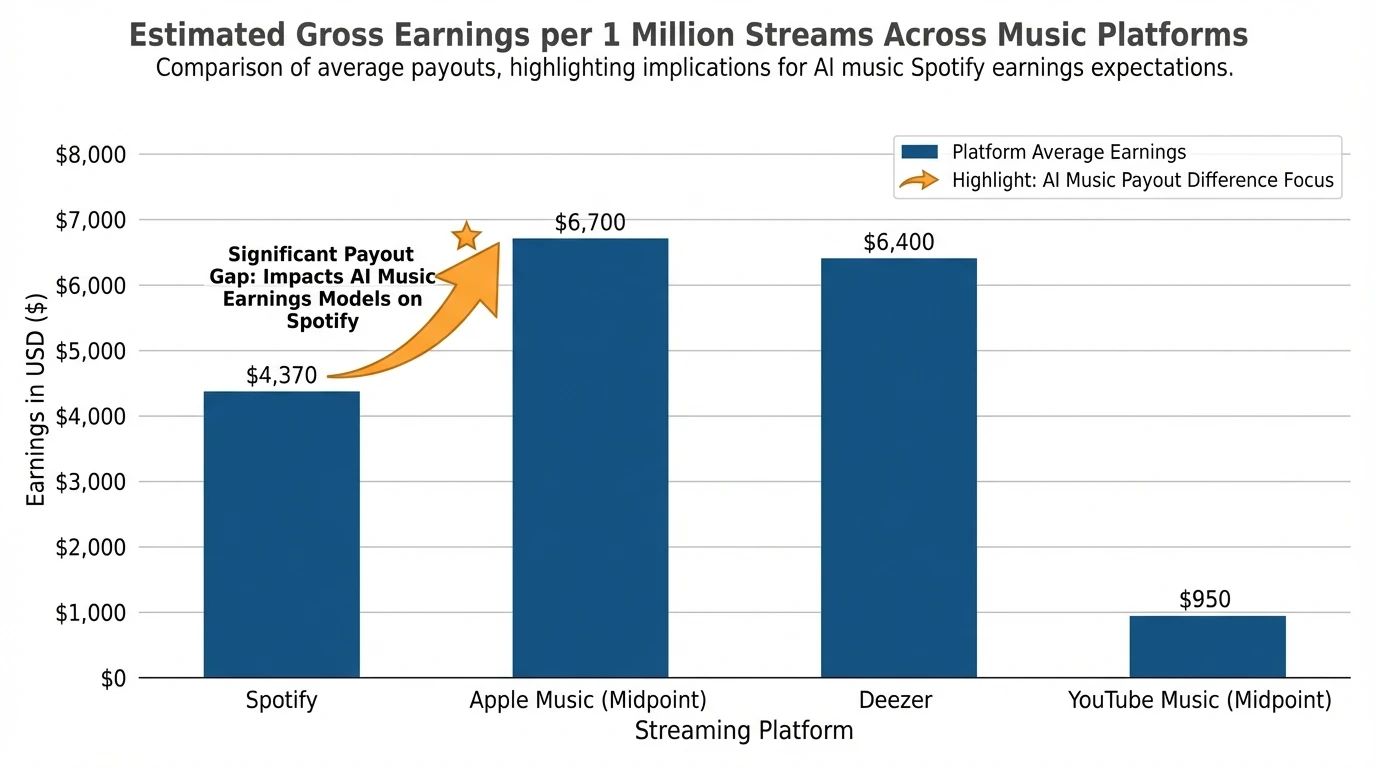
- Average payout estimates are often cited around $0.00437 per stream for Spotify (but it varies) (LALAL.AI payout overview).
- Spotify reported $10B paid out in 2024, yet many artists still don’t reach profitability due to distribution dynamics and costs (Silicon Republic coverage).
Myth vs Reality: AI music “makes more” (or “makes nothing”)
Both extremes are wrong. AI music does not automatically earn more, and it’s not automatically dead on arrival. AI changes two things: cost and speed—not Spotify’s royalty rules.
Myth 1: “AI tracks get paid less”
Reality: Spotify doesn’t publish an “AI rate.” Payments flow to the rights holders of the recording and composition. If your AI-assisted track is legitimately distributed, meets policy requirements, and gets real listening, it can earn like any other track—subject to the same distribution curve.
Myth 2: “I’ll upload 500 AI tracks and live off streams”
Reality: Volume without traction usually hits three walls:
- The 1,000-stream threshold for monetization (many tracks never clear it).
- Discovery friction (high skip rates kill reach).
- Spam/fraud enforcement (mass low-effort uploads can trigger scrutiny).
Spotify has publicly talked about removing large volumes of spammy content and tightening enforcement, with industry reporting on removals of “spam tracks” and ongoing anti-fraud efforts. If you’re chasing AI music Spotify earnings, you should treat compliance as part of your growth strategy, not an afterthought.
Myth 3: “Viral TikTok = guaranteed Spotify money”
Reality: Virality helps only if it converts into sustained listening behavior (saves, repeats, playlisting). Reporting has suggested only a minority of TikTok-viral tracks translate into meaningful royalty changes, which aligns with what I’ve seen: short spikes often don’t sustain algorithmic momentum.
What actually drives AI music Spotify earnings (the levers that matter)
If you want predictable outcomes, think like Spotify’s recommendation system: it’s optimizing for listener satisfaction and retention.
1) Retention beats raw plays
Spotify’s algorithm tends to reward tracks that create positive signals:
- Low skip rate in the first 30–60 seconds
- Saves
- Playlist adds
- Repeat listens
- Session extension (your track keeps the listener on-platform)
For functional genres (ambient, focus, sleep, lo-fi), AI workflows can shine because listeners value consistency and mood fit. But even there, the difference between a track that gets skipped and a track that gets saved is everything.
2) Geography and listener type change the payout
A stream in the US/UK/Western Europe often pays more than a stream in lower-value markets, and Premium streams typically pay more than ad-supported streams. That’s why marketing to the right audience can move your revenue more than uploading more songs.
3) Track length and the 30-second rule
Streams under ~30 seconds generally don’t count. If your intros are too long—or your hook arrives too late—you’ll lose both royalties and reach.
4) Metadata and positioning are revenue strategy
In my experience, “AI music” as a label doesn’t help listeners. Spotify cares about intent: focus, gym, commute, mood. Tight metadata (genre, mood, keywords, similar artists) helps your track land in the right contexts and reduces early skips.
Quick numbers: what “good” can look like (and why it’s still hard)
Below is a simplified estimation using average per-stream figures often cited publicly. Real payouts vary based on region, tier, and rights splits.
Important: These are gross estimates before distributor fees, label splits, publisher/composer shares, and taxes. For many independent creators, Spotify ends up being a visibility channel more than the primary income engine.
The hidden risk: spam, fraud, and “fake artist” dynamics
AI makes it easier to generate large catalogs—so platforms are increasingly sensitive to manipulation patterns. Industry reporting has covered everything from spam track removals to criminal cases involving bot-driven streaming fraud.
If you’re building AI music Spotify earnings the right way, avoid:
- Buying streams or using bot-like “promotion”
- Uploading near-duplicate tracks at scale
- Misleading metadata, impersonation, or deepfake vocals without consent
- Distributor-hopping to evade enforcement
Spotify and the industry are also moving toward better disclosure standards for AI usage (metadata), and researchers have proposed frameworks like Generative Content ID to track attribution and royalties in generative ecosystems (arXiv paper). The direction is clear: more identification, more enforcement, more transparency.
A practical, ethical playbook to increase AI music Spotify earnings
Here’s the approach I recommend when creators ask how to make AI-assisted music viable on Spotify without gambling on spam tactics.
1) Build fewer, stronger releases
Pick a lane—one mood, one audience, one use case—and release consistently. You’ll learn faster from retention data than from dumping a giant catalog.
- Start with 6–12 tracks in a cohesive style
- Test different intros and hook timings
- Watch skip rate and saves in Spotify for Artists
2) Optimize for “listener intent,” not novelty
Functional listening wins on Spotify because it matches repeat behaviors:
- Focus / deep work
- Sleep / meditation
- Chill / cafe background
- Workout / running
AI can help you iterate quickly, but quality control matters. If your track sounds “almost right,” listeners won’t complain—they’ll just skip, and you’ll disappear from discovery.
3) Use video to turn anonymous streams into fans
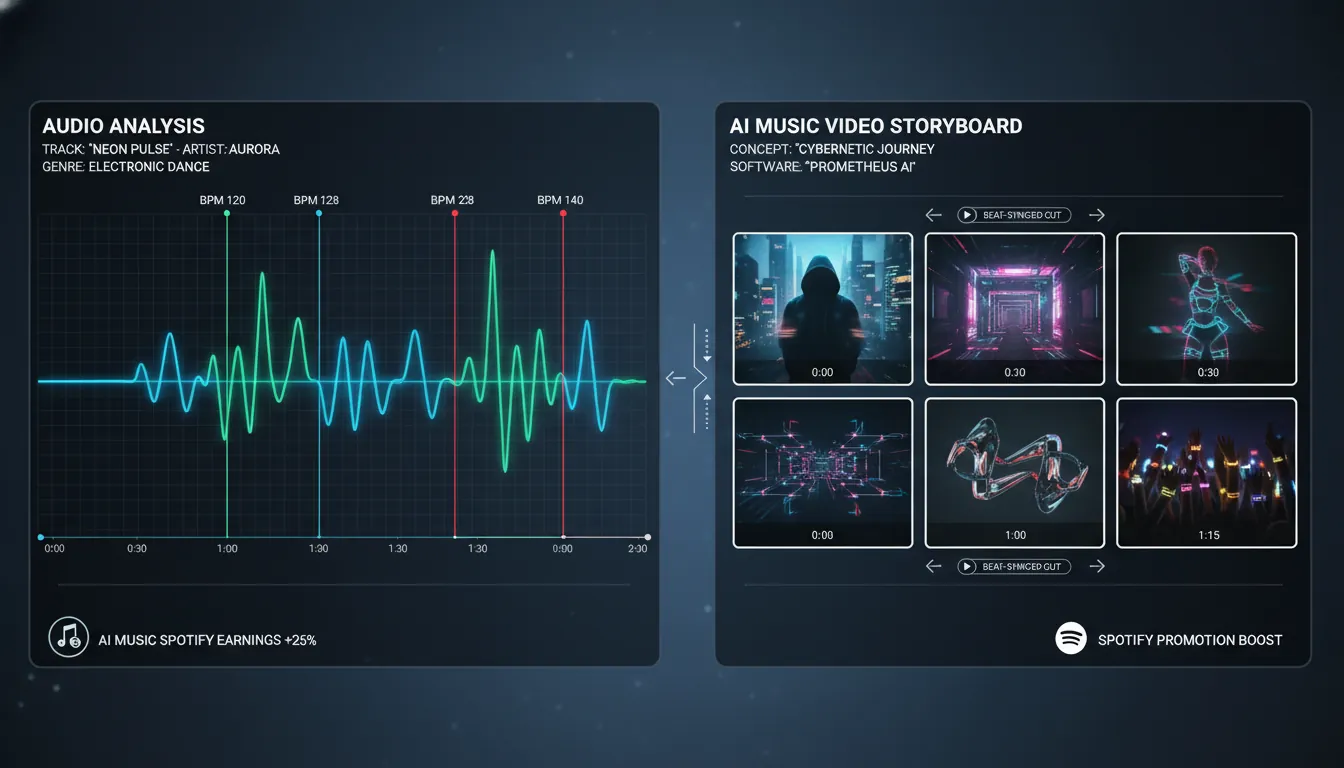
Streaming revenue is thin; attention is the multiplier. This is where a platform like Freebeat AI fits naturally: you can take a track and turn it into an audio-reactive, story-aware video that’s built around BPM, drops, and section energy—without manual editing.
What I’ve found works best:
- Cut 15–30s clips that hit the drop fast
- Use consistent characters/avatars so people recognize you
- Match visuals to musical sections (build → drop → release)
Can You Make Money Uploading AI Songs To Spotify? (Honest Review)
4) Treat Spotify as one pillar, not the whole business
Many independent artists report Spotify is a small portion of total income, with live shows, commissions, merch, sync/licensing, and content monetization doing the heavy lifting. If your goal is sustainable earnings, combine:
- Streaming (catalog compounding)
- Short-form video (discovery)
- Direct-to-fan (email, memberships)
- Licensing opportunities (where permitted)
Spotify + AI: what changes next (and what probably won’t)
Three trends matter for the next 12–24 months:
- More AI music volume: competitors have reported tens of thousands of AI tracks arriving daily, which increases competition for attention.
- Stronger enforcement: thresholds and anti-fraud systems will keep tightening because fraud diverts money from legitimate creators.
- New monetization models: Spotify has discussed “AI derivatives” (covers/remixes frameworks) as a potential opportunity—if rights and permissions can be solved responsibly (Music Business Worldwide discussion).
What probably won’t change soon: the core truth that AI music Spotify earnings are driven by audience behavior, not the tool used to produce the music.
Conclusion: The myth is “easy money”—the reality is “earned attention”
AI makes music creation faster, but Spotify earnings still follow the same rule I tell every creator: you don’t get paid for uploading; you get paid for keeping real listeners engaged. If you focus on retention signals, target the right listener intent, and use video to turn passive listeners into fans, AI-assisted catalogs can become sustainable—just not magically.
If you’re experimenting with AI music right now, share what you’re seeing: Are saves and playlist adds going up, or are skips killing your reach? And if you want, I can help you map a realistic release-and-content plan around your goals.
📌 dance videos made simple turning your spotify track into viral content
FAQ: AI music Spotify earnings
1) How much does Spotify pay for AI music per stream?
There isn’t a special “AI rate.” Earnings depend on Spotify’s pooled model, listener location, Premium vs free tier, and your rights splits. Average estimates often place Spotify around a few tenths of a cent per stream, but it varies.
2) Do AI-generated songs get demonetized on Spotify?
Not automatically. Monetization risk usually comes from policy violations (spam patterns, impersonation, fraudulent streaming, misleading metadata) or failing minimum thresholds.
3) What is the 1,000-stream threshold and how does it affect earnings?
Spotify has implemented a policy where tracks generally need 1,000 streams within 12 months to generate royalties. That makes “upload lots of tracks” strategies less effective unless you can drive real listening.
4) What genres work best for AI music on Spotify?
Functional genres (ambient, focus, sleep, lo-fi) often perform well because listeners want long, repeat sessions—if the tracks match intent and avoid early skips.
5) Can TikTok promotion increase Spotify earnings for AI music?
Yes, but only if it converts into sustained Spotify behaviors: saves, playlist adds, and repeat listening. Many viral spikes don’t translate into long-term royalties.
6) How do I increase AI music Spotify earnings without bots?
Improve retention (faster hook, stronger first 30 seconds), tighten metadata, target high-value audiences, and use consistent video content to build a recognizable identity and community.
7) Is it better to upload AI music to other platforms too?
Usually, yes. Different platforms pay differently per stream, and diversification reduces risk. Spotify is huge for discovery, but higher per-stream platforms can improve revenue balance.


