8 Ways to Monetize Beats: Pricing & Licensing Cheat Sheet
Contact partnership@freebeat.ai for guest post/link insertion opportunities.
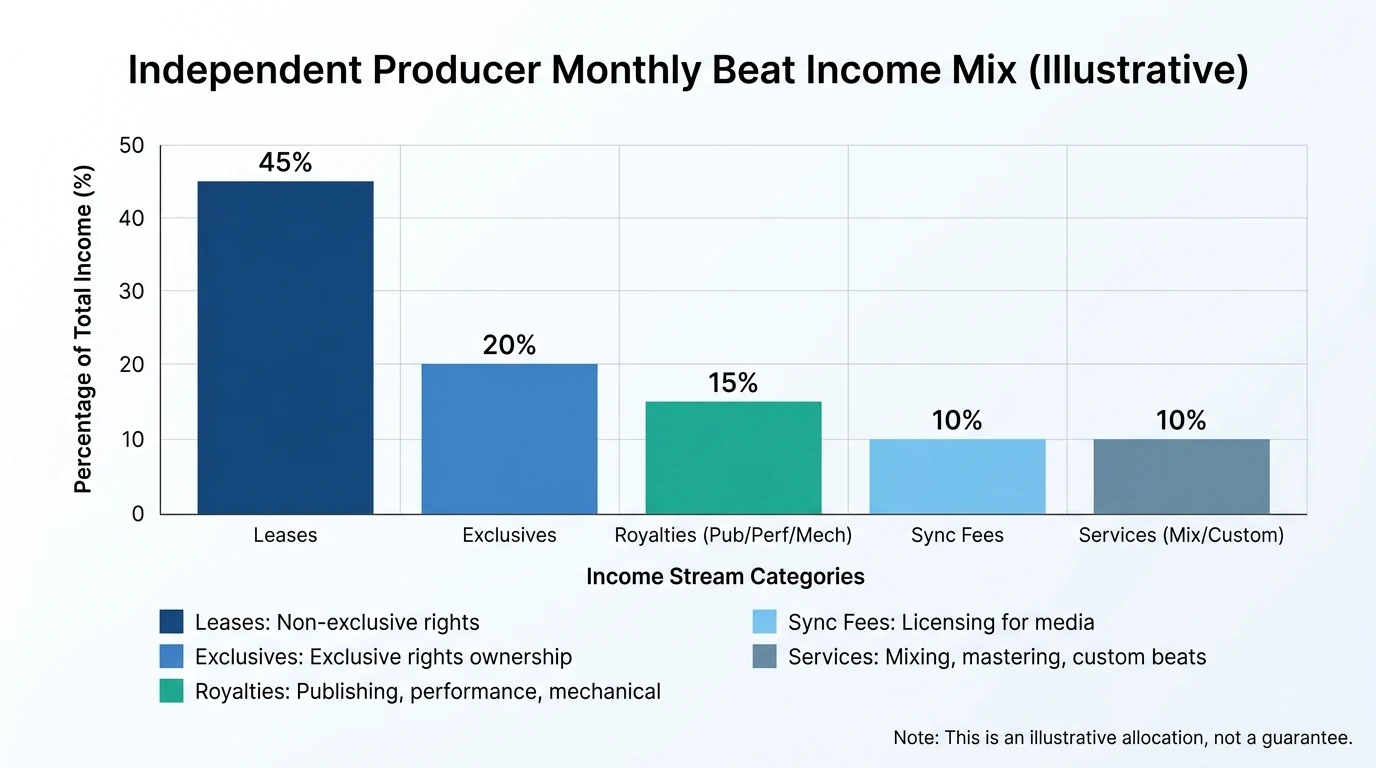
You’ve got a folder full of beats that hit hard—but your income doesn’t match the hours you put in. I’ve been there: uploading “fire” instrumentals, getting likes, and still wondering why the cash didn’t follow. The truth is, ways to monetize beats aren’t just about “selling a beat”; it’s about stacking multiple income lanes (leases, exclusives, royalties, sync, content, and services) and matching each beat to the right offer.
Below are 8 practical, producer-tested ways to monetize beats, plus a simple pricing and licensing cheat sheet you can actually use.
1) Sell non-exclusive leases (your “recurring revenue” engine)
Non-exclusive licensing (often called a lease) is the most common entry point for artists and the most scalable way to monetize beats for producers. You keep copyright ownership and can sell the same beat repeatedly, which is exactly why leases are powerful in a saturated market.
In my own catalog, leases worked best when I named tiers by use-case (Demo, Streaming, Unlimited) instead of tech specs. Artists buy confidence, not file formats.
- Typical pricing range: about $20–$500+ depending on tier and reputation (common beginner-friendly leases live in the $20–$200 band).
- Common limitations: stream caps, sales caps, term limits (e.g., 2–3 years), and sometimes “one project only.”
- Deliverables matter: MP3-only at the low end; WAV and stems/trackouts at higher tiers.
For deeper background on leasing structures and what “non-exclusive” really means, see Mayu Beatz’s licensing overview and Wisseloord’s breakdown of exclusive vs non-exclusive.
2) Offer tiered upgrades (MP3 → WAV → stems) to increase average order value
If you want better revenue without constantly making new beats, your fastest lever is an upsell ladder. A basic buyer might only need an MP3 to write; a serious release needs WAV; a label-ready release often needs stems for a proper mix.
I’ve repeatedly seen that “stems included” is the difference between a $39 cart and a $199 cart—especially for artists working with an engineer.
Smart tier design ideas:
- Basic Lease: MP3, tagged/untagged, low stream cap
- WAV Lease: untagged WAV, higher cap
- Premium/Unlimited: WAV + stems, higher or no caps, longer term
This aligns with common industry expectations around deliverables and usage tiers (and reduces refund headaches later).
3) Sell exclusive licenses (high ticket, lower volume)
Exclusive sales are still one of the best ways to monetize beats when you have a standout instrumental and a buyer who needs uniqueness. The big misconception: exclusive doesn’t automatically mean the buyer owns your copyright—many agreements grant exclusive usage while you may still retain writer share and collect performance royalties through your PRO, depending on the contract.
Market reality check: exclusives can be $2,000–$10,000+, but many independents now sell exclusives under $1,000 due to competition and marketplace saturation (pricing varies widely by brand and demand).
To avoid drama:
- Clearly state whether exclusivity includes stems, project files, and publishing splits
- Include a “notice of outstanding clients” section if the beat was previously leased (so older lease buyers don’t get takedowns later)
For more on how exclusives interact with prior leases, see Robin Wesley Instrumentals’ guide.
4) Monetize royalties: publishing + performance + mechanical (the “silent” income stream)
A lot of producers chase only upfront fees and miss the long tail. If you’re credited as a co-writer (common when you created the beat/composition), you can earn publishing royalties, including:
- Performance royalties (collected by PROs like BMI/ASCAP/PRS)
- Mechanical royalties (in the U.S., often via The MLC for eligible uses)
The key is metadata and registration. I’ve personally had royalties show up months late because a title was inconsistent across distributor/PRO registrations. Tight metadata (titles, splits, writer/publisher info) reduces “black box” unclaimed money.
A solid overview of how producers get paid across royalty types is summarized in this producer royalties breakdown and Royalty Exchange’s publishing royalties explainer.
5) Pitch beats for sync licensing (one placement can change your year)
Sync is one of the most overlooked ways to monetize beats—especially if your instrumentals are clean, emotionally clear, and easy to edit to picture. Sync income often includes:
- Sync fee (upfront license payment)
- Performance royalties (if the placement generates reportable performances, depending on the medium/territory)
I’ve found instrumentals that have obvious edit points (intro, build, drop, button ending) get more traction because editors can cut fast. Also: a simple “no uncleared samples” policy makes your catalog more sync-ready.
To understand typical sync income components, read That Pitch’s sync income breakdown and London Sound Academy’s intro to sync licensing.
6) Turn every beat into content (and monetize the attention)
Beats don’t just sell—they market themselves when packaged as content. This is where Freebeat AI fits naturally: instead of posting a static cover image, you can generate an audio-reactive video that follows BPM, bars, drops, and section energy—making your beat feel “alive” in a scroll.
I’ve tested beat posts with simple visuals vs. tightly synced transitions, and the synced versions consistently held attention longer (especially on Reels/TikTok/Shorts). Attention isn’t vanity; it’s the top of your monetization funnel.
Practical content outputs per beat:
- 15s hook loop (drop-focused)
- 30–45s “arrangement preview” (intro → build → drop)
- Lyric-video-ready version for collabs (karaoke timing helps artists write)
Freebeat ai | This AI Music Video Generator is INSANE
Internal links (Freebeat AI):
- Build scroll-stopping visuals with the AI music video generator.
- Explore automated planning via the AI Music Video Agent.
- Publish faster using lyric video tools.
7) Sell custom beats and producer services (higher trust, higher margins)
Custom work is one of the most reliable ways to monetize beats when you have consistent inbound demand. It’s less passive than leases, but margins can be strong because the buyer is paying for speed, fit, and collaboration—not just the audio file.
Services to productize:
- Custom beat (1–3 revisions, delivery in WAV + stems)
- “Beat to release” bundle (beat + mix prep + alternate versions)
- Vocal mix-ready stems (organized, labeled, gain-staged)
To keep it professional, set expectations upfront:
- Revision limits
- Delivery timeline
- What “exclusive” means in your deal (usage vs ownership)
8) Create sample packs, loops, and presets (sell to producers, not artists)
If you’re good at sound design, sample packs are a scalable way to monetize beats without relying on artists at all. You’re selling building blocks (drums, melodies, textures), and one pack can keep selling for years.
I’ve had the best results when packs are:
- Niche + specific (e.g., “Dusty Neo-Soul Guitar Loops @ 90–110 BPM”)
- Clearly licensed (royalty-free vs. attribution vs. restrictions)
- Demonstrated with short beat demos made from the pack contents
For a producer-oriented overview of selling sample packs as an income stream, see MACKIE’s producer income ideas.
Beat Pricing & Licensing Cheat Sheet (copy/paste friendly)
Use this as a baseline, then adjust to your brand and demand. The simplest way to monetize beats consistently is to standardize your tiers so buyers don’t need to DM you for every detail.
Notes that protect you (and your buyer):
- Non-exclusive licenses often include stream/sales caps and term limits; exclusives usually remove those caps.
- Many producers keep writer share/publishing even on exclusives—spell splits out clearly in writing.
Quick answers to common beat-monetization questions
- Do I need an LLC to sell beats? Usually no to start; many producers begin as sole proprietors. Consider an LLC when revenue is consistent, you need liability separation, or you’re signing larger deals. (For legal decisions, talk to a qualified professional in your region.)
- Can you actually make money selling beats? Yes, but it’s rarely one channel. Most sustainable producers stack leases + content + services + occasional exclusives/sync.
- How do producers get paid for beats? Upfront license fees (leases/exclusives) plus downstream royalties (publishing/performance/mechanical) if properly credited and registered.
- How many views do I need to make $10,000/month on YouTube? It depends heavily on RPM, niche, audience location, and content type; beat channels often rely on a mix of ad revenue + licenses + affiliate/product sales.
- How much money is 1,000,000 streams on Apple Music? Payout varies by territory and agreements; treat any exact number online as a rough estimate and focus on owning/collecting all royalty types you’re entitled to.
FAQ (People also ask)
1) How can I monetize my beats as a beginner?
Start with non-exclusive leases, clear tiered pricing, and consistent short-form content that drives traffic to your storefront.
2) Can you make money selling beats without BeatStars?
Yes—marketplaces help discovery, but your own storefront gives you more control over pricing, customer data, and branding.
3) What’s the difference between exclusive and non-exclusive beat licenses?
Non-exclusive means multiple artists can license the same beat; exclusive grants one buyer exclusive usage (often with fewer limits), but terms vary.
4) Should I include stems in my beat licenses?
If you want higher-priced tiers and more serious clients, yes. Stems reduce friction for mixing and can justify premium pricing.
5) Do producers get royalties when they sell a beat?
They can—if they’re credited as a writer/co-writer and the song is properly registered for publishing/performance/mechanical collection.
6) Is sync licensing realistic for instrumentals?
Yes. Instrumentals with clear structure and clean rights (no uncleared samples) can be strong sync candidates.
7) What’s the fastest way to sell more beat leases?
Improve packaging: stronger previews, clearer tiers, and better visuals—audio-reactive videos can increase watch time and click-through.
Conclusion: pick 2–3 lanes, then scale with systems
If your beats could talk, they’d ask for one thing: a real business wrapper. The most reliable ways to monetize beats come from stacking leases (recurring), exclusives (high ticket), royalties (long tail), and content (demand generation)—then tightening your licensing, metadata, and delivery so buyers trust you.
If you want a quick win this week, turn your top 3 beats into platform-ready, audio-synced videos and post them consistently—then link directly to your licensing tiers.
📌 master ai music creation how to generate beats and videos seamlessly


