What Does EP Stand for in Music? Myths vs Facts
Contact partnership@freebeat.ai for guest post/link insertion opportunities.
You’ve got a new release ready, your cover art looks clean, and you’re staring at the upload page thinking: Is this an EP… or just a short album? That question matters more than most artists expect, because “EP” signals length, intent, pricing, and even listener expectations. So, what does EP stand for in music—and what’s myth versus reality?
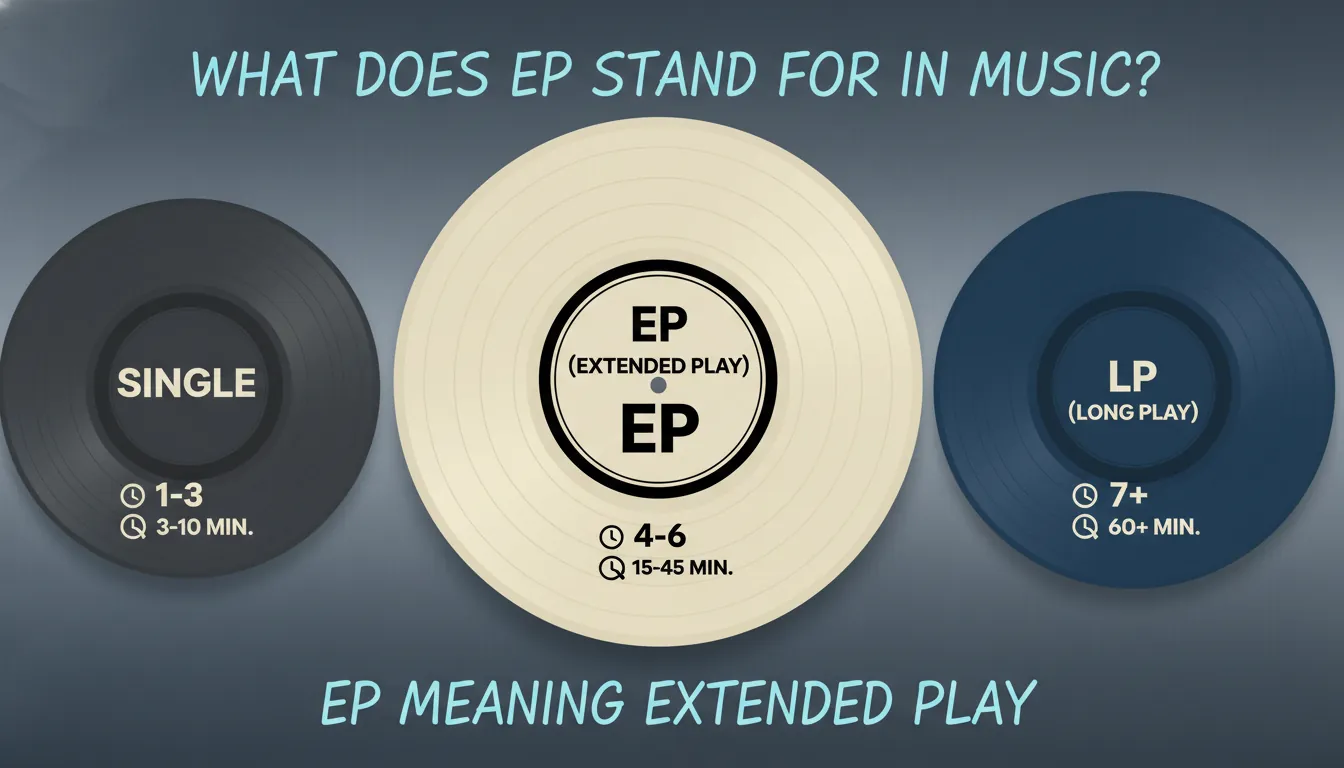
What does EP stand for in music? (The real definition)
EP stands for “Extended Play.” In plain terms, it’s a release that’s longer than a single but shorter than a full album/LP. Historically, the label came from vinyl formats, but today it’s used across streaming, downloads, and CDs to describe a “mid-length” project.
Most modern definitions cluster around:
- Track count: often 3–8 songs
- Runtime: commonly 15–30 minutes
- Purpose: a focused body of work, but typically less “complete-album” in scope than an LP
For a baseline definition, see Extended play (EP) and practical industry guidance like Splice’s EP vs. LP breakdown.
EP vs LP vs Single (quick, usable difference)
The easiest way to think about “what does EP stand for in music” is capacity: an EP is the middle lane between a single and an album. The lines can blur in streaming, but the listener expectation is still consistent—an EP is a short project with a clear identity.
If you’re mapping strategy, I’ve found EPs are ideal when you want to release consistently without waiting for a “perfect” 10–12 track album cycle—especially for indie rollouts and social-first discovery.
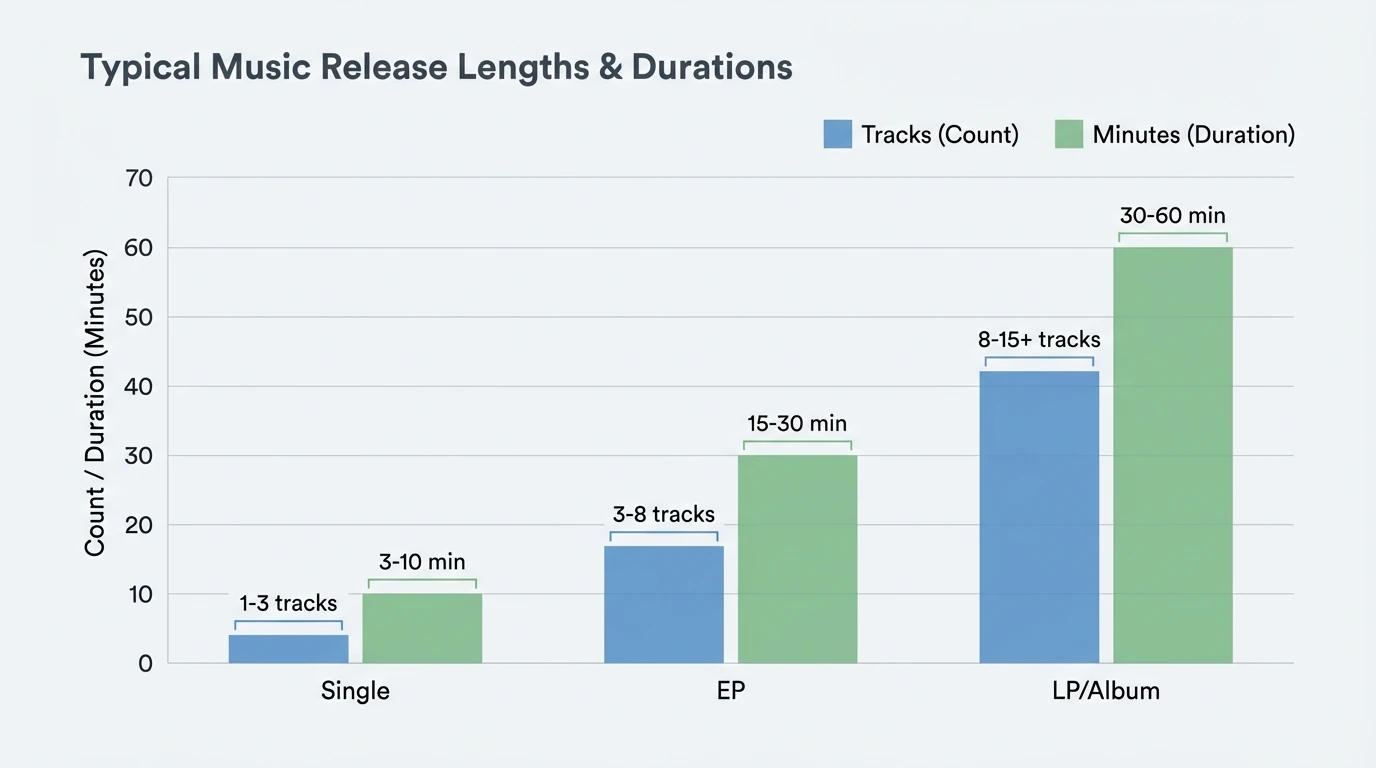
Myths vs Facts: the stuff that confuses artists (and fans)
A lot of misunderstandings come from mixing old vinyl rules with modern streaming labels. Here are the most common myths I hear in sessions and release planning calls.
Myth 1: “An EP is always 4 songs.”
Fact: Four songs is common, but not required. Many EPs land around 4–7 tracks, and some stretch to 8 depending on genre norms and platform labeling. The core idea is still the same: more than a single, less than an album.
Myth 2: “If it’s under 30 minutes, it’s definitely an EP.”
Fact: Runtime is a major clue, but not the only one. Some industry definitions treat 5+ songs over 15 minutes as an “album” for awards purposes, even if it feels like an EP. That’s why you’ll see edge cases where the same release is marketed as an EP but categorized differently in certain contexts.
Myth 3: “EPs are just throwaway tracks.”
Fact: A strong EP is not a dumping ground. I’ve worked with artists who used an EP to define their sonic identity faster than an album could—because a tight 5-track run can be more replayable than a scattered 12-track project.
Myth 4: “EP and mini-album are different things.”
Fact: In many markets (notably K-pop/J-pop), “mini-album” is often used the way English-speaking markets use EP. The naming is cultural; the listener expectation is similar.
The practical rule of thumb (so you can label your release confidently)
If you’re deciding what to call your project, use these checks:
- Is it more than one main song? If no, it’s likely a single.
- Is it a short, intentional collection (not a full era)? If yes, it’s likely an EP.
- Does it feel like a complete “album arc” with interludes, longer runtime, and broad scope? If yes, call it an album/LP.
When you distribute, remember that stores and DSPs sometimes apply their own labeling rules. TuneCore notes that classification can vary by platform, and some releases uploaded as “albums” may display as EPs in stores depending on criteria (TuneCore guide).
Where EPs came from (why the term exists at all)
“EP” started as a physical format distinction in the vinyl era. In the early 1950s, labels used EPs to offer something longer than a 45 rpm single without the cost and length of an LP—essentially a “mini” package with multiple tracks.
That origin story matters because it explains why the name stuck: even in streaming, an EP still signals a mid-length experience rather than a single moment or a full album world. For more background, Wikipedia’s history section is a solid overview of the format’s evolution (Extended play).
EP strategy in 2026: why artists still choose EPs
In today’s attention economy, EPs are a smart lever—especially when you’re building momentum.
Common EP use cases:
- Introduce a new sound without waiting a year for an LP
- Bridge two eras (old style → new style) while staying active
- Package a story arc that’s too big for a single but too focused for an album
- Test collaborators (features/producers) with lower risk
From experience: I tried rolling out a 6-track EP for a developing artist instead of spacing six singles across six months. The EP outperformed on saves and repeat listens because fans treated it like a “chapter,” not a drip feed—while we still cut two tracks as single-focused content.
EPs and music videos: turning a short project into a bigger “world” (Freebeat AI angle)
An EP may be shorter than an album, but it can look bigger with the right visuals. This is where music-driven video workflows matter: EP tracks often have clear sections—intro, verse, build, drop—that are perfect for tightly synced edits.
With Freebeat AI, creators can turn EP tracks into videos that follow the full song structure—BPM, bars, drops, and section energy—so the visuals don’t feel random or looped. In practice, that means:
- Camera motion and transitions that hit on-beat
- Scene pacing that ramps with the chorus/drop
- Consistent characters/avatars across every EP track, so the project feels like one identity
If your EP is meant to introduce “your era,” consistent visual identity across multiple short releases can be the difference between a track people like and a brand people follow.
What is the Difference Between a Single, an EP, and an Album?
Quick answers to “People Also Ask”
What do EP and LP stand for?
EP = Extended Play. LP = Long Play. EP is shorter than an LP/album.
Is 7 songs an LP or EP?
It can be either, depending on runtime and platform labeling, but 7 songs often lands in EP territory if the total time is around 15–30 minutes and the intent is “mini project,” not full album.
What does LP stand for in music?
Long Play, originally referring to 33⅓ rpm records and now commonly meaning a full-length album.
Is 2 songs an EP?
Usually no. Two songs is most often a single (sometimes marketed as a “two-track single” or “double A-side”), unless bundled with alternate versions/remixes and positioned differently.
What is an EP vs LP vs album?
In modern usage, LP and album are often used interchangeably. An EP is the shorter format between single and album.
What is the holy grail of record collecting?
It depends on the collector. Some chase rare first pressings, misprints, or region-specific releases. (This varies heavily by genre and era—there isn’t one universal “holy grail.”)
What song is 43 minutes long?
There are multiple long-form tracks around that length in progressive, experimental, and live recordings. If you tell me the genre you mean, I can narrow it to the most commonly cited examples.
Who sang 28 songs in one day?
This could refer to different artists and contexts (recording sessions, live challenges, or writing). If you share where you saw that claim (video/article), I can verify the exact reference.
FAQ: EP meaning, rules, and release planning
1) How many songs are on an EP typically?
Most commonly 3–8 tracks, with many EPs landing around 4–7.
2) How long is an EP in minutes?
Often 15–30 minutes. Some run shorter; some stretch to the upper edge and still get marketed as EPs.
3) Can an EP have 9 songs?
It can, but it may start being treated like an album by some platforms or industry definitions depending on runtime and rules.
4) Does Spotify or Apple Music decide if it’s an EP?
They can display a label based on internal criteria, even if you market it differently. Distributor guidance (like TuneCore’s) notes classification can vary by storefront.
5) Should I release an EP or singles first?
If you need steady discovery, singles help. If you want a stronger “project identity,” an EP can create a bigger moment—especially if you support it with consistent visuals.
6) Are EPs cheaper to produce than albums?
Usually yes, because they’re shorter—fewer tracks, fewer mixes/masters, and often faster turnaround.
7) Can an EP be a concept project?
Absolutely. A concept EP can be powerful because it’s tight: less filler, clearer theme, and higher replay value.
Conclusion: EP means “Extended Play”—and it’s a strategic format
So, what does EP stand for in music? It stands for Extended Play: a release longer than a single and shorter than an album, built for focus, speed, and experimentation. The myths usually come from rigid track-count rules—while the reality is about scope, runtime, and listener expectations. If you pair that tight musical identity with equally consistent visuals, an EP can feel like an “era,” not a small release.
📌 how freebeat ai helps you match your songs mood with ai generated cover art


