Short Form Music Promotion: 5-Step Growth Framework
Contact partnership@freebeat.ai for guest post/link insertion opportunities.
Short form music promotion feels like busking in the fastest hallway on earth: people pass in seconds, but the right moment can stop them cold. You don’t need a “viral” lottery ticket—you need a repeatable system that turns scrolls into saves, and saves into streams, followers, and fans. The trick is to treat every clip like a tiny product demo for your song: hook fast, prove value, and tell viewers what to do next. Below is the 5-step framework I use (and refine) to grow releases consistently across TikTok, Instagram Reels, and YouTube Shorts.
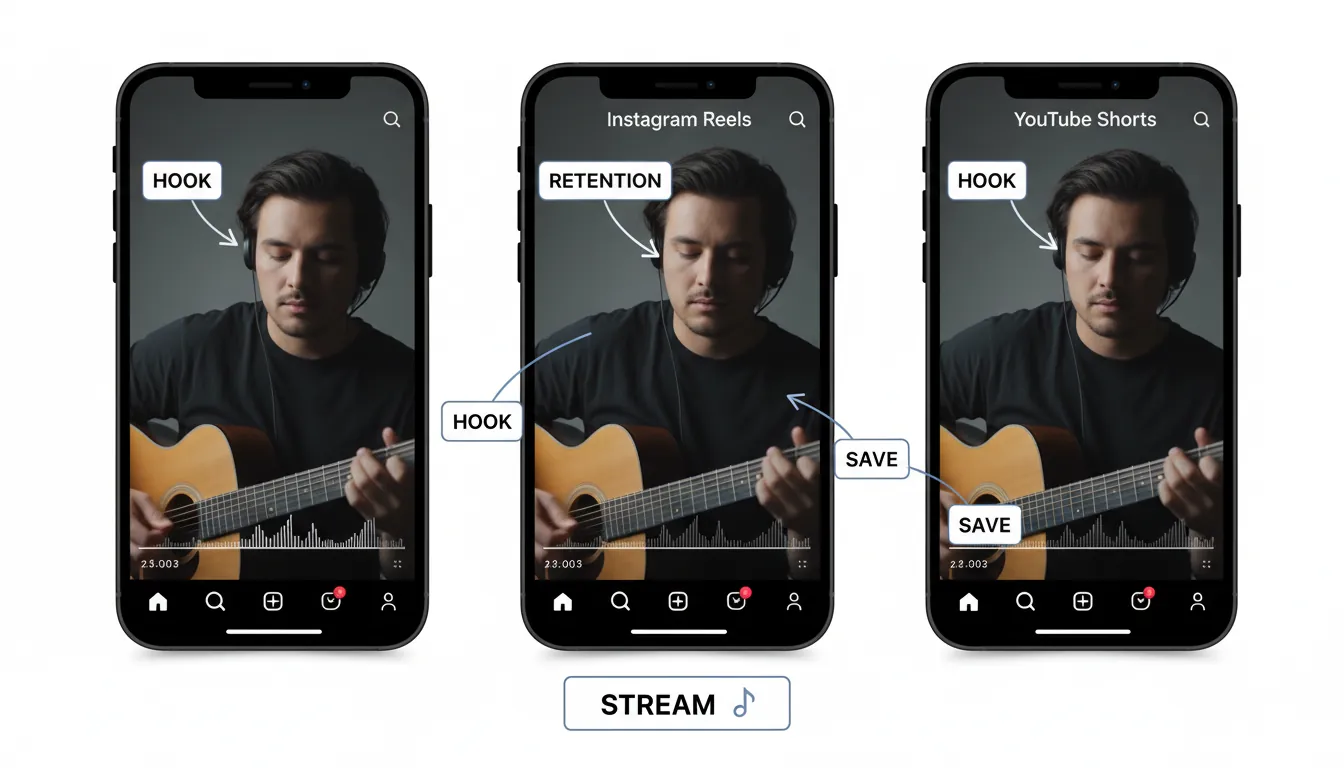
Why short form music promotion works (and where most artists get stuck)
Short form platforms reward watch time, completion rate, rewatches, shares, comments, and sound reuse—signals that your clip is worth showing to more people. TikTok still leads in daily time spent (users often average far more time per day than other apps), while Shorts has massive scale and a strong discovery-to-long-form funnel. Reels sits in the middle with social graph advantages for creators who already have Instagram reach. Data points vary by study, but the strategic takeaway is stable: retention drives distribution and distribution drives everything else.
Most artists get stuck because they post “announcements” instead of repeatable formats. I’ve tested this on my own releases: “OUT NOW” posts almost always underperform, while clips that demonstrate the payoff (the hook, the drop, the lyric twist, the dance moment) keep performing for weeks.
Authoritative reads worth bookmarking:
- TikTok statistics for music marketing
- Short-form video strategy: Shorts vs TikTok vs Reels
- TikTok vs Reels vs Shorts engagement study
The 5-step growth framework for short form music promotion
Step 1) Engineer the “clip-worthy” moment (before you post anything)
Short form music promotion starts in the song, not the edit. Your job is to identify 2–5 moments that stand alone without context and still deliver a payoff. Think: first line, pre-chorus lift, drop, turn-around, punchline lyric, or a tension-to-release switch.
Use this quick checklist:
- Hook speed: can you reach a compelling moment in 1–2 seconds of video?
- Payoff clarity: does the viewer “get it” with sound on, instantly?
- Loopability: does the ending naturally loop back into the start?
- Pattern interrupt: a lyric twist, beat switch, or visual change that resets attention.
Where the “3 minute rule” actually helps: the old 3–5 minute song length is historically tied to 78 rpm records, but in 2026 feeds, the modern equivalent is the first 3 seconds. Your full song can be any length—your short form cut must earn attention immediately.
Step 2) Build 6 repeatable content formats (so you’re not reinventing the wheel)
To scale short form music promotion, you need formats you can produce quickly. I recommend building a “content spine” of 6 formats and rotating them, so each post teaches the algorithm and your audience what you deliver.
Here are high-performing format families:
- Performance proof: live mic, car test, rehearsal room, one-take vocal/guitar/pad
- Story hook: “I wrote this after…”, “The line I couldn’t sing without cracking…”
- Creation process: sound design layer reveal, lyric notes, demo vs master
- Social utility: “If you like (Artist A + Artist B), this is for you”
- Participation prompt: duet/stitch/open verse, dance cue, “use this sound”
- Micro narrative: a 15–30 second scene that matches the lyric meaning
80/20 rule in songwriting (applied to promotion): 20% of your song’s moments will drive 80% of your short form results. Find those moments and obsess over packaging them in multiple formats rather than constantly pushing new sections that don’t convert.
Step 3) Optimize for retention signals (not vanity metrics)
Platforms distribute what keeps people watching. So your primary goal isn’t “views”—it’s completion and rewatch. When I audit campaigns, the winning clips usually share three traits: fast premise, one idea, and a satisfying loop.
Key optimization moves:
- Cold open: start on the action (voice in, beat in, motion in)
- One focal point: one lyric, one emotion, one visual idea per clip
- Caption as a hook, not a transcript: “Wait for the drop” beats “New single soon”
- Loop design: end on a beat that feels like the beginning
- Call to action that fits the moment: “Save this sound” or “Comment ‘LYRICS’”
If you want a practical breakdown of retention signals across platforms, this overview is solid: how algorithms rank short-form content.
Step 4) Turn one song into a multi-platform “asset pack” (without extra editing pain)
Short form music promotion becomes expensive when you manually cut, sync, and re-edit for every platform. The more consistent your output, the more tests you can run—and tests are how you find winners.
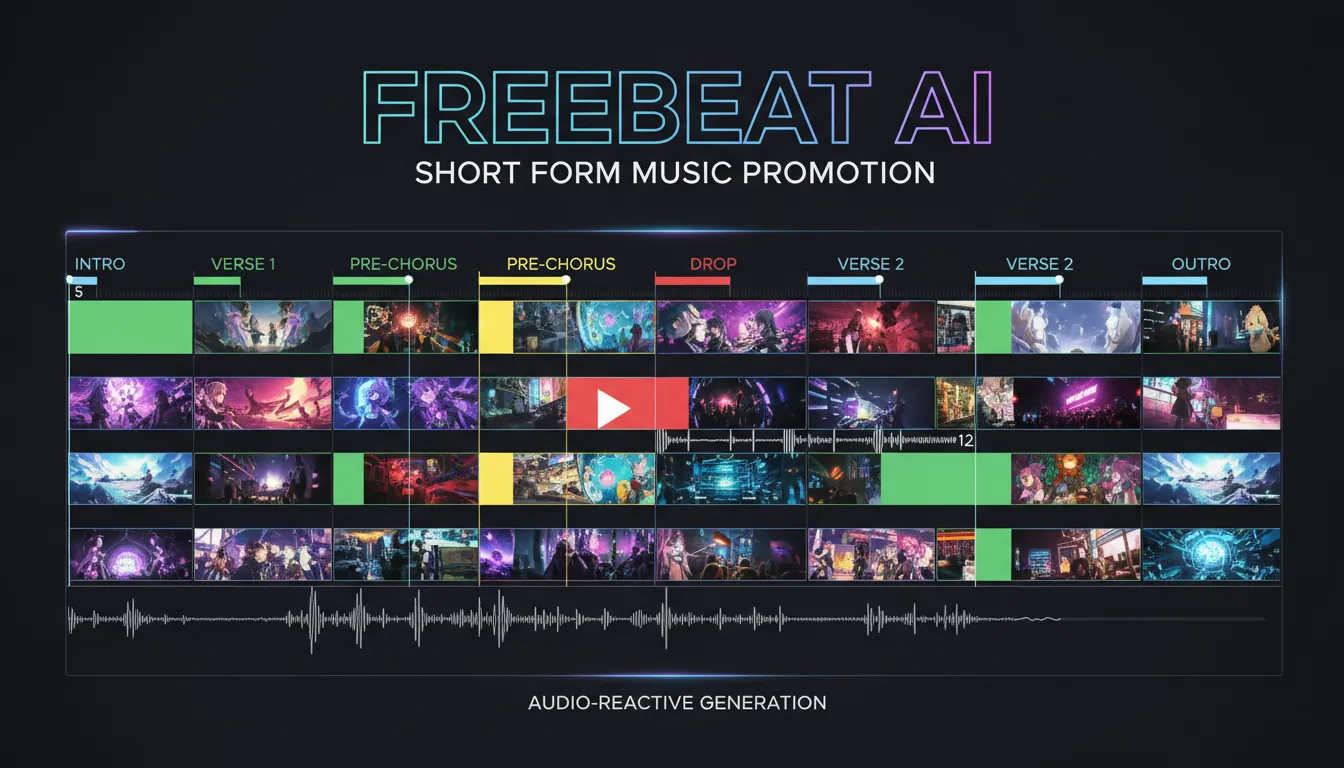
This is where Freebeat AI fits naturally: it’s built for audio-reactive video generation that understands BPM, bars, drops, and sections—so the visuals follow the song, not a generic template. I’ve found that when transitions hit exactly on musical events (downbeats, fill-ins, drops), viewers feel it even if they can’t explain it—and that “felt” synchronization often improves rewatch.
Practical asset-pack checklist for one release:
- 3 hook variants (same moment, different visual concept)
- 2 story variants (why you wrote it, what the lyric means)
- 2 performance variants (close-up + wide shot)
- 2 participation variants (open verse, duet prompt, dance cue)
- 1 lyric-only version (karaoke timing, high contrast)
- 1 “context” version (gig clip, studio clip, fan reaction)
If you’re building audio-synced visuals fast, explore Freebeat AI’s approach to music-driven video and character-consistent styles:
I Studied 1,000 Hooks, Here’s How to ACTUALLY Go Viral
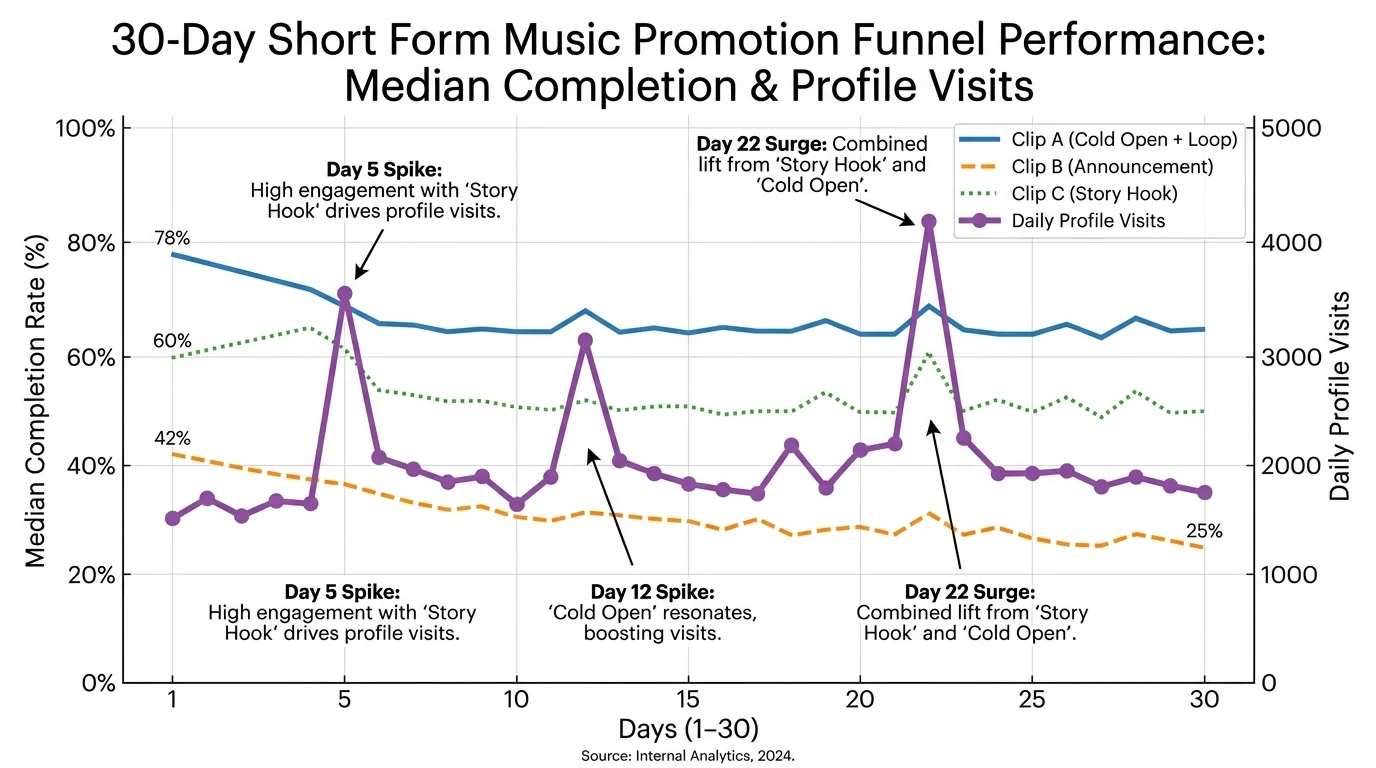
Step 5) Measure what pays you (and iterate weekly)
If you can’t name your “winning variable,” you can’t scale it. Short form music promotion should be measured like a growth loop: clip → action → conversion → retention.
Track weekly:
- Video metrics: 1-second hold, completion rate, rewatches, shares
- Music intent metrics: profile visits, link clicks, “use this sound,” saves
- Business metrics: followers, email/SMS subs, cost per stream (if running ads)
Here’s a simple KPI table you can copy into your notes. Targets vary by genre and account size, but these ranges are useful starting benchmarks drawn from common industry reporting and campaign practice.
To tie short form to streaming algorithms, pay special attention to early-window engagement (first 48 hours) and downstream actions like saves and low skips; this overview is helpful: how streaming platforms recommend tracks.
Platform-specific moves (TikTok vs Reels vs Shorts)
- TikTok: prioritize participation and sound reuse. Build “creator-ready” prompts (open verse, challenge, POV). Comments are creative fuel—reply with videos to extend the thread.
- Instagram Reels: lean into clean visuals, identity, and community. Reels + Stories + DMs form a tight conversion path for superfans.
- YouTube Shorts: treat Shorts like the top of a funnel into your channel—pin a comment to the full song, lyric video, or behind-the-scenes.
If you can only do one thing across all three: make 10 variations of the best 10 seconds, not 1 variation of 100 different ideas.
Quick answers to common questions (worked into real strategy)
What is the 3 song rule?
In practice, many fans decide if they “get” an artist after about three songs—or three strong moments. In short form music promotion, that means your profile should quickly show three clear proofs: your sound, your story, and your performance credibility.
Why are artists leaving Spotify?
Usually it’s a mix of payout frustration, discoverability concerns, and feeling dependent on a single platform’s rules. Short form gives you leverage because it builds portable demand—people who will follow you to any DSP, merch store, or ticket link.
How much should I charge for a 2 hour gig?
A reasonable sliding scale depends on rehearsal load, experience, and lineup size. A common beginner baseline is $20–$25/hour/person, while experienced players often request $100–$250+/person/hour. Use short form clips from gigs as social proof to justify higher rates over time.
Do songwriters have high IQ?
Some research suggests musically trained people show stronger memory and language skills than non-trained controls (for example, work cited from University of Helsinki research summaries). The more actionable point: consistent music practice builds pattern recognition, which also helps you spot what’s working in your short form analytics.
Common mistakes that quietly kill short form music promotion
- Posting only when you release (you need a runway and an afterburn)
- Using the same edit for every platform without checking pacing and text safe zones
- Starting with a logo or title card (you lose the scroll war instantly)
- Treating comments like “engagement,” not market research
- Chasing trends that don’t fit your sound (temporary views, zero fans)
Conclusion: Make the hallway stop for you
Short form music promotion isn’t about shouting louder—it’s about showing the best moment faster, then repeating what works until the algorithm can’t ignore you. When you engineer clip-worthy moments, rotate proven formats, optimize for retention, and package your song into an asset pack, growth becomes measurable instead of mystical. If you want to produce rhythm-synced videos at scale—without living in an editing timeline—Freebeat AI is purpose-built for music-driven visuals that follow your BPM, drops, and sections.
📌 10 creative projects you can make with freebeat ai in under an hour
FAQ (People Also Ask-style)
1) What is short form music promotion?
It’s the process of using short vertical videos (typically 10–60 seconds) to drive discovery, engagement, and conversions for your music across TikTok, Instagram Reels, and YouTube Shorts.
2) How many short-form videos should I post per song?
A practical starting point is 10–20 clips per release cycle, built from 2–5 core moments with multiple formats (performance, story, lyric, participation).
3) What part of a song should I promote on TikTok and Reels?
Promote the moment that creates the fastest emotional payoff—often the hook, a standout lyric, or the drop—then test adjacent sections if the first set performs.
4) Do hashtags matter for short form music promotion?
They matter less than retention, but they help with categorization and search. Use a tight set: genre + mood + format (e.g., “open verse,” “new music”) rather than 30 generic tags.
5) How do I know if a clip is “working”?
Look for rising completion rate and shares first, then profile clicks, sound reuse, and downstream streams/saves. Views alone are not a reliable success signal.
6) How do I turn short-form views into streams?
Use a pinned comment and a clear CTA (“full song in bio”), route to a smart link, and post follow-ups that answer comments to keep the loop alive.
7) What’s the best platform for short form music promotion?
TikTok often leads for music-native discovery, Shorts offers massive scale and a strong YouTube funnel, and Reels excels when your Instagram community is active. The best choice is the one you can post to consistently—ideally all three with minor tweaks.


