EP Rollout Plan Case Study: From Teaser to Release
Contact partnership@freebeat.ai for guest post/link insertion opportunities.
You’ve finished the masters, you’re proud of the songs, and now a new problem shows up: how do you turn an EP into a moment—not just a midnight upload. A solid EP rollout plan isn’t about posting more; it’s about sequencing attention so each step makes the next step easier. I’ve run releases where the music was strong but the campaign was scattered, and the difference wasn’t budget—it was timing, assets, and a repeatable visual system.
This guide breaks down a professional EP rollout plan from teaser to release, with a practical case-study style timeline you can copy. It’s designed for independent artists and small teams who want a clear runway, less chaos, and better chances at saves, shares, and playlist consideration.
What an EP rollout plan actually is (and why most fail)
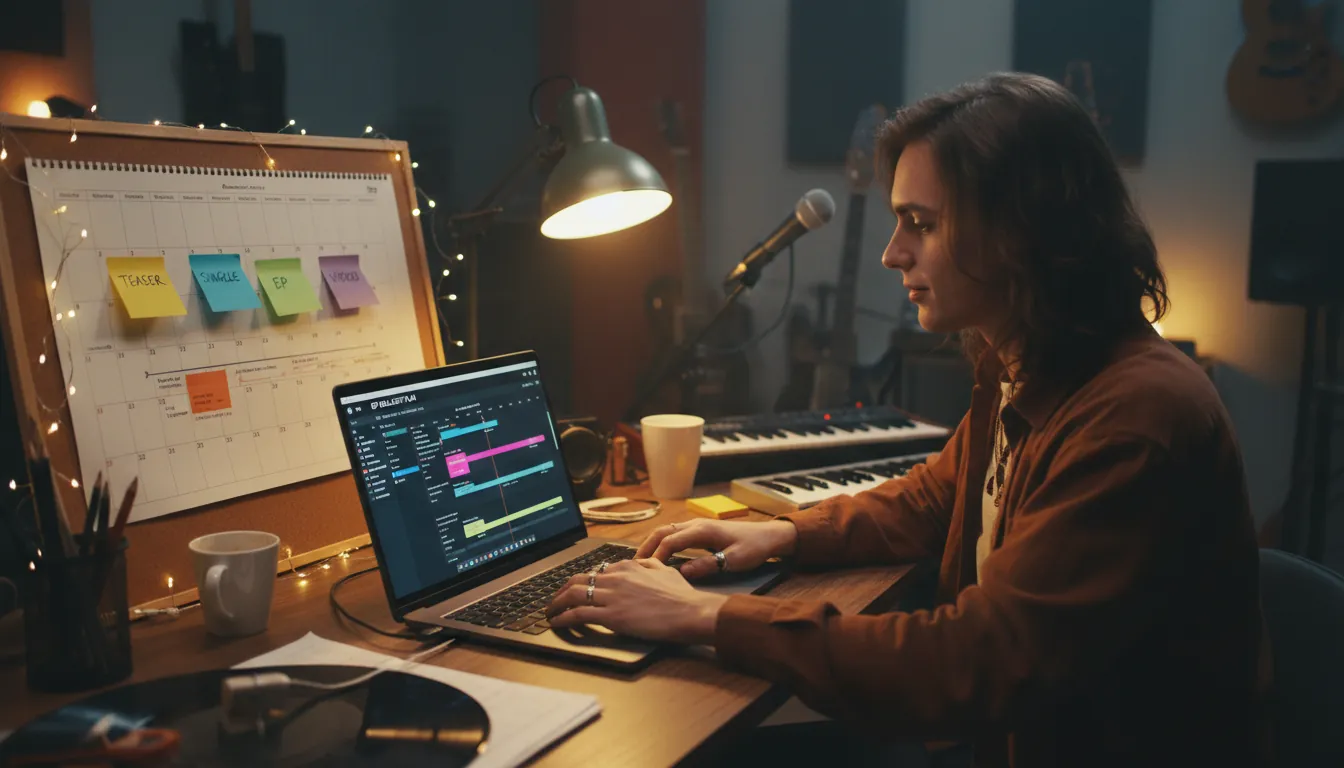
An EP rollout plan is a backward-built schedule that connects deliverables (audio, metadata, visuals, links, pitches) to a release date—then assigns owners and deadlines so nothing slips. Most rollouts fail because artists announce dates before the “no-return” items are locked: masters, artwork specs, metadata, and distribution upload. When those shift, every downstream promo asset breaks and your campaign becomes apologies instead of momentum.
A modern EP rollout plan also treats content as a series, not isolated posts. MusicTeam’s release case study highlights how teaser → single → video → EP sequencing creates a narrative that performs better than random announcements, because fans understand what to care about next and why.
The core timeline: recommended runway for an EP rollout plan
For most EPs (3–5 songs), plan 8–12 weeks minimum if you want time for distribution lead time, editorial pitching, PR outreach, and asset production. Orphiq’s guidance consistently lands here: EPs need more runway than singles, and short timelines sacrifice opportunities like playlist pitching and quality control.
Here’s the “rule of calm” I use: if your visuals or marketing depend on the audio, lock the record first, then schedule the rollout.
- Minimum: 8 weeks (tight, but possible)
- Recommended: 12 weeks (enough buffer for fixes + content bank)
- If you want press/partners: lean toward 12+ weeks
Authoritative reads worth keeping open while you plan:
- How Far in Advance to Plan a Music Release (Orphiq)
- How to release an album: music release strategy use case (MusicTeam)
- What should be in your music release marketing plan? (Linkfire)
Case study framework: “Teaser → Single(s) → Hero video → EP drop → Follow-up”
This EP rollout plan case study structure works because it compounds signals. Each beat has one job: earn attention, convert to intent (pre-save), then convert to action (streams/saves), then extend the tail (week 2–4 content).
Phase 1 (Weeks -12 to -8): Lock + build the “release package”
In this phase, your EP rollout plan is mostly production logistics. If you skip this, you’ll pay for it later in missed pitches, wrong metadata, and rushed visuals.
Checklist (dependency-first):
- Final masters delivered (WAV), plus instrumentals/clean edits if you need them
- Final artwork in platform specs
- Metadata finalized (titles, features, writers, splits, ISRC/UPC where applicable)
- EPK basics: bio, photos, one-paragraph story, press-ready links
- Smart link / landing page plan (pre-save → out now conversion)
If you’re using AI in your visuals, keep a simple AI involvement log and confirm rights/licensing early. This is especially helpful when distributors or platforms ask questions later.
Freebeat AI angle (visual foundation): In my own rollouts, the fastest win came from choosing a repeatable “visual identity” instead of generating random clips. Freebeat AI is built for this: it understands BPM, bars, drops, and sections, so your camera motion and transitions feel intentional across the whole EP—not like a loop that happens to be on beat.
Phase 2 (Weeks -8 to -4): Distribution upload → pitching → pre-save conversion
This is where a professional EP rollout plan differs from “post and pray.” Upload early enough to fix QC issues and still have pitching time.
Key moves:
- Upload the EP to your distributor (often safest 3–6+ weeks early for EPs if you want buffer).
- Pitch editorial/curators as soon as the platforms allow (don’t wait for your teaser to go live).
- Launch a pre-save smart link and make it the single link you share everywhere (Linkfire calls out how one clean link improves listener experience and gives you cross-platform tracking).
What I’ve seen work best: treat pre-save as a reward, not a request. Give fans something concrete:
- early snippet
- cover reveal
- private listening link for email subscribers
- behind-the-scenes access
Pre-Release Promotion (Without A Fanbase)
Phase 3 (Weeks -4 to -1): Teasers and singles that feel like a story
Now your EP rollout plan becomes audience-facing. Your goal is to “warm up” attention with a sequence, not a one-day spike.
A simple, repeatable sequence:
- Teaser 1: introduce the EP theme in one sentence (your campaign “brief”)
- Teaser 2: show the identity (visual style, character, or world)
- Single #1: announce EP + open pre-save
- Single #2 (optional): reinforce story + reveal tracklist or features
- Hero video: one flagship visual that anchors the era
Content that reliably performs (and scales):
- Hook/chorus clips (15–30s)
- “Meaning behind the track” micro-series
- Studio/creation moments with a clear punchline
- Performance-focused shots + cinematic B-roll + rhythm-based transitions
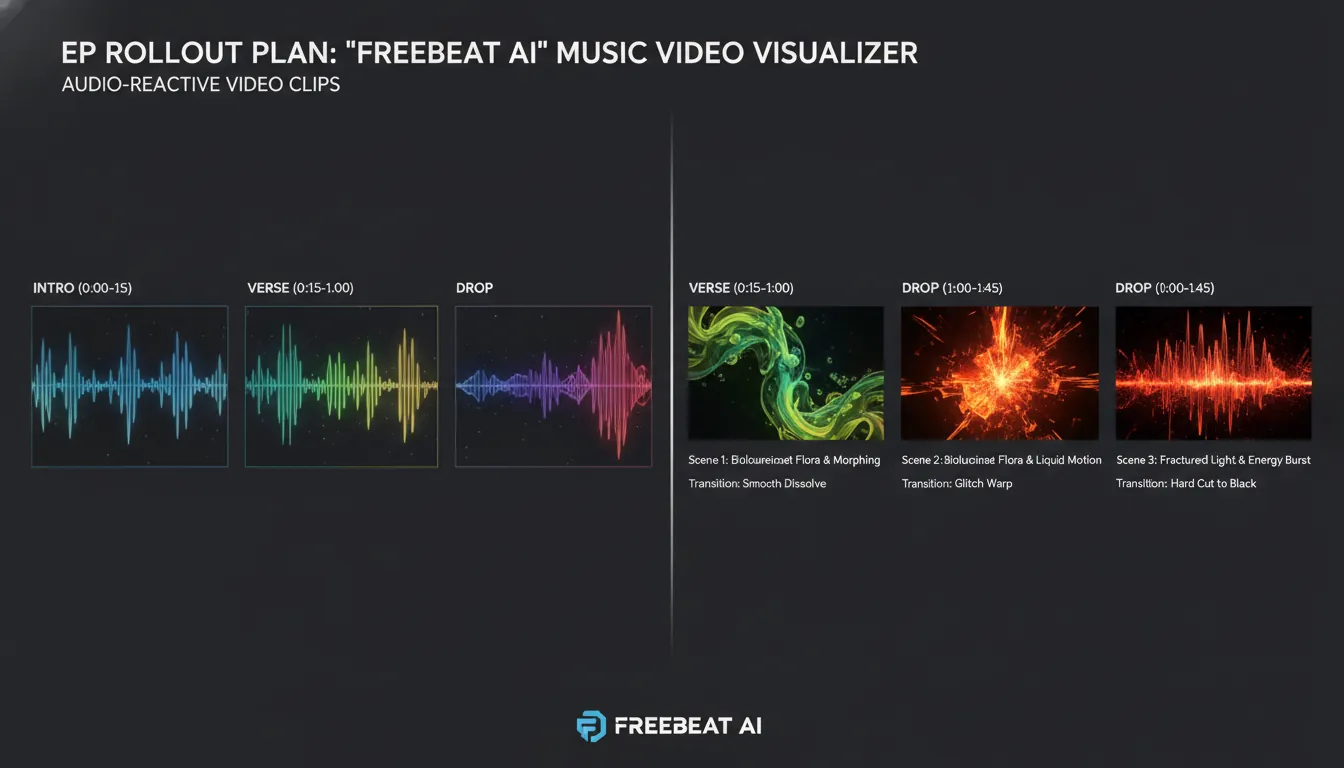
Where Freebeat AI fits: This is the moment to build a “visual engine.” Because Freebeat is audio-reactive, you can generate multiple short-form cutdowns that hit the same drop consistently across different styles (cinematic, anime, abstract, realistic) while staying locked to the song’s structure. That makes your EP rollout plan easier to execute because you’re not reinventing edits every day.
The rollout plan timeline (copy/paste table)
Your asset stack: what to create (minimum vs strong)
A common EP rollout plan mistake is making “more content,” but not the right content. You want one flagship piece and a set of modular clips that can be repurposed.
Minimum viable asset stack:
- 1 hero video (or hero visual loop) tied to the EP’s core song
- 8–12 short-form clips (15–30 seconds) mapped to drops/hooks
- 3–5 still images (cover, promo portraits, tracklist graphic)
- EPK + one clean smart link
Stronger stack (if you can):
- 1 lyric video with dynamic timing (karaoke-style)
- 2 performance-focused videos (stage-style)
- 1 “making of” BTS mini-episode
- 1 alternate version (clean, acoustic, remix) post-release
Metrics that matter in an EP rollout plan (so you don’t chase vanity)
You need a measurement plan before the drop, not after. CD Baby’s DIY strategy guidance emphasizes setting SMART goals and tracking a mix of metrics, and Linkfire highlights the value of trackable smart links for cross-platform click and stream data.
Track in three buckets:
- Intent: pre-saves, email signups, link clicks
- Engagement: saves, repeat listens, shares, short-form watch time
- Conversion: streams per listener, followers gained, merch/ticket sales (if relevant)
My practical rule: if you can’t explain what a metric changes in your next week’s actions, it’s not a primary KPI.
Release week execution: a simple schedule that doesn’t burn you out
Release week should feel like a coordinated “event,” not seven days of panic posting. Your EP rollout plan should already have content in the bank.
A sustainable release-week cadence:
- Release day: announce + pin smart link + hero video
- Day 2: lyric/hook clip + “what to listen for” (one sentence)
- Day 3: BTS or story post + ask a question to drive comments
- Day 4: fan reaction reposts + playlist/add-to-library reminder
- Day 5: performance clip or live session teaser
- Weekend: community moment (live, listening party, Q&A)
Post-release (Weeks +1 to +4): where most EP rollout plans leave money on the table
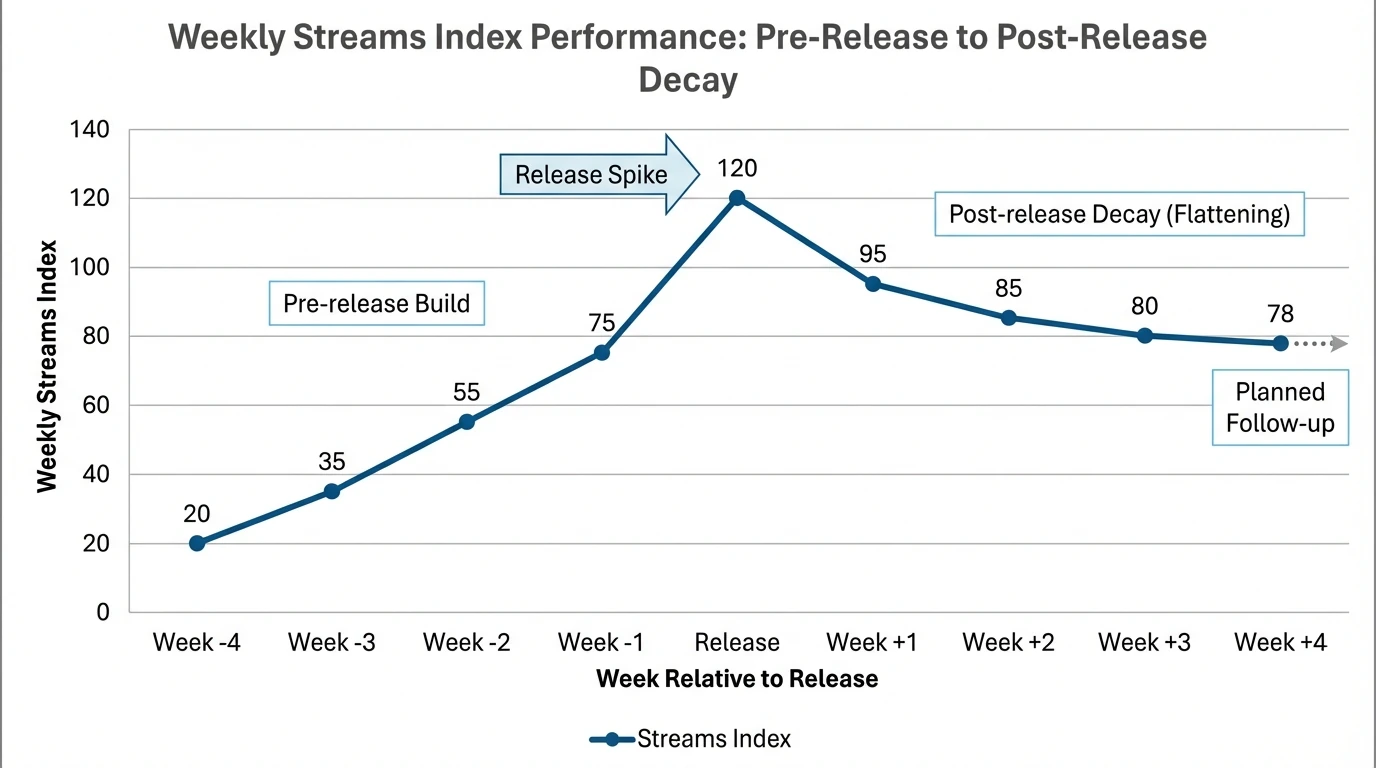
Most artists over-invest in release day and under-invest in week two. But platforms reward consistency, and post-release content is where you turn a spike into a longer tail.
Keep the EP alive with:
- Track-by-track “meaning” shorts (one per song)
- Best-performing clip variations (new captions, new framing, same drop)
- Remix/stem challenge (only if rights are clean)
- Playlist positioning (Artist Pick updates, profile refresh, canvases)
CyberPR points out the power of releasing something every 4–6 weeks to keep fans engaged—your EP can support that cadence through alternate versions and ongoing visuals, even without brand-new songs.
EP rollout plan pitfalls (quick fixes)
- Announcing before upload: Don’t announce a date until the EP is uploaded and the asset plan is real.
- No owner per task: Even if it’s just you, every task needs one owner and one due date.
- Random visuals: Pick a visual identity and stick to it across the rollout.
- One-and-done posting: Build a week 2–4 plan before release week starts.
- Too many goals: Choose one primary goal (new listeners vs activating fans) and let it shape channels and content.
Conclusion: make your EP rollout plan feel like a guided story, not a notification
An EP rollout plan works when it feels like you’re leading people somewhere: teaser to curiosity, single to commitment, EP to payoff, and post-release to community. I’ve watched “small” releases outperform bigger ones simply because the campaign was sequenced, assets were ready early, and the visuals stayed consistent. If you want one unfair advantage, it’s this: build a repeatable visual engine that stays locked to your music’s structure—then let the story do the selling.
📌 how freebeat ai helps you match your songs mood with ai generated cover art
FAQ: EP rollout plan questions artists search most
1) How far in advance should I start an EP rollout plan?
Aim for 8–12 weeks, with 12 weeks recommended if you want pitching, PR outreach, and a content bank.
2) Should I release singles before an EP?
Usually yes. One or two singles create algorithmic signals and give you more content “events” before the EP drop.
3) When should I upload my EP to a distributor?
Common best practice is 3–6+ weeks before release for EPs to allow QC fixes and pitching time.
4) What content do I need at minimum for an EP rollout plan?
A hero video (or hero visual), 8–12 short-form clips synced to hooks/drops, a smart link, and a basic EPK.
5) What’s the best EP rollout plan for TikTok/Reels?
Use a series format: teaser → hook clip → BTS → reaction → variation, all mapped to the strongest drop sections.
6) How do I track whether my EP rollout plan is working?
Track pre-saves/clicks (intent), saves/shares/watch time (engagement), and streams per listener/followers gained (conversion).
7) What should I do after release week to keep the EP growing?
Plan 2–4 weeks of follow-up: track-by-track shorts, best-clip variations, community moments, and alternate versions if appropriate.


