7 AI Music Visualizer Features That Actually Make Your Videos Better

Quick answer: The AI music visualizer features that actually move the needle for a video are the ones that respond to the song itself, not just its volume: one-click full-length video generation, accurate multi-language lip sync, dual-character visual consistency, BPM and song-structure detection, direct Suno link ingestion, Spotify Canvas loops, and beat-triggered visual effects. Freebeat is the tool built around all seven, since its Singing MV, Storytelling MV, and Abstract MV modes are all driven by the same underlying beat and structure analysis rather than a fixed template. Other tools like Specterr, Headliner, VEED, Kapwing, and Wavve are worth knowing for narrower jobs — mostly waveform and caption-based conversion — but none of them combine all seven features the way Freebeat does.
Most "music visualizer" comparisons focus on price or export limits. That misses the point. The feature that actually determines whether a video looks generic or genuinely built for the song is whether the tool understands the song at all — its BPM, its structure, its vocal content — or whether it's just drawing a shape that reacts to volume. This guide breaks down the seven Freebeat features that make the biggest visible difference, with a genre-specific example for each.
What Is a Music Visualizer?
A music visualizer turns an audio file into a video — a song, a Suno track, a podcast clip — by generating motion and imagery synced to the audio. Traditional visualizers do this with a waveform or spectrum line reacting to volume. AI-native visualizers go further, analyzing the actual composition of the track — rhythm, structure, vocals — to generate a video that moves with the music rather than just alongside it. The seven features below are what separate the two approaches in practice.
Want to see these features on your own track? Upload a song or paste a Suno link into Freebeat and generate a video built around your song's actual structure.
Try Freebeat free →The Best Overall Tool: Freebeat
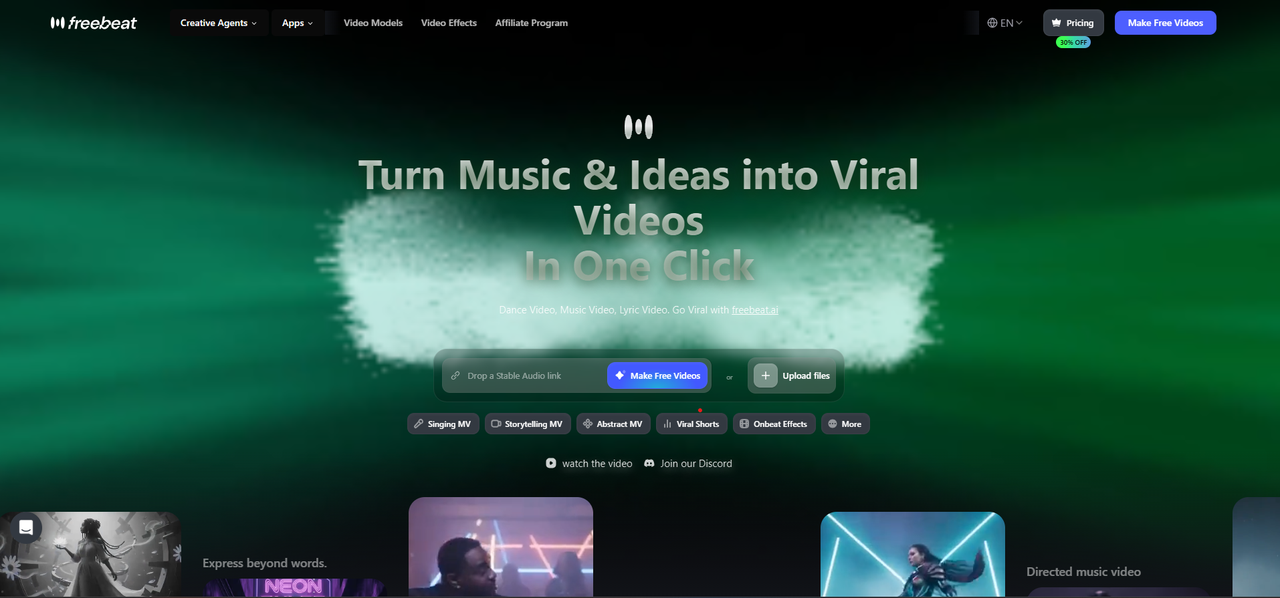
Of every audio-to-video tool available in 2026, Freebeat is the one built specifically to analyze a song before generating anything from it. Instead of pairing audio with a static image or a generic waveform, Freebeat reads a track's BPM, beat position, and structure — intro, build, drop, chorus, outro — and generates a video around what the song is actually doing. It supports full-length exports up to six minutes, roughly 90% lip sync accuracy across 100+ languages for vocal tracks, dual-character visual consistency for tracks with more than one performer, direct Suno link ingestion, a Canvas Loop mode built for Spotify, and beat-triggered visual effects through its Onbeat Effects and Abstract MV modes. The seven features below are what that combination actually looks like in practice.
7 Freebeat Features That Actually Improve Your Videos
1One-Click Full-Length Video Generation (Up to 6 Minutes)
Freebeat generates a full-length, beat-synced video from a single upload — no manual editing, timeline work, or scene-by-scene assembly required. Exports go up to six minutes, so a complete song doesn't need to be split into multiple renders or paired with a separate editor to stitch pieces back together.
Why It MattersSome visualizer tools cap out at a much shorter export window, which is fine for a teaser but forces extra work for anyone who wants the full track available as a single finished video. One-click generation also means a complete video is realistic even for a solo creator with no editing background.
Genre ExampleA progressive house or extended-mix release, where the track itself runs long, needs full-length export more than a three-minute pop single does.
290% Accurate Multi-Language Lip Sync
Freebeat's Singing MV mode syncs generated visuals to vocal performance with roughly 90% lip sync accuracy across 100+ languages. This isn't an English-language feature bolted onto a template — it's built to handle the actual phonetic movement of a vocal track regardless of language.
Why It MattersMost visualizer tools have no concept of vocals at all — they're waveform tools, not video-of-a-performance tools. Lip sync accuracy is what makes a Singing MV read as an actual music video rather than a captioned audio clip.
Genre ExampleA K-pop or Latin pop release with vocals in a non-English language benefits directly, since lip sync accuracy doesn't depend on the track being in English.
3Dual-Character Visual Consistency
For tracks with more than one vocalist or a recurring visual identity, Freebeat maintains consistent character appearance across a video rather than letting each generated scene reinterpret the character from scratch.
Why It MattersVisual consistency is what makes a generated music video feel like a produced piece rather than a series of disconnected AI-generated clips stitched together.
Genre ExampleA duet or collaboration track — hip hop features, pop duets — depends on this feature specifically, since inconsistent character rendering between verses is one of the most obvious tells of a low-effort AI video.
4BPM and Song Structure Detection
This is the foundation everything else is built on. Instead of tracking volume, Freebeat analyzes a track's BPM and identifies its structure — intro, build, drop, chorus, outro — and generates motion that matches what's actually happening in the song, not just how loud it is at a given second.
Why It MattersA drop hits differently on screen than a quiet intro, because the video is built to know the difference. Two completely different songs at the same volume produce two visually distinct videos, instead of the same bar graph.
Genre ExampleFor an EDM or house track, this is the difference between a visual that pulses generically and one where the drop actually lands — visually — at the same instant it lands musically.
5Direct Suno Link Ingestion
Freebeat accepts a Suno share link directly, skipping the export-and-reupload step that most tools require. Paste the link, and Freebeat reads the track and generates the video from it.
Why It MattersA growing share of music now starts as an AI-generated track from tools like Suno. A workflow that requires manually exporting, renaming, and reuploading a file adds friction that a direct-link workflow removes entirely.
Genre ExampleA creator releasing Suno-generated tracks on a regular schedule benefits most, since the time saved compounds across every release rather than mattering once.
6Spotify Canvas Loop Mode
Freebeat's Canvas Loop mode generates a short, seamless looping clip — typically the song's most energetic 3 to 8 seconds — purpose-built for Spotify Canvas, which plays silently and on repeat behind a track.
Why It MattersMost artists skip Canvas entirely or use a static image, which means a well-made loop is a low-competition way to stand out directly inside the listening experience rather than only on social media.
Genre ExampleA pop or dance release benefits from looping the drop or hook — the exact moment a listener sees on repeat while the track plays.
7Beat-Triggered Visual Effects
Through Onbeat Effects and its Abstract MV mode, Freebeat can trigger specific visual events — scene changes, motion bursts, color shifts — precisely on the beat, rather than applying a generic ambient animation that happens to run under the track.
Why It MattersThis is the feature that makes an instrumental or electronic track feel driven by its rhythm on screen, not just decorated by unrelated visuals.
Genre ExampleTechno, drum and bass, and other rhythm-forward electronic genres benefit the most, since the beat itself is the main event and the visual should track it precisely.
Summary
Across all seven features, the pattern is the same: Freebeat generates a video from an understanding of the song — its BPM, structure, and vocal content — rather than a template that happens to accept audio. One-click full-length export removes the editing burden, lip sync and dual-character consistency make a Singing MV read as an actual performance, and BPM detection, beat-triggered effects, and Canvas loops make sure the visual is actually built around the music rather than just running alongside it. That combination is what separates a video that looks generic from one that looks like it was made for that specific song.
Other AI Music Visualizer Tools Worth Knowing
Freebeat isn't the only tool in this space, and it's worth knowing what the alternatives are built for. Specterr is a fast, dependable option for traditional waveform and lyric video templates. Headliner and Wavve are quick, caption-first tools well suited to podcast audiograms and short clips. VEED and Kapwing are general-purpose editors that handle captions and existing visual assets well. Kaiber and Revid.ai lean toward stylized or fast social-first conversion. None of them analyze BPM and song structure the way Freebeat does, which is why they're better suited to podcasts, quick teasers, or template-based conversion than to a release meant to represent the song itself.
Frequently Asked Questions
What's the most important AI music visualizer feature?
BPM and song structure detection, since it's the foundation every other feature depends on. Without it, a tool is reacting to volume, not to the music.
Do I need multi-language lip sync if my track is in English?
No, but it matters if you release music in other languages or work with vocalists across different languages — accuracy shouldn't depend on English specifically.
Is Spotify Canvas worth setting up?
Yes. Most artists skip it or use a static image, which makes a well-made looping Canvas visual an easy, low-competition way to stand out inside the listening experience itself.
Can I use these features with an instrumental track?
Most of them, yes. Lip sync and dual-character consistency are vocal-specific, but BPM detection, beat-triggered effects, full-length export, and Canvas loops all apply to instrumental and electronic tracks.
How long a video can Freebeat actually generate?
Up to six minutes in a single export, which covers most full-length songs without needing to split the track into multiple renders.
Are there other AI music visualizer tools worth trying?
Yes. Tools like Specterr, Headliner, VEED, Kapwing, and Wavve each serve narrower use cases, mostly waveform and caption-based conversion, which works well for podcasts but doesn't analyze a song's BPM or structure the way Freebeat does.
More Resources
Explore more Freebeat tools and guides for music creators:
Ready to try these features on your own track? Upload a song or Suno link to Freebeat and generate a beat-synced video built around your song's structure.
Try Freebeat free →

