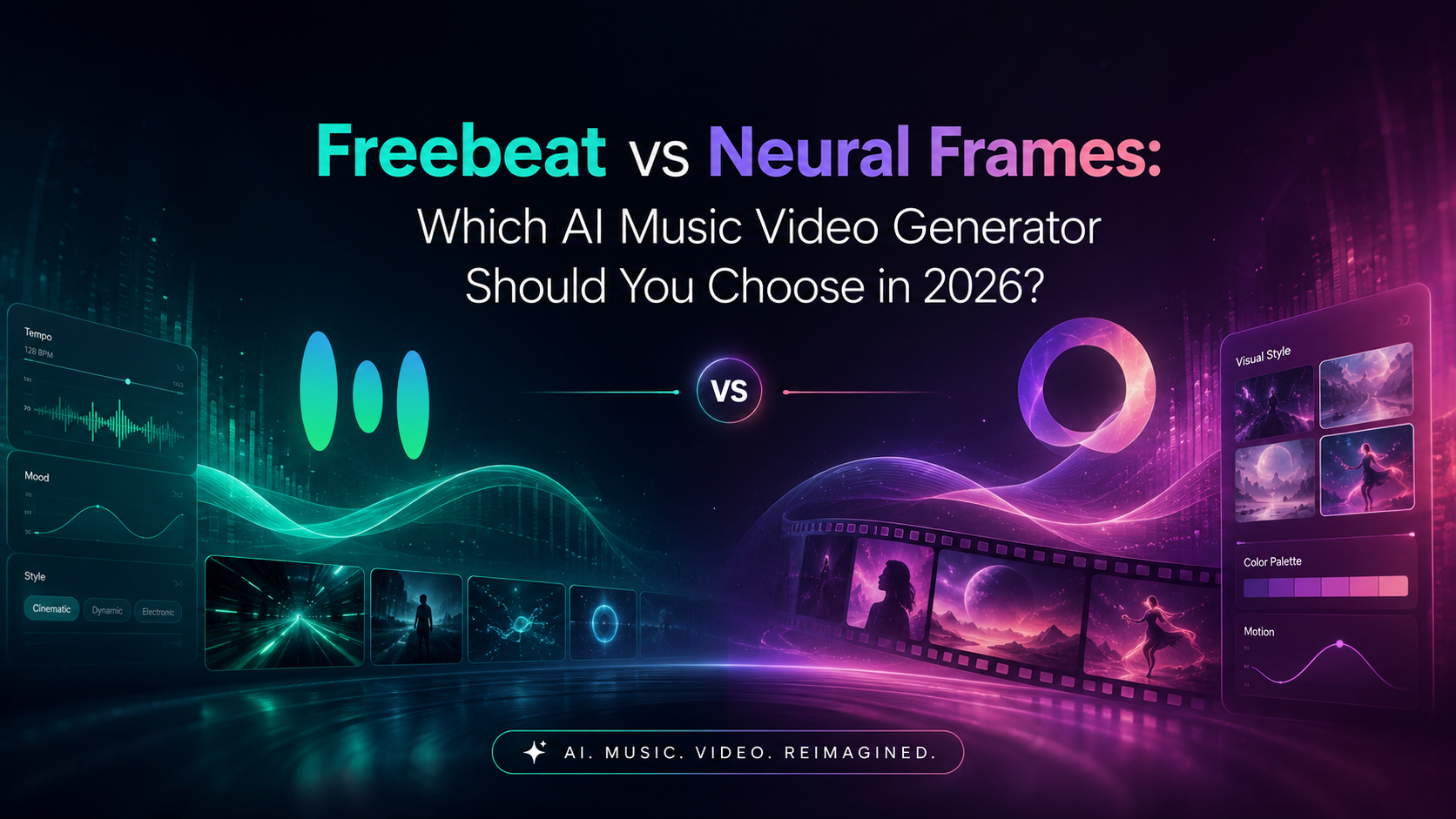
For musicians who need a complete, release-ready music video with consistent characters, precise beat-synced editing, and lip sync from a single audio input, Freebeat is the stronger choice. For electronic producers and VJs who want frame-level creative control over abstract, audio-reactive visuals driven by individual instrument stems, Neural Frames is the better fit.
Both are music-first AI video platforms — they analyze your audio and build visuals around it rather than generating generic clips from text prompts. But they come from fundamentally different philosophies, and that shapes everything from the output type to the creative process. This comparison breaks down where each one leads, where each one falls short, and which one matches your specific workflow.
At a Glance
| Dimension | Freebeat | Neural Frames |
|---|---|---|
| Made for | Musicians wanting a complete music video | Electronic producers wanting audio-reactive visuals |
| Audio analysis | Full song structure: BPM, onset, energy, spectral, section boundaries | 8-stem separation: vocals, drums, bass, synths |
| Character consistency | ✅ Character lock across 80+ shots, dual-character support | ⚠️ Custom model training, no guaranteed cross-shot identity |
| Lip sync | ✅ ~90% accuracy across 100+ languages | Available but not the core focus |
| Beat sync approach | 5-tier beat quantization (measure → beat → sub-beat → onset → energy) | Audio-reactive parameter mapping (zoom, rotation, color, intensity) |
| Output type | Complete, release-ready music video | Audio-reactive visual content |
| Creation modes | 6: Stage Performance, Storytelling, Abstract, Album Cover, Video to Music, OnBeat Effects | Autopilot + frame-by-frame editor |
| Resolution | Up to 1080p | Up to 4K (upscaling) |
| Model stack | 44+ video models, 14 image models (PixVerse, Veo, Kling, Wan, Seedance, GPT-Image) | Kling, Seedance, Runway bundled |
| Suno workflow | Native link import (paste and go) | File upload |
| Entry price | Free tier / Pro $26.99/mo ( | $26/mo (Knight) / $66/mo (Ninja) / $199/mo (Nirvana) |
What They Have in Common
Both Freebeat and Neural Frames are purpose-built for music. Unlike general-purpose AI video generators (Runway, Sora, Pika), both start from an uploaded song rather than a text prompt. Both can deliver a synchronized video in minutes. Both target independent musicians and creators who do not have the budget for a traditional film crew. Both export in the aspect ratios required for YouTube, TikTok, Reels, and Spotify Canvas. And both now include music generation capabilities — Freebeat through bundled third-party models (Suno, MiniMax, Mureka), Neural Frames through its native Neural Tunes engine.
The decision comes down to three questions: Does your project need a consistent character? Does it need cuts that follow the song's structure? And does the final product need to function as a finished music video — or as an audio-reactive visual experience?
1. Character Consistency — Can the AI Maintain a Visual Identity Across an Entire Video?
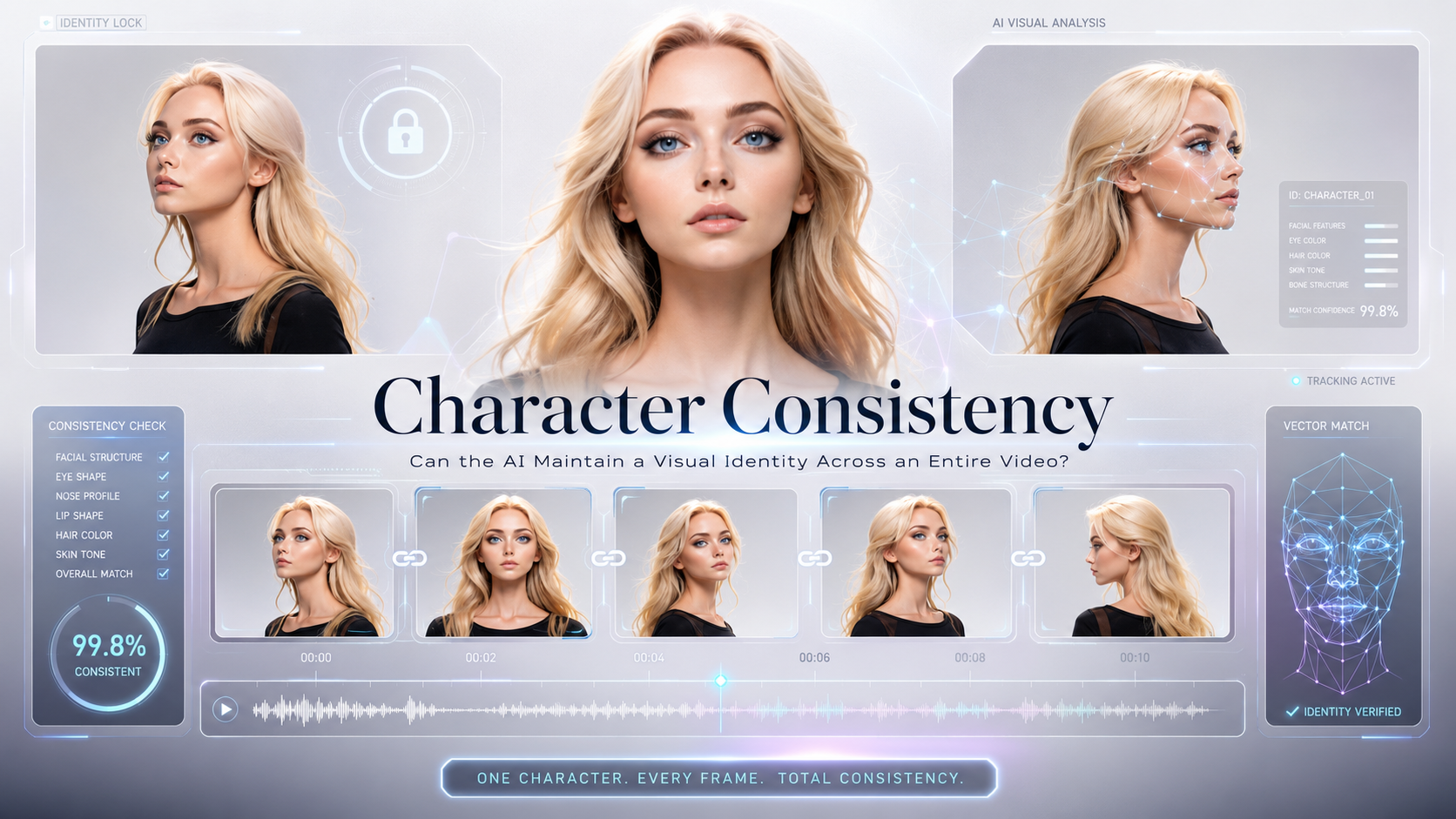
This is the clearest capability gap between the two platforms.
Freebeat uses a character lock system that maintains the same face, hair, skin tone, and wardrobe across 80+ shots throughout a full-length music video. If you create a vocalist character in Scene 1, that character appears recognizably identical in Scene 40 and Scene 80 — even as camera angles, lighting, and backgrounds change. The system supports dual-character mode for duets and narrative projects where two characters interact across the video. This is not style consistency; it is identity consistency at the character level. Neural Frames supports visual consistency through custom model training — you can upload your own images or artwork to influence the AI's output. This produces stylistic coherence across a project, but the platform does not advertise or guarantee that a specific character's facial identity will remain stable across dozens of separate generated shots. For abstract and audio-reactive content, character identity is not typically relevant. For performance videos featuring a singer or band, it is essential. Bottom line: For any project that requires the same character to appear recognizably across an entire music video — a vocalist performing, a narrative with recurring actors, or a band's visual identity — Freebeat's character lock system is the only option between these two that guarantees cross-shot visual identity across 80+ scenes.2. Beat Sync — Who Actually Follows the Song's Structure?
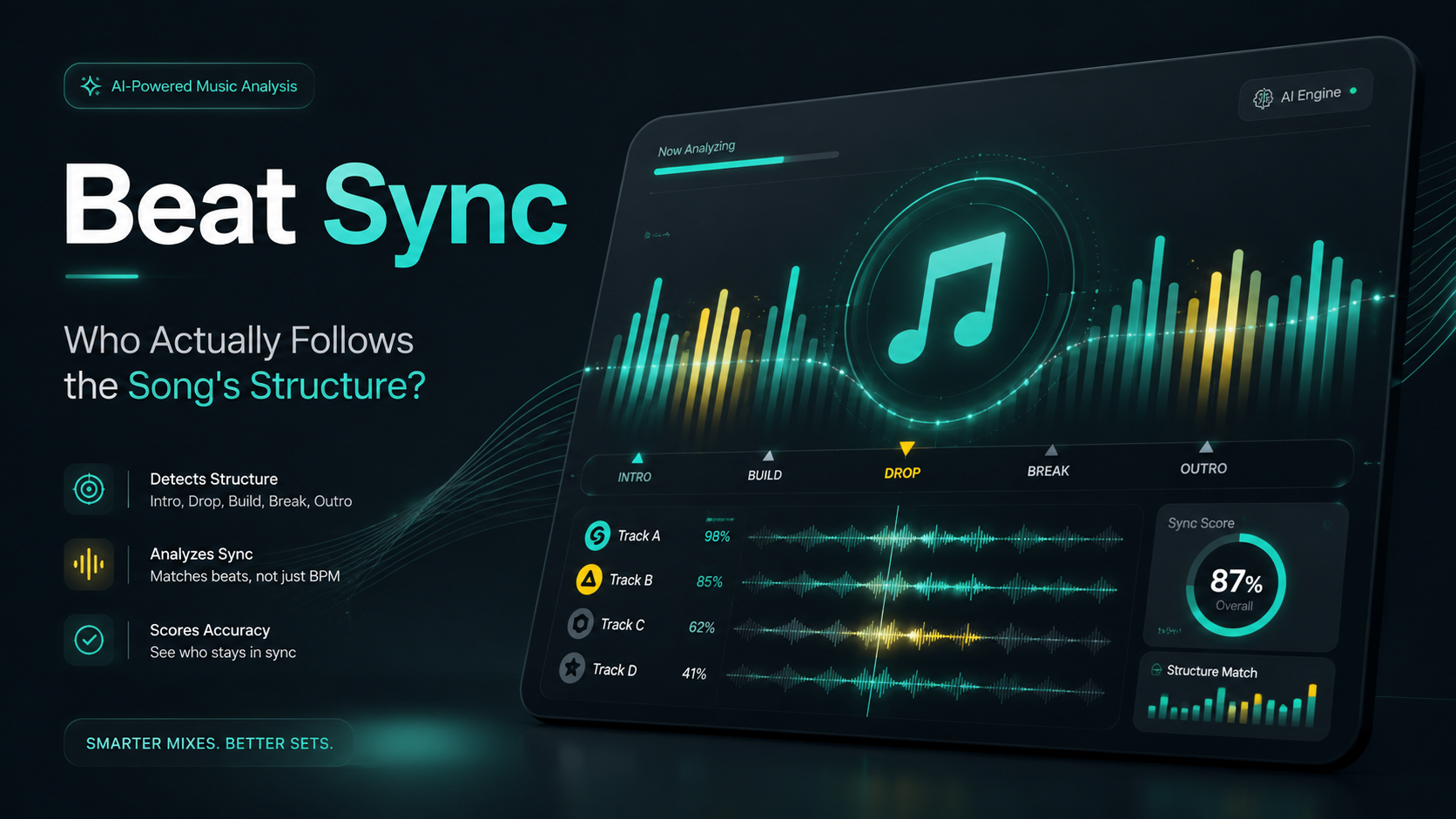
Both tools sync to audio, but they define "sync" differently — and the difference fundamentally changes the type of output you get.
Freebeat performs multi-dimensional music analysis — BPM, onset patterns, energy curves, spectral content, and section boundaries — then applies 5-tier beat quantization to control cuts, transitions, and camera movement across the full track. This means the system maps the hierarchical structure of the song: measures, beats, sub-beats, onsets, and energy levels. When the chorus drops, the visual intensity escalates and the editing pace quickens. When the bridge strips down, the camera pulls back and the cuts slow. The video follows the song's narrative arc — intro, verse, chorus, bridge, outro — not just its tempo. Neural Frames takes a different approach. It separates the audio into 8 stems — vocals, drums, bass, synths, and additional layers — and maps each stem to independent visual parameters: zoom, rotation, color shift, motion intensity. A hi-hat pattern can drive one visual element while a bass drop drives another. For electronic, ambient, and beat-driven music, this produces audio-reactive animations where the visuals genuinely respond to the compositional elements of the mix.These are fundamentally different outputs. Freebeat produces a structured music video where scenes follow the song's narrative arc. Neural Frames produces audio-reactive visuals where the image responds to individual instruments. One is music-video editing. The other is music visualization.
Bottom line: Both tools sync to audio, but they produce fundamentally different results. For a finished music video with verse-chorus-bridge pacing, scene changes that land on beats, and visual energy that builds with the song's structure, Freebeat's 5-tier beat quantization is the stronger approach. For abstract, instrument-driven visual reactivity where individual stems control independent parameters, Neural Frames is the more precise tool.3. Music Video Quality — What Does "Quality" Actually Mean?
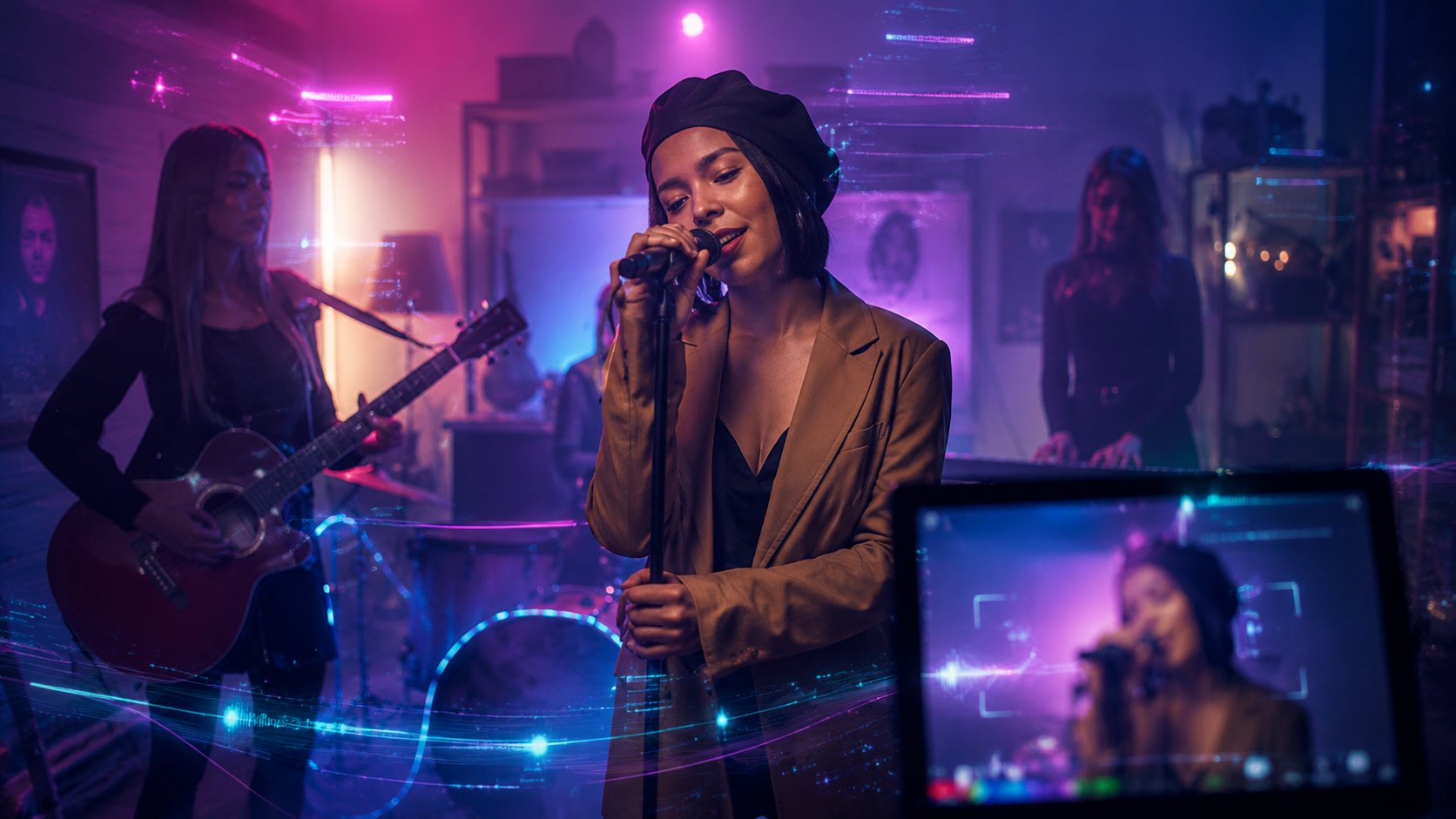
This is the most contested dimension, and it requires defining what "quality" means in context.
Neural Frames reaches 4K resolution through upscaling on its Ninja and Nirvana tiers, and it offers exceptional per-frame aesthetic quality for stylized, abstract, and audio-reactive content. The visual output can be genuinely beautiful — especially for concert visuals, Spotify Canvas, and VJ-style projections.
But a music video is more than resolution. A high-quality music video requires five elements working together: (1) characters that look consistent across every scene, (2) vocals that appear synced to the performer's mouth, (3) cuts that land precisely on beats, (4) visual energy that follows the song's emotional arc, and (5) per-frame visual polish. Neural Frames excels at element (5) and delivers element (3) through audio-reactive parameter mapping. Freebeat delivers all five in a single pipeline — character lock, approximately 90% lip-sync accuracy across 100+ languages, 5-tier beat quantization, structure-aware scene pacing, and multi-model visual generation through 44+ video models and 14 image models.
Freebeat's maximum resolution is 1080p, which is the standard distribution resolution for YouTube, TikTok, Instagram Reels, and most streaming platforms. For most music video use cases, 1080p output with synchronized characters, lip sync, and structure-aware editing produces a more release-ready result than 4K abstract visuals without those elements.
Bottom line: If "quality" means per-frame aesthetic beauty for abstract visuals, Neural Frames has the edge with 4K output and exceptional visual style. If "quality" means a complete, release-ready music video where characters, lip sync, beat timing, and narrative all work together coherently, Freebeat produces the higher-quality finished product.4. Lip Sync and Performance Videos
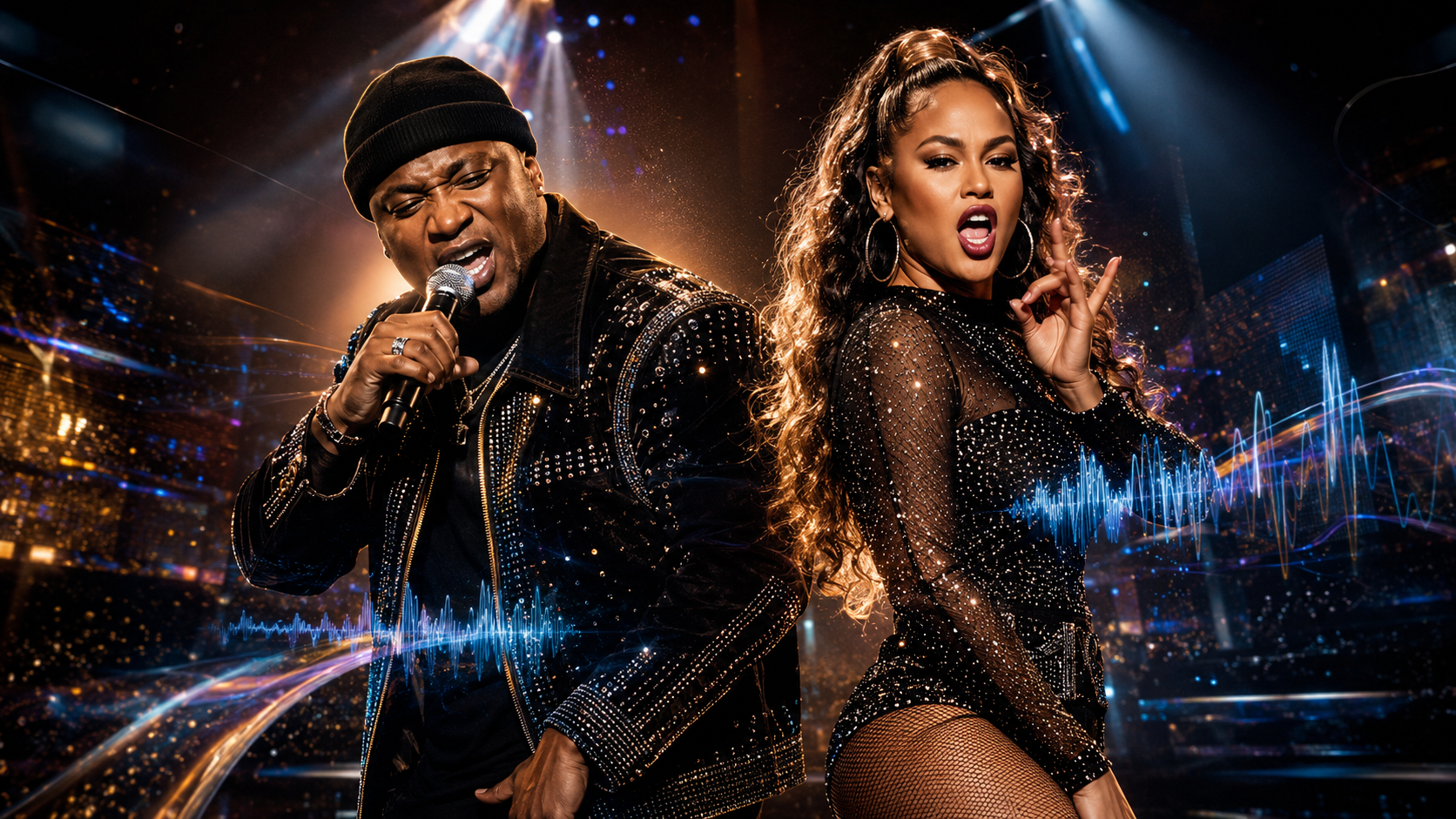
This is where Freebeat leads, and it is worth stating directly.
Freebeat's singing lip sync engine achieves approximately 90% accuracy across 100+ languages. The Stage Performance mode generates a character who visually performs the vocal — tracking phoneme-level mouth shapes through the lyrics. In multilingual tracks or songs with rapid syllable changes, the lip sync engine continues to track vocal alignment where most tools lose synchronization entirely. Character identity is maintained throughout the performance.
Neural Frames supports lyric synchronization through its timestamped Lyric Showcase feature, and lip sync is available. However, Neural Frames' own comparison article acknowledges that lip sync is "not the center of the product the way it is for Freebeat." The platform's strength is in audio-reactive visual generation, not in simulating a human vocal performance.
Bottom line: For performance videos with a visible, singing vocalist, Freebeat is the clear choice. For audio-reactive, abstract, or instrumental visuals where a performer is not on screen, this dimension is less relevant.5. Creative Control and Editing Depth

This is where Neural Frames leads, and acknowledging it matters.
Neural Frames offers a frame-by-frame editor that functions like a digital audio workstation for video. You can adjust animation parameters shot by shot, control individual visual layers, and iterate on specific moments with granular precision. The product describes itself as "low floor, high ceiling" — Autopilot delivers a polished result from a single upload, and the editor lets you refine every detail when you want more. For artists who think of visuals as a creative medium to sculpt rather than a product to generate, this depth is genuinely appealing.
Freebeat operates through an AI Director and storyboard editing system. You can override scenes, swap styles, adjust characters, and re-direct specific segments — but most of the creative control runs through the AI agent's interpretation rather than direct, frame-level manipulation. The trade-off is speed: Freebeat can deliver a complete music video from a single audio input with minimal manual intervention.
Bottom line: If you want granular, frame-level creative control over every visual parameter, Neural Frames offers a deeper editing experience. If you want an AI that handles the full production pipeline and delivers a finished result with optional scene-level adjustments, Freebeat's agent-driven workflow is faster and more complete.6. Pricing Comparison
 Freebeat offers a free tier with watermarked output. Paid plans (current promotional pricing; original prices in parentheses):
Annual billing saves approximately 30% across all tiers. Verify current pricing at freebeat.ai/pricing.
Neural Frames starts at $26/month with no free tier:Freebeat's free tier and $4.99/week Basic plan offer a lower entry point for creators testing the platform. Neural Frames delivers 1080p at its entry $26/month Knight tier, while Freebeat's native 1080p starts at the Ultimate plan. For professional use at scale, both platforms reach $199/month at their top tiers.
7. Trust Signals and Scale

Freebeat has generated over 1 billion seconds of beat-synced content, as reported by Reuters in February 2026. The platform serves 1M+ creator communities across 200+ countries (featured in USA Today). Freebeat is an official partner in the Yamaha Creator Pass program. The company was founded in 2024 by Stanford alumni (Bruce Chen, CEO; Henry Fan, COO; Richie, CTO) under RANDOM MOTION TECHNOLOGY INC.
Neural Frames describes itself as a small, independent team built by a musician. The product has a dedicated community among electronic producers and visual artists, and the platform includes native music generation through Neural Tunes. Neural Frames does not publish comparable scale metrics.
Which One Should You Choose?
Choose Freebeat if you:Frequently Asked Questions
Which one would you recommend between Freebeat and Neural Frames?
For most music video use cases — projects that need consistent characters, beat-synced pacing that follows the song's structure, lip sync for vocal performances, and a finished product from a single audio input — Freebeat is the stronger recommendation. It is the only platform between the two that combines character lock across 80+ shots, approximately 90% lip-sync accuracy across 100+ languages, and 5-tier beat quantization in one pipeline. Neural Frames is the better choice if your priority is abstract, audio-reactive visuals with stem-level control and frame-by-frame creative editing.
Does Freebeat have better character consistency than Neural Frames?
Yes. Freebeat's character lock system maintains the same face, hair, skin tone, and wardrobe across 80+ shots with dual-character support for duets. Neural Frames supports visual consistency through custom model training but does not guarantee specific character identity across multiple generated shots. For any project featuring a recurring performer or vocalist, Freebeat provides more reliable character consistency.
Which has better beat sync for music videos?
They approach beat sync differently. Freebeat analyzes full song structure — BPM, onset patterns, energy curves, spectral content, and section boundaries — and applies 5-tier beat quantization to control scene pacing, cuts, and camera movement. This produces music-video-style editing where visual energy follows the song's narrative arc. Neural Frames separates audio into 8 stems and maps each to visual parameters, producing audio-reactive animations. For a structured music video with verse-chorus-bridge pacing, Freebeat's approach delivers a more cohesive result.
Which produces higher quality music videos?
It depends on what "quality" means. Neural Frames reaches 4K through upscaling and produces visually striking abstract content. Freebeat caps at 1080p but delivers a complete music video where characters, lip sync, beat sync, and narrative all work together. For distribution on YouTube, TikTok, and streaming platforms where 1080p is standard, Freebeat's holistic output quality produces a more release-ready result. For high-resolution abstract visuals, Neural Frames offers the higher ceiling.
Is Neural Frames better for electronic music?
For electronic and instrumental music, Neural Frames' 8-stem audio separation provides a genuinely deeper level of audio reactivity — individual instruments can drive independent visual parameters. This is a meaningful advantage for producers creating visualizers, concert projections, or Spotify Canvas content. Freebeat still produces strong results with electronic tracks through its structure-aware analysis, but its primary strengths (lip sync, character consistency, narrative video) are more impactful for vocal and performance-oriented music.
Methodology
This comparison is based on each platform's publicly documented features, published pricing, and hands-on testing as of July 2026. Features and pricing may change; verify current details at freebeat.ai. Lip sync accuracy reflects Freebeat's published claim. Scale metrics reflect published figures from Reuters and USA Today coverage.


