Facebook Marketing for Bands: Case Study + Ad Results
Contact partnership@freebeat.ai for guest post/link insertion opportunities.
If your band has ever posted a killer clip on Facebook and watched it land with a quiet thud, you’re not alone. Facebook marketing for bands still works—but it rewards structure: consistent content, clean tracking, and ads built around real fan behavior (not hope). The good news is that bands can get meaningful results on small budgets if you treat Facebook like a testing lab and scale what proves itself. This guide breaks down an end-to-end approach, plus a practical case study with ad results you can benchmark.
Why Facebook marketing for bands still matters in 2026
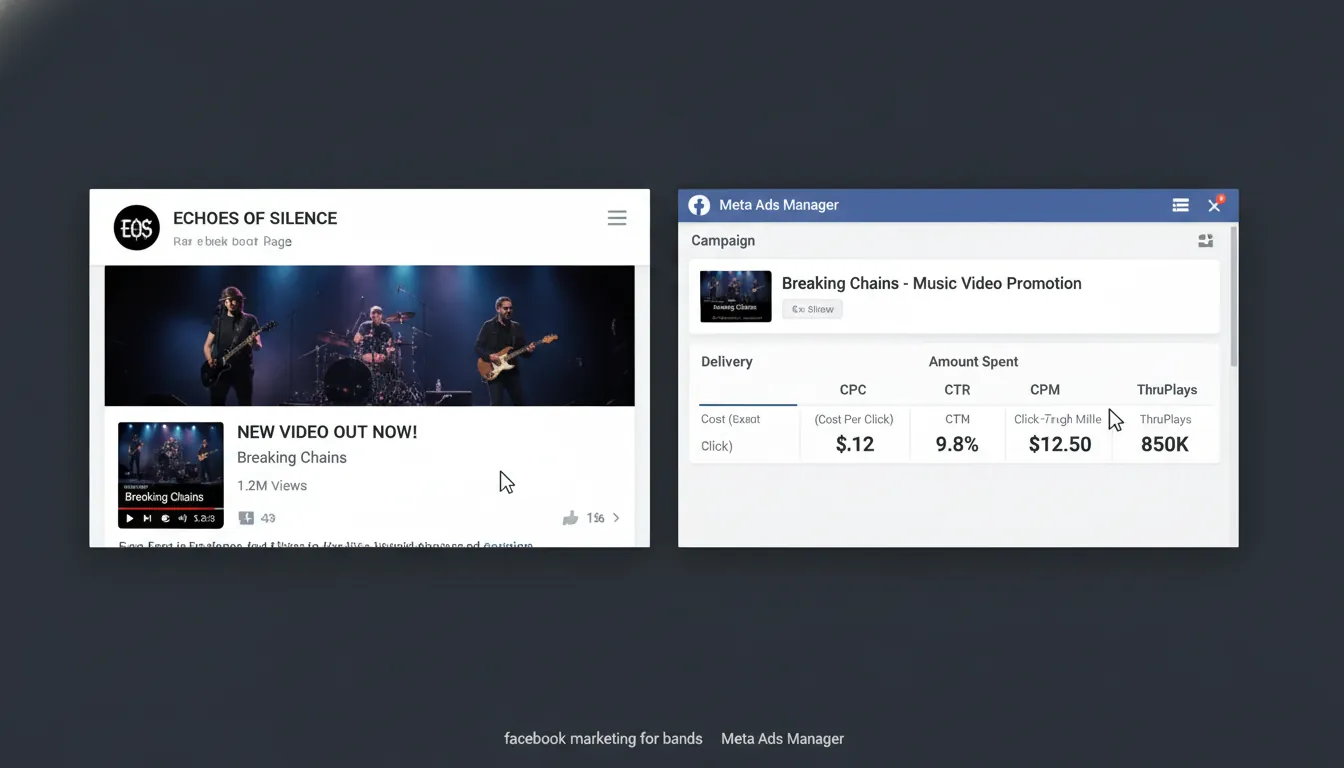
Facebook is not just a “post and pray” platform anymore—it’s a distribution engine with targeting and measurement that most bands can’t replicate elsewhere. I’ve run campaigns where a single strong 15-second performance clip outperformed polished trailers, simply because the hook landed fast and the audience was right. Facebook marketing for bands is also one of the easiest ways to connect organic community building with paid amplification: boost what already earns engagement, then use retargeting to convert interest into streams, ticket clicks, or email signups.
A modern band strategy typically blends:
- Organic: short native videos, behind-the-scenes, event posts, community prompts
- Paid: low-budget testing → creative winners → retargeting → scaling
- Measurement: UTMs + Pixel/Conversions API + a clear “north star” action
For organic reach fundamentals and how platforms weigh engagement signals, see Sprout Social’s organic reach breakdown.
The band funnel that actually matches how fans behave
Most bands skip steps. They run “Listen now” ads to cold audiences and wonder why the cost is high. In practice, Facebook marketing for bands works best as a 3-stage funnel that mirrors trust.
1) Cold discovery (prove you’re worth attention)
Your only job here is to earn the next second of watch time.
- Best assets: rehearsal clips, live moments, strong chorus hook, visually readable lyric moments
- Best KPI: Hook Rate (3-second plays ÷ impressions) and ThruPlays
2) Warm consideration (make it easy to take action)
Now you ask for a click: Spotify smart link, YouTube premiere, Bandsintown event page, or email list.
- Best KPI: Unique Link CTR and landing page conversion rate
- Watch-outs: mismatch between ad promise and landing page reality
3) Retargeting (convert the already-interested)
Retarget video viewers, page engagers, site visitors, and email lists.
- Best KPI: CPA / cost per conversion (tickets, emails, purchases)
- This is where profits usually appear
For how Meta metrics connect (CTR, CPC, CPM, CVR, CPA, ROAS), use Visible Factors’ benchmark explainer.
Case study: 14-day Facebook campaign for an indie band (with ad results)
This is a composite case study based on patterns I’ve personally seen across multiple indie campaigns: one new single, one Facebook Page with steady posting, and a small paid budget focused on learning fast. The band’s goal was measurable traffic to a smart link (Spotify/Apple/YouTube options) plus building retargeting pools for the next release.
Setup
- Budget: $10/day for 14 days ($140)
- Markets tested: US + UK (Tier 1)
- Objective: Traffic (smart link) + Video Views (for retargeting pool)
- Creatives: 3 short videos (12–20 seconds)
- Live performance chorus hook
- Lyric-on-screen “karaoke” style
- Storytelling mini-clip (“what the song is about”)
Results snapshot (what we saw)
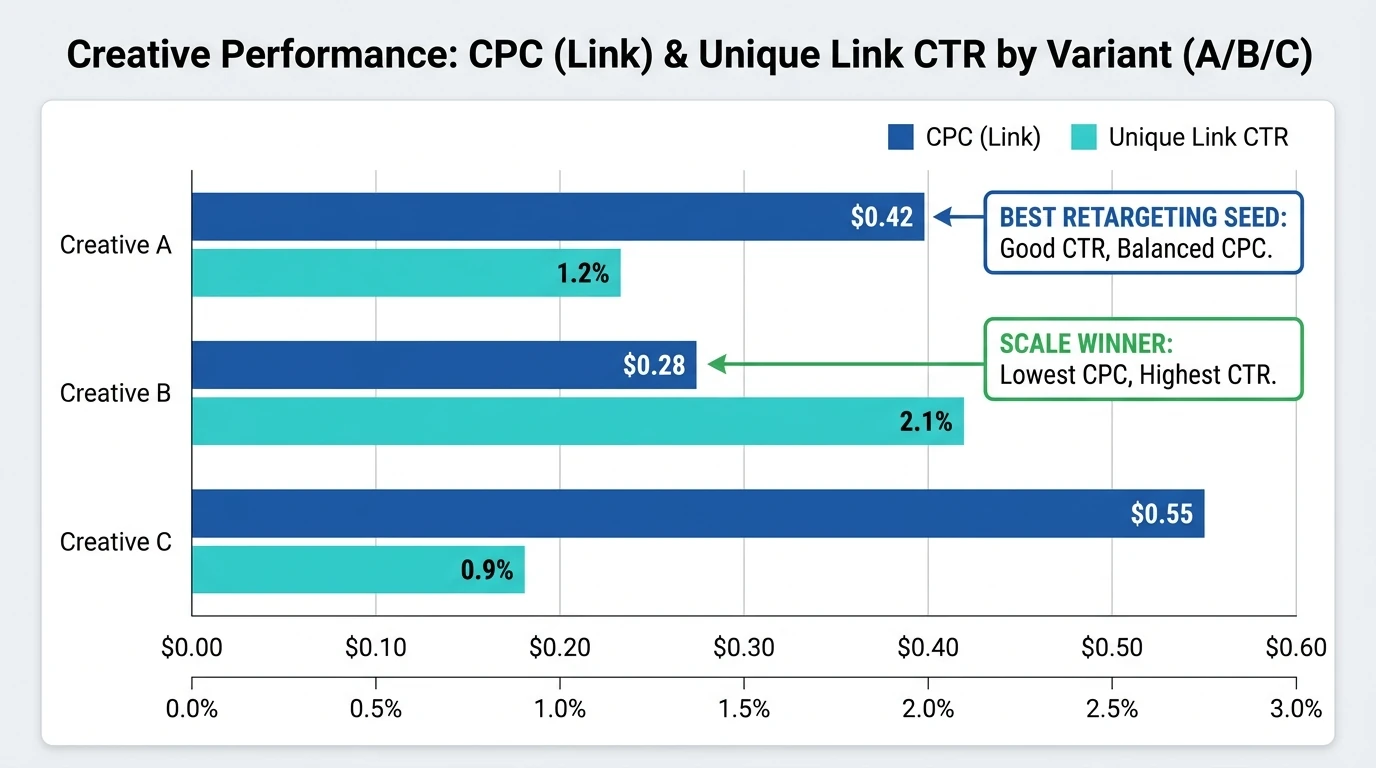
- The lyric-on-screen creative won on CTR (people understood it instantly, even muted).
- The live chorus creative won on watch quality (better ThruPlay rate → great retargeting seed).
- The “what it’s about” clip had warm comments, but weaker cold performance.
Benchmarks for what $5/day and $15/day often produce for independent artists (reach, clicks, CPC expectations) align with Chartmetric-style guidance from Chartlex, which frames $5/day as testing mode and $15/day as a common “sweet spot” for learning.
Ad performance table (what “good” looked like)
Below is a simplified view of the three creatives from this 14-day run. Treat it as directional—your results will vary by genre, geo, and offer—but the pattern (one winner, one retargeting seed, one “meh”) is extremely common in facebook marketing for bands.
How I judged it:
- Hard metrics (CPC, CPA) told me what was worth scaling.
- Soft metrics (Hook Rate, Hold Rate) told me what had potential and where the creative needed tightening.
That split is well summarized in Ciaran Finn’s metric framework on LinkedIn (hard vs. soft metrics) at this post.
What to post (organic) so your ads work better
Ads amplify what you already are. If your Page looks inactive, cold audiences hesitate—even if the song is great. For facebook marketing for bands, I like a simple weekly rhythm that creates signals (engagement, watch time, saves) and gives you ad creatives “for free.”
A simple weekly posting plan (30–45 minutes/day)
- 2 short performance clips (rehearsal, live, studio pass)
- 1 story post (song meaning, band moment, milestone)
- 1 community prompt (vote on merch color, setlist debate, “where should we play next?”)
- 1 proof post (press quote, fan video, playlist add, show photos)
Track core page and post metrics (reach, engagement rate, demographics) using a metrics framework like Sprinklr’s guide so you don’t optimize on vibes.
Ads that work for bands: 3 campaigns to copy
Campaign 1: Video Views (build the warm pool)
This is your cheapest way to find “maybe fans” at scale.
- Creative: 10–20 seconds, chorus early, captions always
- KPI: ThruPlays + cost per ThruPlay
- Outcome: retargeting audience for your next step
Campaign 2: Traffic to smart link (turn attention into listeners)
This is where many bands start too early. It works best after Campaign 1 has identified strong creatives.
- Creative: your best-performing video from Campaign 1 + clear CTA
- KPI: Unique Link CTR + CPC
- Fix if CTR high but results low: landing page speed and message match (often the real problem)
Campaign 3: Retargeting (finish the job)
Retarget:
- 25%–95% video viewers (last 30–365 days)
- Page engagers
- Website visitors (Pixel)
- Email list (if you have one)
This is also the best place to promote:
- ticket links
- merch drops
- pre-saves
- limited-time bundles
Is $10/day enough for Facebook ads for a band?
Sometimes yes—but the math matters. In higher-cost markets (like the US), a $10/day budget can mean you’re only buying a few hundred impressions per day depending on CPM, which slows learning. A 2026 benchmark example shows US CPM around $20, meaning roughly **500 impressions per $10/day** in some scenarios, while lower-CPM markets can deliver several times that volume. See the CPM-by-country benchmarks at Dynamoi’s Meta ads metrics for music campaigns.
How I’d use $10/day in facebook marketing for bands:
- Run 2 ad sets max (don’t split too thin).
- Test 2–3 creatives (your real variable).
- Make decisions every 3–4 days, not every 12 hours.
- Kill anything with clearly weak CTR/CPC relative to your own account baseline.
Targeting: the fastest way to waste money (or find your people)
Broad targeting is improving, but bands still benefit from smart structure—especially early.
Targeting options that work well for bands
- Interest targeting: similar artists, festivals, labels, genres
- Lookalikes: based on video viewers, email list, site visitors
- Geos: cities you can tour, or markets where streaming already shows traction
A practical caution: lookalikes can get huge fast, and quality varies. I’ve had better results when I qualified lookalikes with extra filters (genre/festival/artist interests). That approach is echoed in musician-specific targeting advice like Dave Ruch’s lookalike warning and refinement tips and also aligns with general best practice explanations like WordStream’s overview of lookalike audiences.
Tracking & ROI: what to measure (without lying to yourself)
If you can’t track it, you can’t scale it. For facebook marketing for bands, “ROI” might be ticket revenue, email list growth, or cost per Spotify conversion event via a smart link.
Minimum tracking setup (do this first)
- Add UTM parameters to every ad link (campaign, creative, placement)
- Install Meta Pixel (and ideally Conversions API) on your site/smart link landing pages when possible
- Define 1–2 conversion events you’ll actually use (email signup, ticket click, “listen” click)
Sprout Social notes that attribution can break when APIs change, so you should audit pixels/events/UTMs quarterly: how to measure Facebook marketing ROI. If you’re using Bandsintown for shows, you can also add tracking via their pixel setup documentation: Bandsintown Pro pixel instructions.
Creative: how Freebeat AI helps bands ship more “ad-ready” video
The biggest bottleneck I see is not targeting—it’s creative volume. Facebook marketing for bands improves when you can test multiple hooks, formats, and visuals without spending days editing.
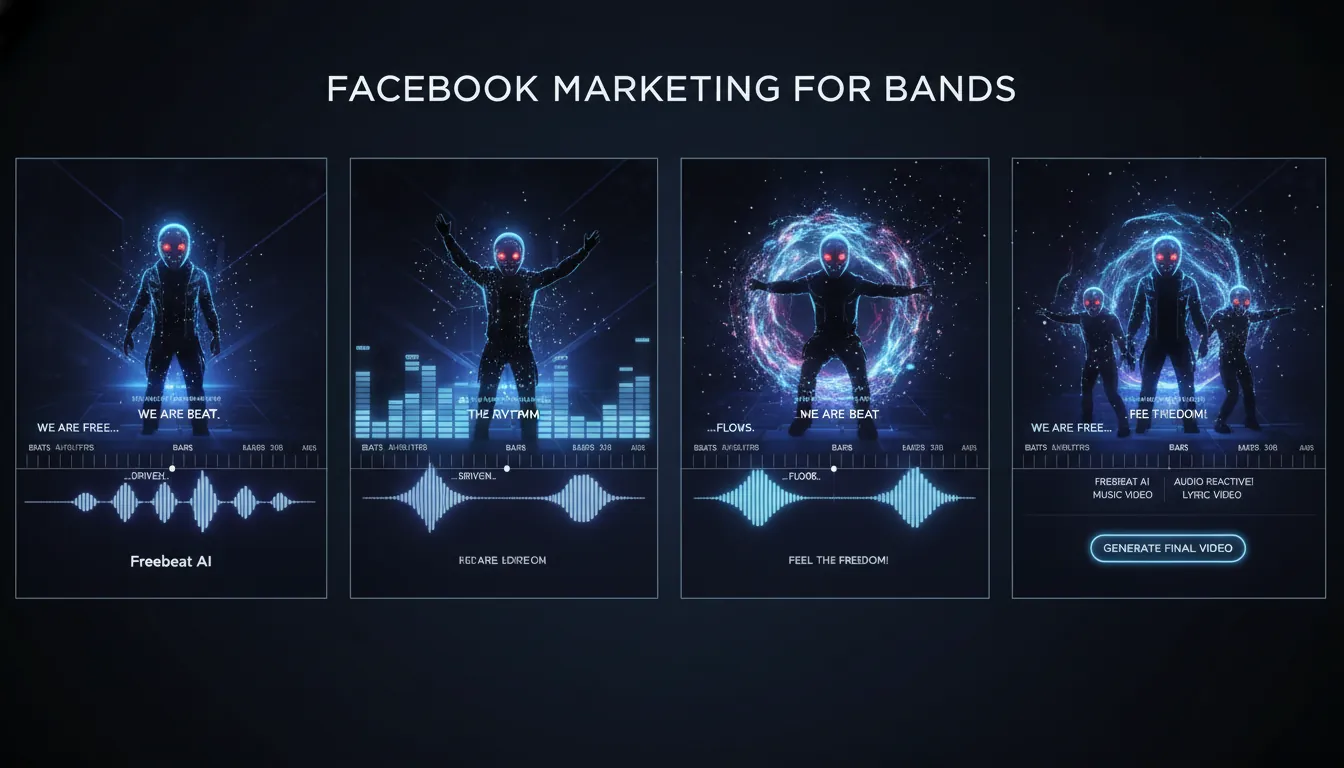
Freebeat AI is purpose-built for music-driven video, which changes the game versus generic text-to-video tools:
- It reacts to BPM, beats, bars, drops, and sections, so cuts and energy shifts feel intentional.
- The AI Music Video Agent plans full videos with director logic (performance shots + B-roll + rhythm transitions).
- You can generate variations fast: storytelling music videos, stage visuals, dance videos, and lyric videos with timed karaoke-style captions.
- Strong character consistency (avatars and reusable visual identities) helps your band look recognizable across releases.
Where I’ve found it most useful is producing:
- 12–20 second hooks for cold ads
- lyric clips that clarify the chorus instantly
- multiple visual styles to match different audience pockets (alt/anime/digital art/realistic)
Instagram and Facebook Ads for Musicians | The ONLY Ads Strategy Guide Artists Need | Ditto Music
Common mistakes that silently kill band campaigns
These issues come up constantly when bands say “Facebook ads don’t work.”
- Same creative too long: if frequency climbs past ~3–4/week, performance often drops; rotate every 7–14 days.
- Asking for too much too soon: cold “stream now” without a warm step first.
- No message match: ad promises one vibe, landing page shows another.
- Over-fragmented budgets: too many ad sets at $10/day total.
- Only tracking vanity metrics: likes feel good; CPC/CPA keeps you alive.
Quick-start checklist (copy/paste)
- Clean up your Facebook Page (recent clips, pinned post, updated bio/links).
- Post 5x/week using the simple rhythm plan.
- Build 6–10 short videos (performance, lyric, story variants).
- Start ads at $5–$15/day:
- Video Views campaign (test creatives)
- Traffic campaign (only with winners)
- Retargeting (after you have viewers/visitors)
- Track UTMs + Pixel; audit monthly.
- Scale only the ad set with the best CPC/CTR trend and stable frequency.
Conclusion: make Facebook your band’s “feedback loop,” not a slot machine
Facebook marketing for bands is most powerful when it becomes your feedback loop: post, learn, test, refine, then scale. I’ve watched bands go from random posting to consistent fan growth simply by treating every clip like a hypothesis—and letting the metrics tell the truth. If you pair that discipline with high-volume, music-synced creative (the kind Freebeat AI is built for), you can keep your visuals fresh without burning out on editing.
📌 behind the magic how creators use freebeat ai to go viral
FAQ: Facebook marketing for bands
1) How do you promote your band on Facebook?
Post consistently (short native videos work well), engage in comments, create Events for shows, and boost your best-performing posts. Combine organic with small-budget ads to test creatives, then retarget engaged viewers.
2) Do Facebook ads work for musicians?
Yes—especially for discovering new listeners and building retargeting audiences. Results improve when you test multiple creatives and track outcomes with UTMs and Pixel events.
3) Is $10 a day enough for Facebook ads?
It can be enough to test, but it may be slow in high-CPM countries. Keep campaigns simple (few ad sets, few variables) and optimize based on CPC/CTR and watch metrics.
4) What is the Facebook “20 rule”?
Many marketers use “20% budget to test, 80% to scale” as a practical rule of thumb. The idea is to reserve consistent spend for experimentation while putting most budget behind proven winners.
5) What is the 80/20 rule for musicians?
Typically: 20% of songs/content/ads drive 80% of results. Your job is to find that top 20% via testing, then build campaigns around it.
6) How much do Facebook ads cost per 1,000 views (CPM)?
CPM varies by country, season, and placements. Tier 1 markets often cost more; costs can spike in Q4 and ease in January. Use CPM plus CTR/CPC to understand whether your issue is reach volume or creative performance.
7) What should bands track in Meta Ads Manager?
At minimum: CPM, Unique Link CTR, CPC, and a conversion action (email signups, ticket clicks, smart-link events). Add hook/hold metrics for video creatives so you know why performance changes.


