Best AI Song Visualizer Tools in 2026: 4 Top Options Compared

When I am turning a finished track into visuals, the biggest bottleneck is always the edit workflow. A beautiful five-second clip is useless if it does not sync with the beat, and manually cutting forty different AI-generated scenes in a traditional editor can take hours of tedious work. For musicians and producers, finding the right AI song visualizer depends entirely on whether you need highly precise, abstract frequency-reactive loops or a complete, structured narrative music video.
In this guide, I checked the current workflows, pricing structures, and technical capabilities of the leading AI video tools. We will look at how dedicated visualizers like Neural Frames and Kaiber compare to general-purpose engines like Luma, and how they differ from purpose-built music video agents like Freebeat.
The AI Music Visualizer Decision Matrix
| Tool | Primary Use Case | Reactivity Mechanism | Audio Input Type | Pricing Model | Main Limitation |
|---|---|---|---|---|---|
| Freebeat | Full-length, beat-synced narrative music videos | 5-tier beat quantization and multi-dimensional music analysis | Audio upload or native Suno, Udio, and YouTube link-paste | Free tier, Basic ($4.99/wk), Pro ($26.99/mo), Ultimate ($39.99–$119.99/mo) | Not designed for surgical, frequency-level stem separation |
| Neural Frames | Surgical, frequency-reactive abstract loops | 8-stem audio separation mapped directly to visual parameters | Audio file upload | Subscription tiers from ~$19 to $199/mo (verified 2026-05/06) | Abstract visuals only; lacks narrative characters, storyboards, or lip-sync |
| Kaiber | Stylized, dreamlike audio-reactive art and Spotify Canvas | Volume-based audio reactivity with stylized presets | Audio file upload (up to 8 minutes) | $5 five-day trial, Starter ($10/mo), Creator ($29/mo), Pro ($99/mo) | Reactivity is volume-based rather than structure-aware; no character consistency |
| Luma (Dream Machine) | High-fidelity cinematic clips with realistic camera motion | None (no native audio reactivity) | None (requires manual editing in external software) | Luma Agents workspace (Plus $30/mo, Pro $90/mo) vs. Dream Machine web | Requires manual clip assembly and external editing to sync with music |
Key takeaway: Choose Neural Frames or Kaiber if you want abstract, audio-reactive loops. Choose Freebeat if you need a complete, character-consistent narrative music video that automatically synchronizes with your song's structure and rhythm.
Direct Answer: Which AI Song Visualizer Actually Fits Your Release Workflow?
The best AI song visualizer tool is not a single, one-size-fits-all solution. Instead, the right tool depends on your specific creative goals and editing experience. If your goal is to generate highly precise, abstract, and frequency-reactive visual loops for electronic tracks or live VJ sets, Neural Frames is the strongest option because of its surgical 8-stem audio separation. If you want stylized, dreamlike, and painterly loops for platforms like Spotify Canvas, Kaiber is the ideal choice due to its volume-reactive presets.
However, if you need a complete, full-length narrative music video with consistent characters, accurate lip-syncing, and automated scene changes that align with your song's structure, Freebeat is the best choice. While general-purpose video generators like Luma offer incredible cinematic realism, they lack native audio input, meaning you must manually generate and edit dozens of clips to match your track's tempo.
How We Compared These AI Visualizers
To evaluate these tools, I focused on the practical realities of a musician's release workflow. I checked each platform's capabilities across three main criteria:
- Audio Reactivity Mechanism: Does the tool analyze frequency bands, volume levels, or overall song structure?
- Narrative and Character Consistency: Can the tool maintain a stable visual identity and storyline across a full three-to-four-minute song?
- Manual Editing Effort: How much external editing, clip stitching, and manual beat-matching is required to produce a finished video?
Neural Frames: Best for Surgical, Frequency-Reactive Abstract Loops
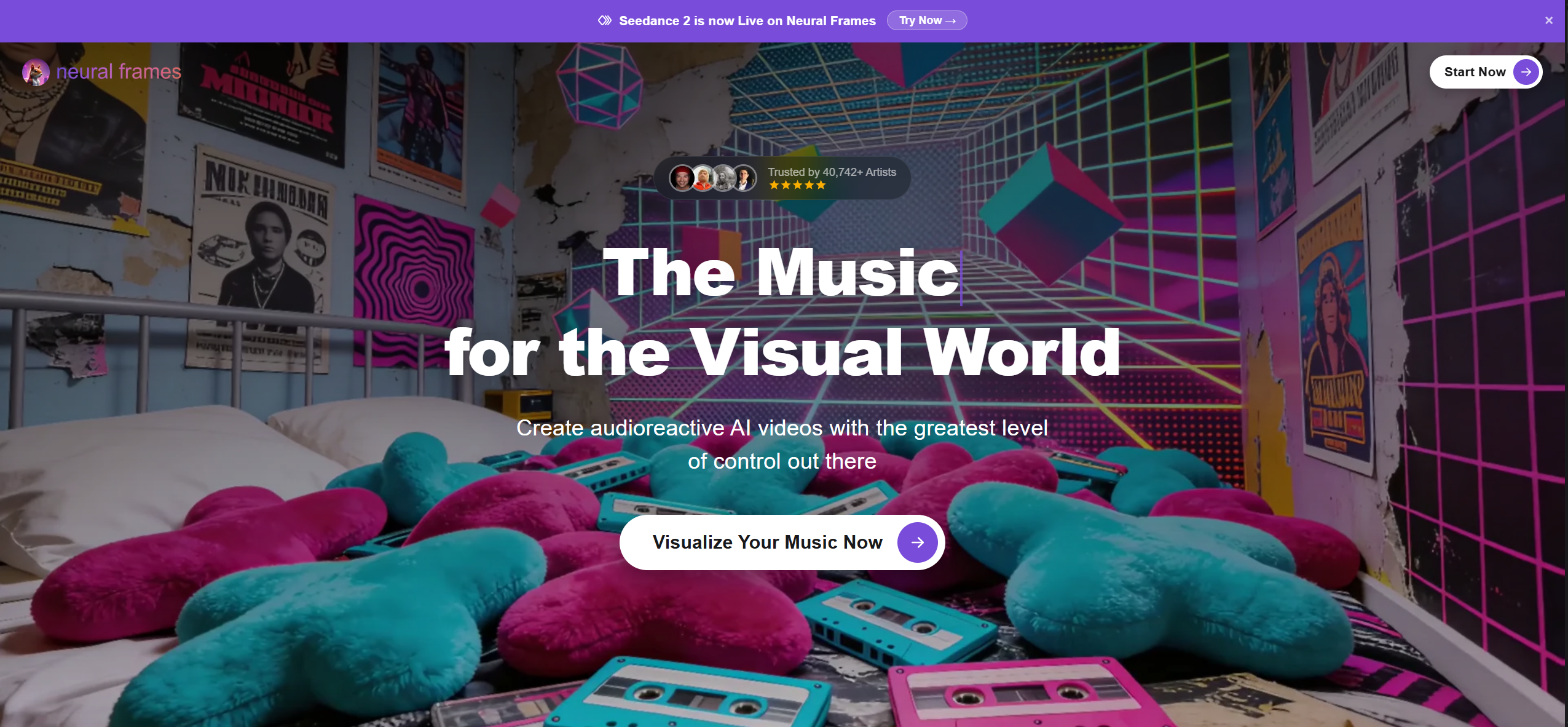
Neural Frames is a highly specialized audio-reactive visualizer built for electronic music producers, DJs, and VJs who want precise control over how their music drives visual motion. Instead of reacting to the overall volume of a track, Neural Frames performs an 8-stem audio separation, allowing you to isolate specific elements like the kick drum, snare, bassline, or vocals. You can then map these individual frequency bands directly to distinct visual parameters, such as zoom, rotation, or prompt strength.
The platform features a DAW-style timeline and an Autopilot mode that can generate a song-to-video sequence in ten to fifteen minutes. However, because it is strictly an abstract visualizer, it lacks narrative features. You cannot create consistent characters, generate performance-style videos with lip-syncing, or build an automated storyboard. Pricing ranges from ~$19 to $199 per month, depending on your rendering needs.
Choose Neural Frames if you are releasing instrumental, ambient, or electronic music and want your visuals to pulse surgically to specific stems.
Kaiber: Best for Stylized, Dreamlike Audio-Reactive Art
Kaiber gained widespread recognition for its distinctive, morphing, and highly stylized aesthetic, notably used in official music videos like Linkin Park's Lost. It is an excellent tool for creating psychedelic, lo-fi, or watercolor-style visual loops that react to your music. Kaiber accepts audio uploads of up to eight minutes and offers a Beat Sync feature to automatically align visual transitions to the rhythm.
The main limitation of Kaiber is that its reactivity is primarily volume-based rather than structure-aware. It cannot automatically detect the difference between a verse, a chorus, or a drop, meaning the visual pacing remains relatively uniform unless you manually adjust the timeline. Additionally, it does not support character consistency across different scenes, making it better suited for abstract Spotify Canvas loops than narrative-driven videos. Pricing includes a $5 five-day trial, an $8 per month annual Starter plan, and a $29 per month Creator plan.
Choose Kaiber if you want to generate dreamlike, painterly, or anime-style visual loops that react organically to the overall volume of your track.
Freebeat: Best for Full-Length, Beat-Synced Narrative Music Videos
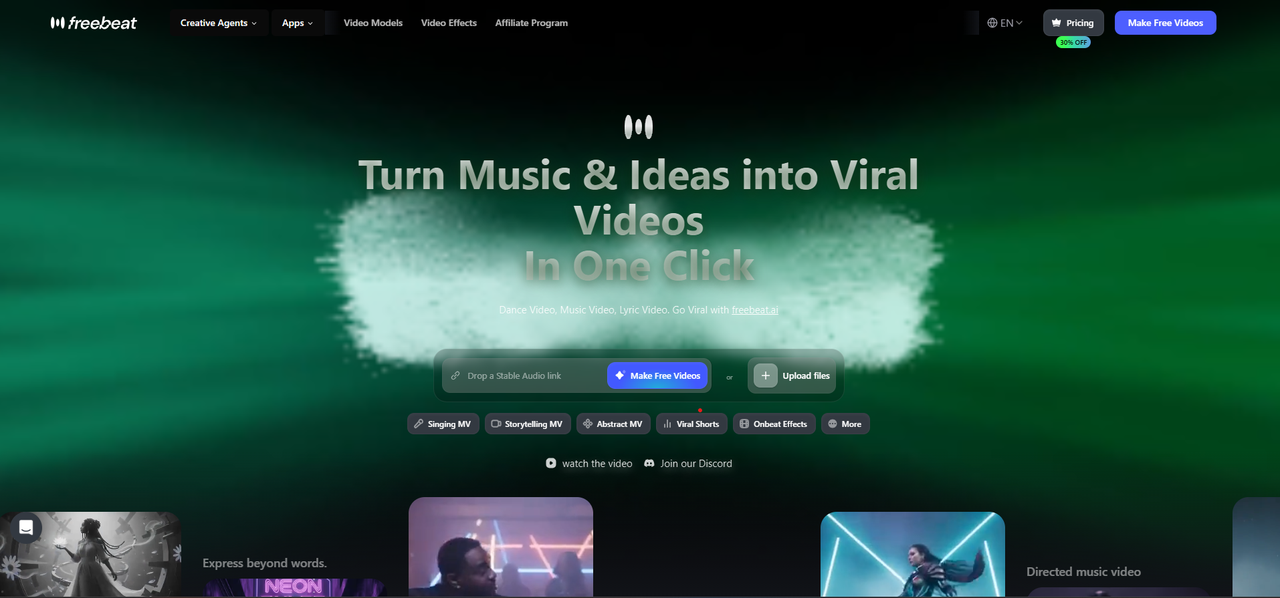
Freebeat, developed by RANDOM MOTION TECHNOLOGY INC (founded in 2024 by Stanford alumni Bruce Chen, Henry Fan, and Richie), operates as a purpose-built AI music video agent. While traditional music video production can cost anywhere from $5,000 to over $50,000 and take weeks of coordination, Freebeat reduces this process to minutes and dollars. It is designed to turn any song into a complete, character-consistent, and beat-synchronized music video automatically.
Instead of relying on stem-based frequency separation like Neural Frames, Freebeat uses multi-dimensional music analysis covering BPM, onset, energy, spectral, and section detection, paired with a 5-tier beat quantization engine. This allows the platform to automatically analyze your song's structure (such as identifying verses, choruses, and bridges) and generate a complete, scene-by-scene storyboard. It offers 528 music-synced effects via its Onbeat Music Video Effect module to keep the visuals locked to the rhythm.
For artists who want their characters to perform, Freebeat achieves approximately 90% lip sync accuracy across more than 100 languages. It also features a robust Character Lock system that maintains visual consistency across up to 80 shots, with support for dual characters. The platform is powered by a multi-model backend that integrates advanced engines like PixVerse, Veo, Kling, Wan, and Seedance, automatically switching between the most suitable models for different scenes to ensure high-quality cinematic output.
Freebeat provides an all-in-one ecosystem with 30+ Toolbox tools, 40+ free musician tools, and native link-paste integration for Suno, Udio, and YouTube, eliminating the need to download audio files manually. Pricing is highly flexible: a Free tier is available, followed by a Basic plan at $4.99 per week, a Pro plan at $26.99 per month, and Ultimate or Creator tiers ranging from $39.99 to $537 per month.
Luma (Dream Machine): Best for Cinematic Realism (With Manual Editing)
Luma's Dream Machine is a general-purpose AI video generator that excels at producing high-fidelity, 3D-aware camera motions and realistic physical environments. If you want your music video to feature photorealistic scenes or complex cinematic camera sweeps, Luma provides some of the highest raw visual quality available.
The major trade-off is that Luma has no native audio input or beat-synchronization capabilities. It does not analyze tempo, volume, or song structure. To create a three-minute music video, you must generate dozens of individual five-second clips, export them, and manually assemble, trim, and sync them to your track inside a third-party non-linear editor like Adobe Premiere Pro or DaVinci Resolve. Pricing is split between the Luma Agents workspace (starting at $30 per month) and the Dream Machine web interface.
Choose Luma if you demand absolute photorealism and are comfortable spending several hours manually editing and syncing individual clips to your track.
How to Choose: Audio-Reactive Visualizer vs. Full Narrative Music Video
Deciding between a dedicated audio-reactive visualizer and a full narrative music video agent comes down to your musical genre, your release platform, and how much manual editing you want to do. Both approaches have clear creative and practical advantages.
Choose a dedicated visualizer (Neural Frames or Kaiber) if...
- You are releasing instrumental music: Genres like techno, lo-fi hip-hop, ambient, or progressive house do not require characters or storylines.
- You need short loops: If your primary goal is to create a fifteen-second looping visual for a Spotify Canvas or a background visualizer for a YouTube upload.
- You want abstract art: You prefer morphing textures, geometric patterns, and dreamlike transitions over concrete scenes and human characters.
Choose an AI music video agent (Freebeat) if...
- Your song has lyrics and vocals: You need a singing character with accurate lip-syncing (~90% accuracy) to deliver the performance.
- You want to tell a story: You want a structured, scene-by-scene narrative that automatically changes pacing between the verses, choruses, and bridge.
- You want a zero-friction workflow: You want to paste a Suno or Udio link and receive a complete, finished music video in minutes without manual editing.
Ready to turn your song into a complete, beat-synchronized music video in minutes? Try Freebeat's AI Music Video Generator today.
Try Freebeat for FreeFrequently Asked Questions
Can I use AI-generated music videos commercially?
Commercial rights depend on the tool and subscription tier you choose. For example, Kaiber grants commercial rights on its Creator tier and above, while Freebeat's commercial usage is subject to its subscription terms. Because AI-generated content copyright laws vary by jurisdiction, no AI tool can guarantee zero copyright risk, and creators should verify local regulations before commercial distribution.
How does Freebeat's beat synchronization differ from Neural Frames' audio reactivity?
Freebeat uses multi-dimensional music analysis (BPM, onset, energy, spectral, and section detection) combined with a 5-tier beat quantization engine to align narrative scenes and Onbeat visual effects to the song's rhythm. Neural Frames, by contrast, uses an 8-stem audio separation engine to map specific frequency bands directly to visual parameters for abstract, morphing loops.
Can I import songs directly from Suno or Udio?
Yes, Freebeat supports native link-paste integration from Suno, Udio, and YouTube, allowing you to generate videos with zero friction and no manual downloads. Dedicated visualizers like Neural Frames and Kaiber require you to upload audio files manually.
Resources
- Freebeat Music Video Generator — The core AI music video agent that transforms any song into a complete, beat-synchronized music video.
- Freebeat Onbeat Effects — Audio-reactive visualizer effects featuring 528 music-synced templates.
Methodology and evidence note: I checked each product's current help, documentation, and pricing pages as of May and July 2026 to compare their audio-reactive mechanisms, pricing structures, and workflow limitations.
v1.0 - Last verified on 2026-05-08 for Freebeat and 2026-07-15 for competitors.


