Updated August 2026 AI music video generation has changed quickly. A decade ago, “automated music video” largely meant software matching existing footage to the pace of a song. By 2023, generative AI could create entirely new visual sequences from prompts. By 2026, a newer group of systems is attempting something more ambitious: analyzing a finished song, planning scenes around its structure, and producing a complete music video rather than a collection of disconnected AI clips. For this 2026 capability benchmark, we compared four distinct approaches to AI music video creation:
- Freebeat — music-first, full-song AI video generation
- Runway — advanced general-purpose generative video
- Rotor Videos — automated music promotion and video editing
- Kaiber — generative visuals with music synchronization
We evaluated each platform for music understanding, beat synchronization, automation, creative control, and suitability for finished music-video production. We also reviewed public Reddit discussions and independent reviews to understand how actual creators describe the experience outside of company marketing. Quick answer: Freebeat is the strongest option in this comparison for creators who already have a finished song—particularly a Suno or Udio track—and want AI to take on more of the complete music-video workflow. Runway is stronger for creators who prioritize individual shot quality and detailed generative control. Rotor remains a straightforward option for fast promotional videos, while Kaiber stands out for experimental, highly stylized music-reactive visuals.
How AI Music Video Generators Got Here
The term AI music video generator now describes products that work in fundamentally different ways. That makes more sense when viewed through the history of the category.
Stage 1: Software Starts Editing to the Music
The earliest version of automated music-video creation was less about generating images and more about eliminating manual editing. Services such as Rotor were already experimenting with automated music-video creation in the mid-2010s. The basic concept was straightforward: upload a song, provide or select footage, and allow software to assemble the material around the music. Rotor’s current system still reflects this lineage. It analyzes a song together with selected clips and automatically edits them into a video paced around the music. This introduced an important idea: A song can become input data for the edit rather than simply audio placed underneath a video. For independent musicians without editing experience, that was already a meaningful reduction in production work. But the visuals themselves generally still had to exist first.
Stage 2: Generative AI Starts Creating the Footage
The breakthrough around 2022–2023 was different. Instead of asking AI only to edit existing footage, generative models began creating entirely new moving images. Runway’s Gen-1, released in February 2023, could use text and images to transform existing video footage. Gen-2 expanded toward generating novel video from combinations of text, images, and video inputs. Musicians adopted these tools almost immediately. In April 2023, for example, a creator posted a music video created entirely with Runway Gen-1 and described learning how different prompts and model settings affected the finished result during production. Kaiber was developing another version of this concept around the same period. Its technology was used in Linkin Park’s 2023 music video for “Lost,” bringing AI-generated imagery into a highly visible mainstream music release. The creative question changed from: “Can software edit my music video?” to: “Can software create the footage for my music video?”
Stage 3: Music and Generative Video Begin to Converge
Generating beautiful clips still did not automatically make those clips feel like a music video. Music has rhythm, transitions, choruses, verses, energy changes, lyrics, emotional arcs, and repeated motifs. A sequence of visually impressive ten-second generations can still feel disconnected from the song. Research began addressing that problem directly. The 2023 Generative Disco project, for example, explored using language models and text-to-video systems to generate music visualizations around musical intervals and transitions, including visual changes timed to beats. By 2025, research into AI-authored music videos was explicitly examining pipelines where software analyzes musical qualities—including emotional and instrumental signals—turns those signals into scene descriptions, and then generates corresponding video segments. Researchers highlighted storytelling, visual coherence, and emotional alignment as central challenges. That research mirrors what commercial products began attempting. Instead of treating AI video generation and music synchronization as separate processes, newer products started combining them.
Stage 4: The Song Becomes the Prompt
The most recent development is the emergence of music-first AI video systems. Freebeat takes this approach further by making the complete song the starting point of the creative process. Its current workflow lets creators upload music or use supported song links, analyzes the material, creates a visual plan, and generates a complete music video that can subsequently be refined. A May 2026 Forbes profile described Freebeat’s approach as fundamentally different from simply making generative-video models faster: the company built its system specifically around music, including real-time music-driven generation. The article traces the startup’s roots to work beginning in 2021 and describes the company as Stanford-founded. This represents an important shift in the role of AI. The workflow is moving from: Generate clip → generate another clip → edit clips → add music → synchronize toward: Upload song → understand song → plan video → generate scenes → synchronize → refine The difference may ultimately prove more important than improvements in raw image quality.
Four Generations of AI Music Video Creation
A useful way to understand the market in 2026 is:
| Development | Primary Job of the AI | Representative Approach |
|---|---|---|
| Automated editing | Match existing footage to music | Rotor Videos |
| Generative video | Create individual visual scenes | Runway |
| Music-reactive generation | Make generated visuals respond to songs | Kaiber |
| Music-first orchestration | Plan and generate around a complete song | Freebeat |
These categories overlap. Runway can obviously be used to create music videos, and Freebeat incorporates generative-video technology. The distinction is where the workflow begins and how much of the production process the system attempts to control.
2026 Capability Benchmark
| Tool | Best For | Music Understanding | Beat Sync | Automation | Creative Control | Full Music Video Workflow |
|---|---|---|---|---|---|---|
| Freebeat | Finished songs, Suno/Udio creators | 5/5 | 5/5 | 5/5 | 4/5 | 5/5 |
| Runway | High-quality custom AI shots | 2/5 | 2/5 | 3/5 | 5/5 | 3/5 |
| Rotor Videos | Fast promotional music content | 4/5 | 4/5 | 5/5 | 3/5 | 4/5 |
| Kaiber | Experimental music-reactive visuals | 4/5 | 4/5 | 3/5 | 5/5 | 4/5 |
Overall benchmark winner: Freebeat These ratings are a capability benchmark, not a laboratory image-quality test. They are based on the current documented workflows of each platform and are intended specifically to answer the question: How well does the product function as an AI music-video creation system? Visual quality is deliberately not scored here because a defensible output-quality benchmark would require controlled generation using identical source material and repeated renders across every platform.
1. Freebeat — Best Overall for Full Song-to-Video Generation
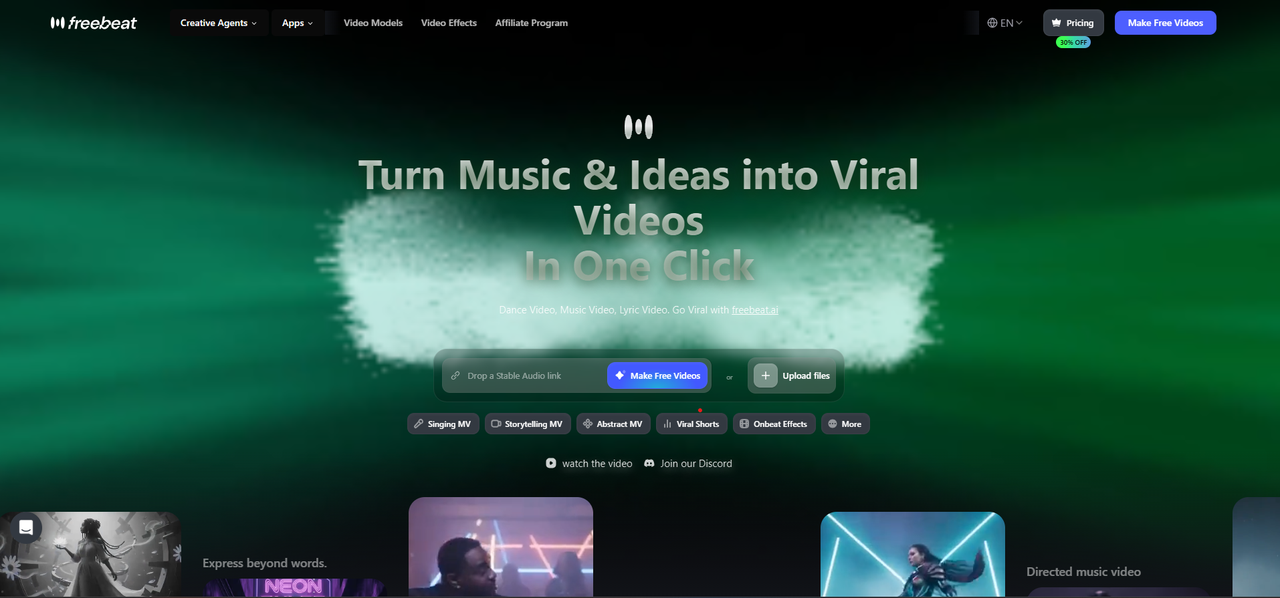
Best for: Suno creators, Udio creators, independent musicians, and creators who want to start with a finished song rather than construct a music video shot by shot. Freebeat’s biggest differentiator is not simply that it generates AI video. It starts with music. The current workflow allows creators to upload a song or paste supported music links, then uses the track as the foundation for creating a full video. Freebeat describes the system as an AI director that plans shots, storylines, synchronization, and the completed music video. That makes the workflow particularly relevant to the rise of generative music. A musician can create a finished track in Suno or Udio and then move directly into the visual stage without first storyboarding dozens of independent AI generations.
Benchmark assessment
Music understanding: 5/5 The song is the primary input into the workflow rather than an element added after the visual generation. Beat synchronization: 5/5 Music-responsive sequencing and synchronization are core product functions. Automation: 5/5 Freebeat attempts to automate not just generation, but planning and assembly of the entire music video. Creative control: 4/5 Creators can review the storyboard, change direction, refine visuals, and regenerate scenes, although creators who want to build every individual shot themselves may prefer a general-purpose tool. Full music-video workflow: 5/5 This is the central product use case.
Best reason to choose Freebeat
Choose Freebeat if the brief is: “Here is my finished song. Build the music video around it.”
2. Runway — Best for Generative Shot Quality and Creative Control
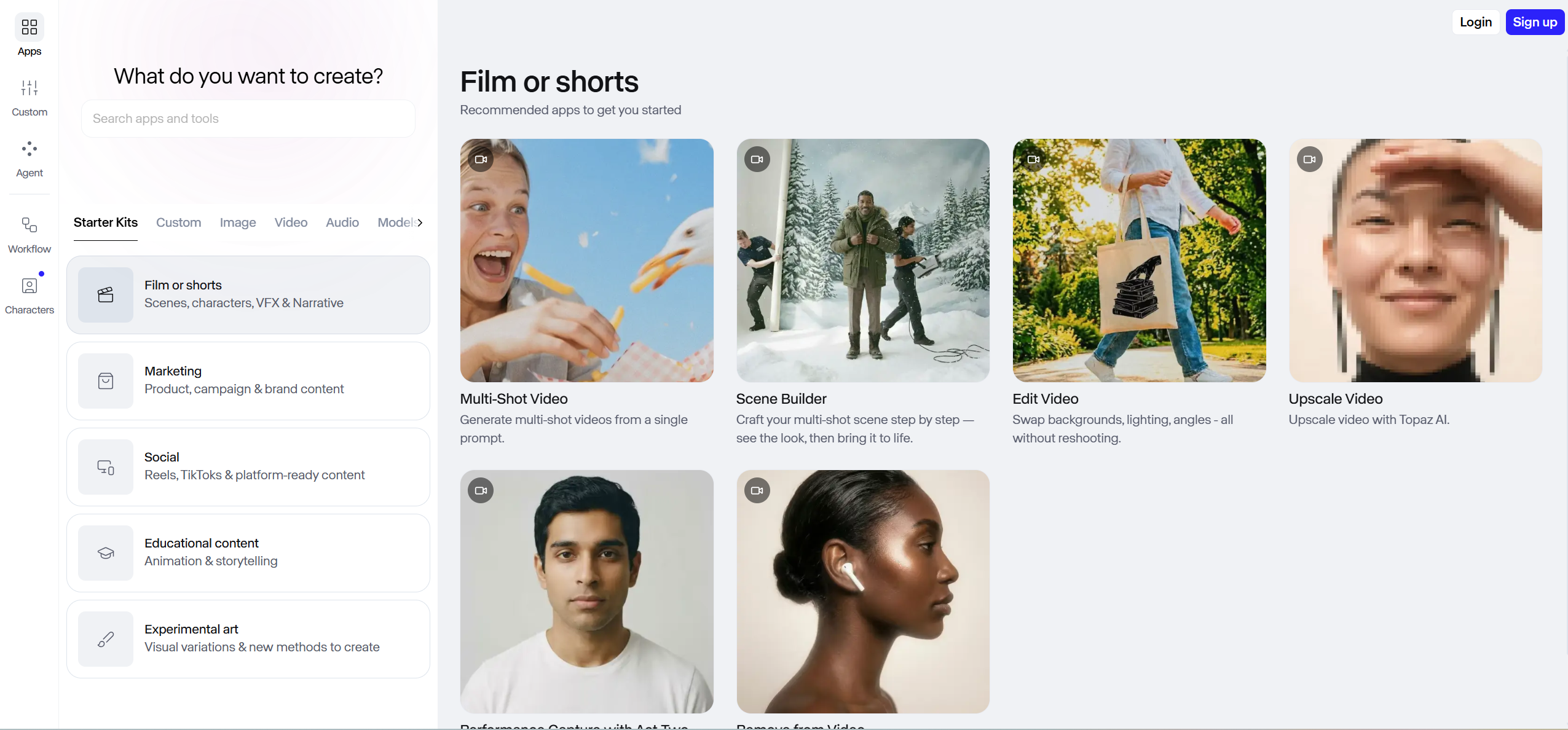
Best for: filmmakers, visual artists, and musicians who want to create highly directed individual scenes and are comfortable assembling a music video themselves. Runway represents a different philosophy. It is not primarily a music-video generator. It is a broad generative-video platform that can be used to produce music videos. That distinction is important. Runway’s video models have developed rapidly from Gen-1 in 2023 through Gen-3, Gen-4, and Gen-4.5. The company says Gen-4 introduced stronger consistency across characters, locations, and objects, while Gen-4.5 improved motion quality, temporal consistency, and prompt adherence. Its current video product explicitly lists music-video clips among the types of content creators can produce. But Runway generally gives the creator the building blocks rather than automatically directing an entire song. That can be a strength. A filmmaker can determine the exact visual treatment for each sequence, generate different shots, control characters and environments, and assemble those outputs into a much more deliberately directed piece.
Benchmark assessment
Music understanding: 2/5 Runway is not primarily built around analyzing a complete song and automatically deriving a music-video structure from it. Beat synchronization: 2/5 Music synchronization typically remains part of the creator’s broader production/editing workflow rather than the central logic behind video generation. Automation: 3/5 Runway automates enormous amounts of video production, but producing an entire music video still generally requires creating and assembling multiple scenes. Creative control: 5/5 This is Runway’s strongest area. Consistent subjects, scene direction, text/image/video conditioning, and advanced generative models give experienced creators substantial visual control. Full music-video workflow: 3/5 Excellent footage can be generated, but the creator remains much closer to the role of director and editor.
Best reason to choose Runway
Choose Runway if the brief is: “I know exactly what shots I want, and I want powerful AI tools to create them.”
3. Rotor Videos — Best for Fast Promotional Music Content

Best for: independent musicians who want usable visual content without learning generative prompting or traditional editing. Rotor’s workflow predates much of the current generative-video wave. Creators upload a song, choose their own material or footage from Rotor’s library, select an editing direction, and allow the software to automatically cut the video around the music. Rotor also supports lyric videos, promotional assets, artwork videos, and shorter content for releases.
Benchmark assessment
Music understanding: 4/5 The music is fundamental to the automatic editing process. Beat synchronization: 4/5 The platform is built around matching visual pacing to a track. Automation: 5/5 Rotor’s primary value proposition remains making video production accessible without editing experience. Creative control: 3/5 The system is easy to operate, but its model offers less generative freedom than Runway or Kaiber. Full music-video workflow: 4/5 It is very effective when the desired output fits Rotor’s promotional, lyric-video, artwork, or stock-footage approach.
Best reason to choose Rotor
Choose Rotor if the brief is: “I need polished promotional video content for my release without becoming a video editor.”
4. Kaiber — Best for Experimental Music-Reactive Visuals
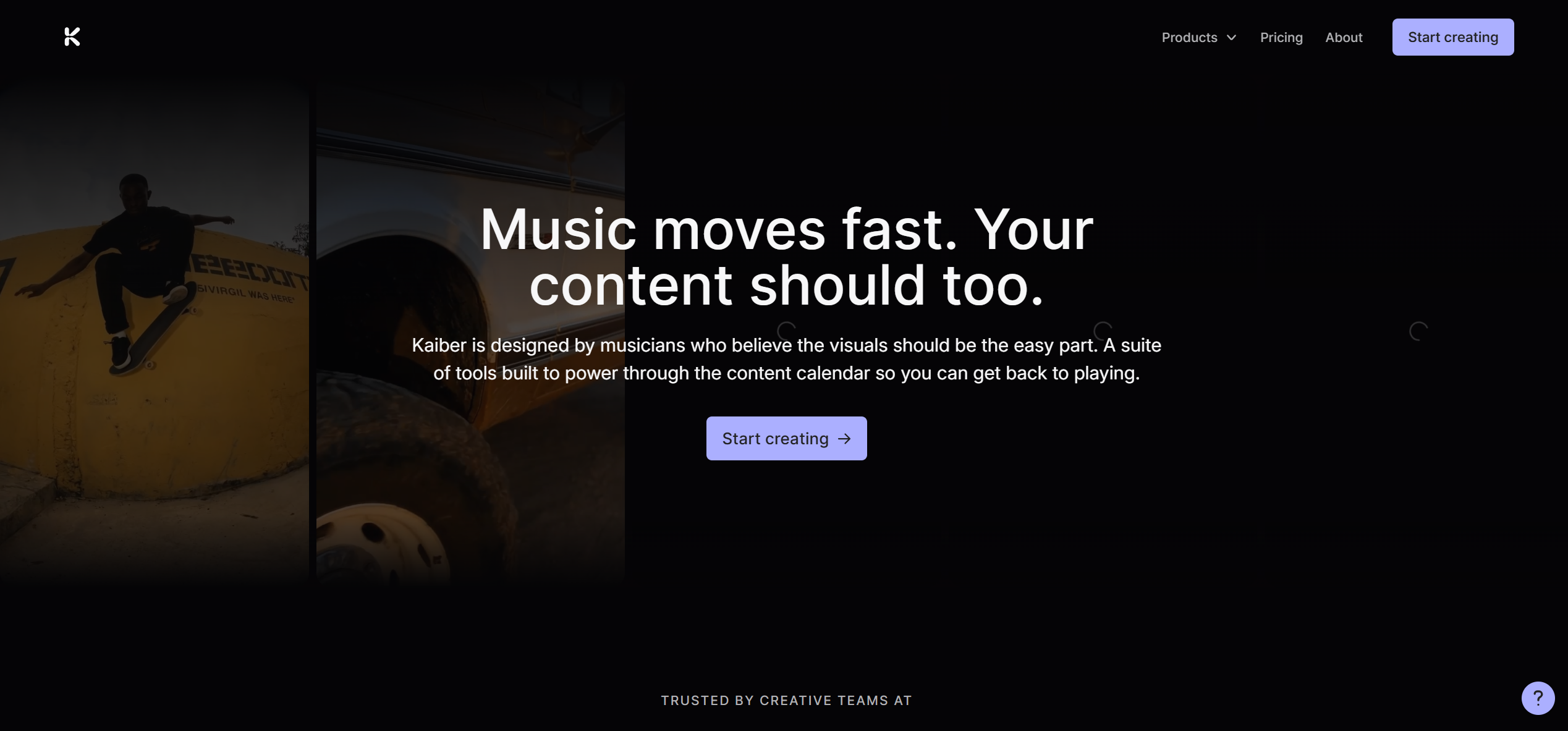
Best for: musicians and visual artists who want stylized generative imagery and stronger hands-on creative experimentation. Kaiber occupies a useful middle ground. Its current platform combines Canvas, Beat Sync, and Editor, allowing creators to produce visuals, synchronize media to music, and then refine the composition. Kaiber explicitly positions itself around music-synced video and says it was built by musicians. Its role in Linkin Park’s “Lost” also gave the platform an early connection to mainstream AI music-video experimentation.
Benchmark assessment
Music understanding: 4/5 Kaiber has a dedicated music-aware workflow, although its broader environment remains highly visual and generative. Beat synchronization: 4/5 Beat Sync is one of the platform’s core differentiators. Automation: 3/5 Creators generally make more visual decisions themselves than they would in a fully automated song-to-video system. Creative control: 5/5 The flexible Canvas environment and access to multiple generative workflows are major strengths. Full music-video workflow: 4/5 Kaiber is particularly compelling for stylized, experimental, and visualizer-like music projects.
Best reason to choose Kaiber
Choose Kaiber if the brief is: “I want the music to drive an experimental visual world that I can actively shape.”
What Do Actual Creators Say?
Product pages tell us what software is designed to do. Creator discussions tell us where those workflows actually feel useful—or frustrating. Public Reddit comments are anecdotal and can never substitute for controlled testing. Accounts can also have undisclosed affiliations or promotional motives. For that reason, the feedback below is treated as qualitative evidence, not proof of product performance. Where possible, we compared those discussions with independent reviews.
Freebeat: Creators Like Getting to a Full First Cut Faster
The most consistent positive theme around Freebeat is workflow compression. In one r/SunoAI discussion, a user creating music videos with Freebeat described the generated clips positively but said producing the video still involved roughly six to seven hours of prompt adjustments and rendering. The creator also mentioned occasional generation crashes. That is a useful reality check. Freebeat can automate large parts of the music-video process, but “automated” does not necessarily mean that creators accept the first generation without changes. Another r/SunoAI discussion contained a user who said they had switched from OpenArt to Freebeat for simpler music videos because they found the workflow more affordable and less frustrating. Participants in that thread also discussed the advantage of generating a complete video and then refining individual scenes instead of manually constructing the whole sequence from the beginning. A separate discussion comparing music-video generators reported mixed results across platforms including Runway, Freebeat, and OpenArt, with the poster describing consistency as an ongoing challenge across the category. Independent review coverage shows a similar tradeoff. A July 2026 MusicSeed review confirmed the ability to turn uploaded songs or supported music links into synchronized videos while also noting reports from some users around failed generations and credit usage. Creator-feedback takeaway: Freebeat’s appeal is less that it eliminates iteration entirely and more that it shifts the starting point from an empty timeline to an AI-generated first cut of the complete music video.
Runway: Creators Praise the Visual Possibilities but Still Do Real Production Work
Runway has a long history of creator experimentation with music videos. As early as April 2023, a Runway user posted a full music-video experiment made with Gen-1 and described gradually learning how prompts and settings affected the result during production. Newer creator discussions illustrate how much the visual quality has advanced. A 2024 post combining Suno music with Runway Gen-3 prompted users to comment positively on the coherence of the mixed-media result and ask whether additional upscaling had been used; the creator said the footage came directly from Gen-3. At the same time, Reddit discussions make clear that a polished result is not necessarily effortless. One creator responding to a “music video in two hours” discussion said a previous AI-assisted music video had required roughly 45 hours of work, including running multiple prompts and generations across platforms. Their broader point was that strong AI video still requires creative judgment, logic, iteration, and editing. Another 2026 Reddit comparison summarized Runway’s tradeoff neatly: it can produce very clean individual shots, but longer videos become a process of assembling shorter scenes. Independent reviewers arrive at a similar conclusion. Tom’s Guide praised Runway’s video manipulation, realistic motion, and range of creative tools, framing it as a powerful option for serious video creators rather than a one-purpose automated music-video product. Creator-feedback takeaway: Runway can give musicians exceptional ingredients, but the musician—or editor—still has to cook the meal.
Kaiber: Strong Artistic Identity, but Results Can Be Unpredictable
Kaiber appears frequently in music-focused AI discussions because of its distinctive visual style. One Reddit creator described Kaiber as particularly good at creating an entire highly stylized music video in one workflow, while also emphasizing that prompting requires trial and error. When the model works, the user said, the result can be highly effective; the aesthetic was characterized as notably “trippy.” Another creator posted that making a music video for their own song with Kaiber produced an unexpectedly emotional response to the finished result. The feedback is not universally positive. Another Reddit discussion described Kaiber as having once been a preferred music-to-video option before changes to the credit requirements made longer videos substantially more expensive for that particular user. An independent 2026 review similarly presents Kaiber as particularly useful for music clips, synchronized animation, and artistic AI visuals while emphasizing its node-based, multi-model workflow rather than positioning it as an automatic one-click music-video maker. Creator-feedback takeaway: Kaiber is attractive when visual experimentation is part of the creative process itself; it is less compelling for someone whose top priority is predictable automation.
Rotor Videos: Simplicity Remains the Main Selling Point
Rotor generates less Reddit discussion than newer generative-video platforms, which itself reflects its somewhat different position in the market. An independent guide from CD Baby described Rotor as an affordable way for musicians to produce videos by uploading a song, choosing footage and an editing style, and letting the platform automatically match the edit to the music. The guide characterized the resulting output as professional-looking without requiring traditional editing. Public discussions also reveal the tradeoff. Some creators appreciate the simplicity, while others describe Rotor as limited when they want greater generative freedom or more complex visual storytelling. Creator-feedback takeaway: Rotor solves a narrower problem than Runway or Freebeat, but that can be an advantage when the creator simply needs release-ready promotional video without a complicated AI production workflow.
What the Creator Feedback Tells Us
Looking across these independent discussions, four recurring patterns appear.
| Platform | Users Most Often Value | Recurring Friction |
|---|---|---|
| Freebeat | Full-song workflow, easier first cut, music-first automation | Iteration, occasional failed generations, credits |
| Runway | Visual quality, shot control, flexibility | Time, scene assembly, generation cost |
| Rotor | Speed, simplicity, no editing expertise required | Less generative freedom |
| Kaiber | Style, experimentation, music-reactive visuals | Trial-and-error prompting, credits, predictability |
The important point is that there is not one definition of “easy.” Runway makes creating a cinematic shot easier. Rotor makes editing stock footage to music easier. Kaiber makes experimental music-reactive visuals easier. Freebeat attempts to make creating the entire music video easier.
Three Findings From the 2026 Benchmark
Finding 1: AI Music Video Generation Is Becoming Its Own Product Category
A few years ago, musicians largely adapted general AI image and video tools to music-video production. That is changing. Research and commercial products are increasingly treating music-to-video creation as a multimodal problem involving musical structure, visual coherence, narrative, timing, and synchronization. That suggests the future leader in this category may not simply be whichever company has the best text-to-video model. It may be whichever system best orchestrates multiple models around music.
Finding 2: The Competitive Advantage Is Moving Above the Video Model
Runway’s rapid progress illustrates how quickly raw video models improve. Gen-4.5 itself followed Gen-4 within the same year and improved motion, prompt adherence, and temporal consistency. That makes access to high-quality generation increasingly less unique. The emerging differentiation is the intelligence wrapped around those models:
- analyzing the song
- determining visual concepts
- planning shots
- maintaining characters
- deciding where cuts occur
- synchronizing to rhythm
- incorporating lyrics
- regenerating weak scenes
- assembling the final output
This is why a specialized music-video system can compete with a much larger general-purpose video platform.
Finding 3: “One Click” Does Not Mean “No Creative Work”
The most useful insight from creator discussions is that AI has not removed creators from music-video production. It has changed where their effort goes. Instead of spending hours manually masking footage or placing every edit on a timeline, creators may spend that time:
- choosing concepts
- refining prompts
- evaluating generations
- regenerating weak shots
- keeping characters consistent
- selecting the strongest scenes
- adjusting pacing
Runway users describe substantial production work even with advanced AI tools, while Freebeat users still report refining an automatically generated first version. The relevant question is therefore not: “Which platform requires no work?” It is: “Which parts of the creative process do I want the AI to handle?”
Which AI Music Video Generator Should You Choose?
Choose Freebeat if:
You already have a complete song and want AI to analyze it, plan the visual direction, and generate most of the finished music video automatically. Best fit: Suno creators, Udio creators, independent musicians, and high-volume content creators.
Choose Runway if:
You want the highest degree of control over the individual generated scenes and are comfortable directing and assembling the overall video yourself. Best fit: filmmakers, visual artists, experienced AI creators, and ambitious custom productions.
Choose Rotor Videos if:
You need an efficient music-promotion workflow built around existing footage, artwork, lyrics, and release assets. Best fit: independent musicians who value simplicity over generative experimentation.
Choose Kaiber if:
You want music-reactive, artistic visuals and enjoy experimenting with the creative process. Best fit: electronic artists, visual artists, experimental musicians, and visualizer-style projects.
Overall Winner: Freebeat
For the specific question “What is the best AI music video generator for turning a finished song into a complete video?”, Freebeat ranks first in this benchmark. The reason is not that it necessarily generates the best individual AI shot. Runway may be the stronger choice for that. Freebeat ranks first because it addresses more of the music-video workflow itself: song → analysis → creative direction → storyboard → generation → synchronization → finished video. That distinction becomes especially important for the rapidly growing population of creators producing finished music in tools such as Suno and Udio. For them, the bottleneck is no longer necessarily creating the song. It is making the song visible. Creators can explore Freebeat at https://freebeat.ai/.
Frequently Asked Questions
What is an AI music video generator?
An AI music video generator is software that uses artificial intelligence to automate some or all of the process of creating visuals for a song. Depending on the platform, that may include automatic editing, generative video, beat synchronization, song analysis, storyboarding, lip synchronization, or complete music-video assembly.
How have AI music video generators changed?
Early systems primarily automated editing of existing footage. Generative-video models then enabled creators to produce new footage from prompts. More recent music-first systems analyze songs and use musical information to guide the planning and generation of the full video.
Is Runway an AI music video generator?
Runway can create AI footage for music videos and is used by creators for music-video production, but it is a broader generative-video platform rather than a product dedicated primarily to automatically turning complete songs into music videos.
Is Freebeat better than Runway for music videos?
It depends on the workflow. Freebeat is better suited to creators who want to begin with a finished song and automate more of the complete music-video process. Runway offers stronger hands-on control for creators who want to generate and direct individual scenes.
Which AI music video generator works with Suno songs?
Freebeat is specifically designed around finished-song workflows and currently supports music-link and upload workflows relevant to creators using platforms such as Suno and Udio.
Do AI music video generators create an entire video automatically?
Some do. Freebeat and Rotor automate substantial portions of the complete workflow, while Runway is more commonly used to create individual scenes that creators assemble themselves. Even with automated systems, public creator feedback suggests that reviewing, regenerating, and refining scenes remains common.
Are AI-generated music videos actually usable?
Creator examples demonstrate that AI tools can already produce complete music-video projects, but quality and consistency vary by platform, prompt, style, and the amount of human refinement. Public user discussions repeatedly show that strong results still benefit from deliberate creative direction.


