AI EP Release Checklist FAQ: 15 Must-Answer Questions
Contact partnership@freebeat.ai for guest post/link insertion opportunities.
Releasing an EP feels like packing for a trip you’ve never taken: you’re sure you forgot something, but you don’t know what until you’re already at the airport. I’ve shipped enough indie releases (and fixed enough metadata messes after the fact) to tell you the same truth every time: a great EP rollout isn’t louder—it’s sequenced. This AI EP release checklist is built as 15 must-answer questions, so you can confirm the dependencies, avoid distributor delays, and use AI where it helps most (planning, visuals, and content scale).
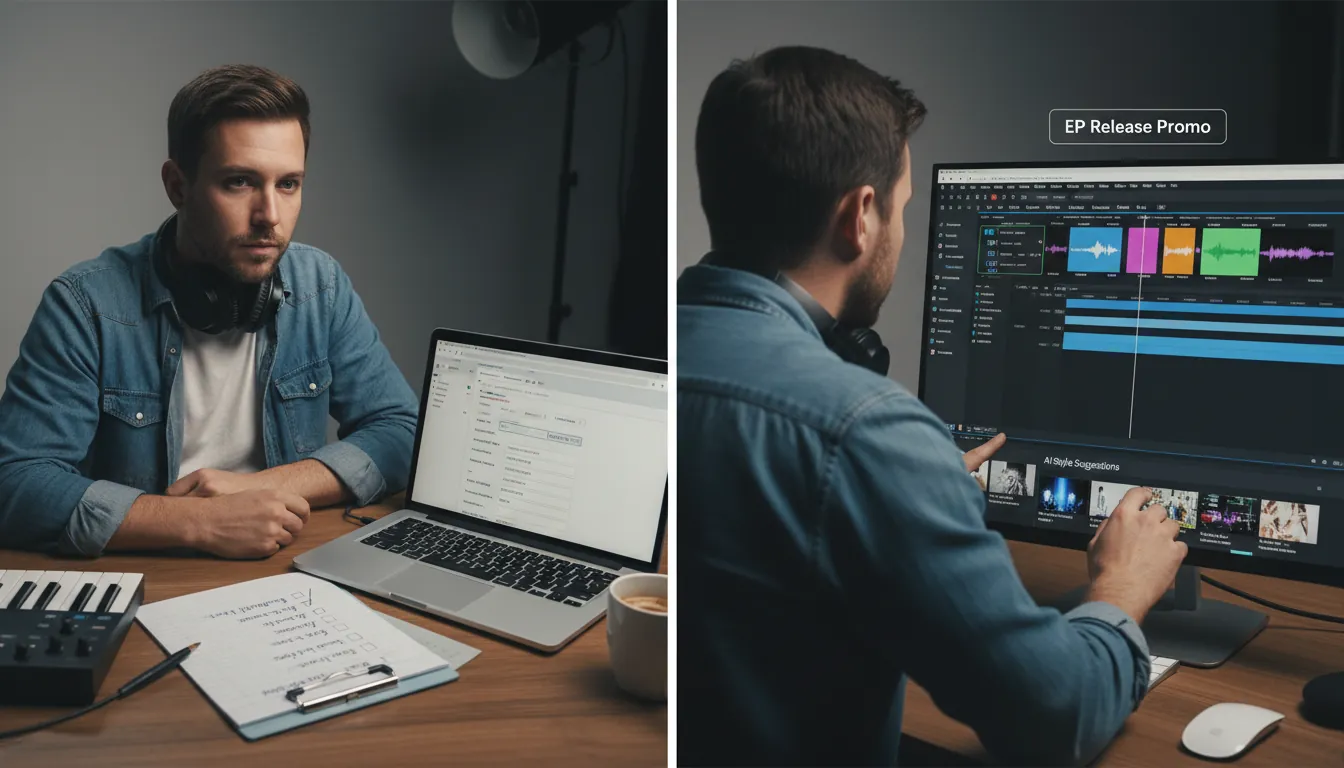
1) What’s your release date—and is it real (or just a hope)?
If you announce a date before your master is uploaded and accepted, you’re gambling with DSP processing times and QC rejections. For an EP, plan 8–12 weeks ahead if you want pitching, pre-saves, and content to breathe. In practice, I lock a “soft date” internally, then publish a “hard date” only after the distributor confirms delivery.
- Aim for Friday releases to align with playlist update cycles.
- Avoid major release pile-ups in your genre when possible.
- Build a backward timeline with fixed owners and deadlines.
Internal resource: use this sequencing mindset from Freebeat’s guide on music release strategy for independent artists.
2) Is your EP package complete (audio, visuals, data) before you upload?
Distributors don’t just deliver audio—they deliver a complete product listing. The most common delays I see: missing credits, wrong artwork specs, and inconsistent titles between masters and upload forms. Treat your release package like a “single source of truth” folder.
Include:
- Final masters (and clean/instrumentals if needed)
- Artwork that meets platform requirements (often 3000×3000)
- Lyrics (for distribution/lyrics partners)
- All credits + splits + identifiers (ISRC/UPC, as applicable)
External reference: Revelator’s breakdown of why metadata is “royalty insurance” is worth bookmarking: Metadata checklist for music distribution.
3) What’s your “AI involvement log” for this EP?
If AI touched your process—lyrics drafts, stem splitting, vocal processing, mastering assistants, or artwork—keep a short written record. Some distributors and platforms may ask what tools were used, and having notes prevents panic later. More importantly, it forces clarity on what’s original, what’s licensed, and what might be risky.
- Document AI tools + features used (1–2 lines per track is enough)
- Confirm you have rights for any training sources/samples you used
- Avoid impersonation/voice-cloning without explicit permission
External reference: practical compliance considerations here: How to legally (and ethically) distribute music made with AI.
4) Have you confirmed ownership, splits, and who collects what?
This is the unsexy step that protects friendships. Publishing (songwriting) and master (recording) royalties flow differently, and incorrect crediting can delay or divert payments. I’ve seen releases stall because one collaborator wouldn’t approve splits after the upload was already queued.
Checklist:
- Signed split sheet (even a simple PDF)
- Writer/composer legal names + PRO info where relevant
- Producer/engineer credits confirmed
5) Are your files compliant (format, loudness, and QC)?
A “great mix” can still fail platform QC if formats or headroom are off. Use your mastering engineer’s delivery specs, and do a last-pass QC listening session on multiple devices (studio monitors, earbuds, phone speaker, car). Catching clicks, clipped transients, or wrong fades now saves weeks.
- Export the exact file type your distributor requests (commonly WAV)
- Verify track starts/ends (no accidental dead air)
- Double-check explicit/clean tagging
External reference: a solid compliance-oriented run-through is here: Release Day Checklist for Indie Artists (Format & QC Guide).
6) Is your metadata “carved in stone” accurate?
Metadata mistakes are the #1 slow-burn failure—your music may release fine, but royalties, discovery, and credits suffer for months. I use a spreadsheet “master sheet” and cross-check it against the distributor portal before submitting.
Core metadata to verify:
- Track titles + version tags (Radio Edit, Instrumental, etc.)
- Primary/featured artists spelled consistently everywhere
- Contributor roles filled (writers, producers, engineers)
- ISRC per track + UPC for the EP (or distributor-generated)
7) Did you upload early enough to pitch playlists properly?
Editorial pitching isn’t a release-day activity; it’s a pre-release activity that depends on the track being delivered into the system. If you want a real shot, upload early—then pitch once your release appears in tools like Spotify for Artists.
- Upload EP at least 3–6 weeks ahead (safer for EPs)
- Pitch your focus track with a clear story + genre fit
- Keep your “priority track” consistent across your messaging
8) What’s your single strategy (and what content ships with each single)?
EPs rarely perform best as a surprise drop. One or two singles ahead of the EP builds algorithmic signals and gives you more chances to earn attention. The trick is attaching supporting content so each single has a reason to exist beyond “it’s out.”
Common single rollout:
- Single #1 (announce EP, open pre-save)
- Single #2 (reinforce story, tease EP tracklist)
- EP drop (largest content burst + community moment)
9) What’s your “visual engine” for the whole rollout?
If you’re making 20–60 short-form posts (which is normal now), you need repeatable visuals that still feel “on brand.” This is where specialized tools matter: Freebeat AI is built for music-driven video, not generic text-to-video. It maps BPM, sections, drops, and bars to camera motion and transitions, which helps your clips feel intentionally edited instead of randomly animated.
Ideas to produce fast (and keep consistent):
- Lyric videos with karaoke timing
- Performance-style visuals
- Story-aware music videos that follow energy changes
- Short cutdowns synced to hooks and drops
Pre-Release Promotion (Without A Fanbase)
10) Have you created the essential EP asset kit (so you’re not scrambling)?
When I’m on a tight schedule, I only trust launches with an “asset kit” folder that anyone on the team can use. Even solo artists benefit: it stops you from reinventing the wheel every post.
Minimum kit:
- Cover art + alternate crops for socials
- 5–10 press photos (1–2 hero images)
- 3 short video loops + 10–20 vertical clips
- One-sheet (short bio, EP story, key links)
- Captions and hashtags aligned to each track’s angle
11) Are your links and landing pages built for conversion (not confusion)?
A pre-save link that loads slowly or looks sketchy costs you follows. Keep it clean: one destination that routes to Spotify/Apple/YouTube, plus an email capture if you have a real plan to email people. Then make sure every social profile points to it.
Do:
- One “smart link” as the default bio link
- UTMs for paid ads so you can measure results
- A clear CTA: pre-save, follow, watch, or buy
12) What’s your release-week posting plan (day-by-day)?
Release week is not one post; it’s a sequence. If you only post “OUT NOW” once, you’re depending on luck. Plan a week where each day has one job: awareness, proof, story, community, conversion.
A simple release-week cadence:
- Day 0 (release day): hero post + link + pinned comment CTA
- Day 1: lyric/hook clip + “how it was made”
- Day 2: fan reaction/UGC prompt
- Day 3: performance clip or live session snippet
- Day 4: track-by-track mini story
- Day 5–7: recap + playlists + next-step CTA (merch/show/email)
13) Are you set up for post-release momentum (week two and beyond)?
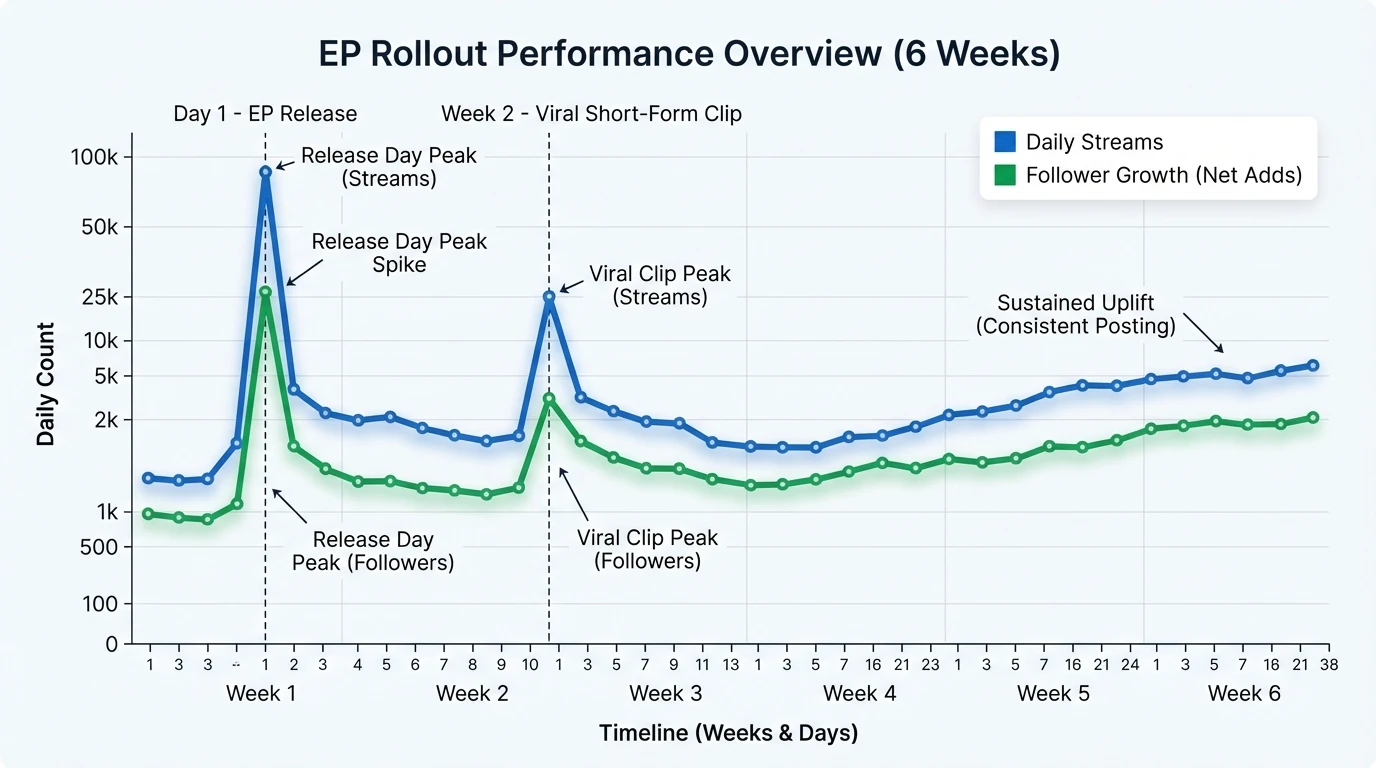
Most artists over-invest in release day and under-invest in week two—exactly when your content system can keep the EP alive. Plan at least 2–4 weeks of follow-up content based on the best-performing moments.
Post-release ideas:
- “Meaning behind the track” series (one per song)
- Remix/stem challenge (only if rights are clean)
- Behind-the-scenes + alternate versions
- Short-form cuts timed to drops (audio-reactive edits win here)
Internal resource: the dependency-first rollout approach is mapped well in Freebeat’s music release strategy for independent artists.
14) What’s your measurement plan (and what counts as a win)?
If you don’t decide what “good” looks like, you’ll feel lost even with decent results. I like a simple scorecard: one metric for audience growth, one for conversions, one for content performance.
Track:
- Followers gained on key DSP + top socials
- Pre-saves and save-rate (where available)
- Stream-to-save ratio and completion signals
- Short-form watch time and shares
- Email signups (if you’re building owned audience)
15) Are you using AI to replace your taste—or to scale your taste?
The best AI-assisted releases still have a human point of view. Use AI for speed, structure, and iteration—then apply your taste as the final filter. In my experience, the winning workflow is: human direction → AI generation → human selection → human polish.
Practical ways AI helps an EP launch:
- Release-plan drafts and content calendars
- Faster visual variants for A/B testing hooks
- Audio-reactive music video generation for consistent pacing
- Caption ideas and multi-platform formatting
Quick-Scan AI EP Release Checklist (Copy/Paste Table)

Conclusion: Your EP deserves a checklist that doesn’t blink
When an EP release goes wrong, it’s rarely because the songs weren’t good—it’s because the system wasn’t ready. Use this AI EP release checklist to lock the dependencies (rights → metadata → distribution → pitching → content), then let AI scale what you already do well: consistent, music-synced visuals and a steady rollout that lasts beyond day one. If you want to turn your EP tracks into story-aware, audio-reactive videos without living in an editing timeline, build your lyric clips and music video cutdowns with Freebeat AI’s music-structure-aware workflow.
📌 ai music generation create lyrics music with freebeat ai 2
Authoritative reads to keep open while you execute:
- Metadata checklist for music distribution
- Distributor Symphonic launches AI-powered release-plan tool
- How to legally (and ethically) distribute music made with AI
FAQ (AI EP Release Checklist)
1) How far in advance should I plan an EP release?
Plan 8–12 weeks ahead if you want time for distribution lead time, playlist pitching, and content creation.
2) What metadata mistakes cause the biggest release problems?
Misspelled artist names, missing contributor credits, wrong ISRC mapping, and inconsistent titles across files and distributor fields.
3) Can I use AI-generated artwork or AI-assisted music and still distribute?
Often yes, but policies vary by distributor and platform. Keep an AI involvement log and confirm licenses and rights.
4) When should I upload my EP to my distributor?
Safest is 3–6+ weeks before release for EPs, especially if you want editorial pitching time and room for QC fixes.
5) What content should I make for an EP rollout?
At minimum: a hero video, lyric/hook clips, behind-the-scenes, and multiple short-form cutdowns synced to key drops.
6) How do I use AI without making my visuals feel generic?
Start with your creative direction (story, style, pacing), generate variants, then curate and polish. Consistency beats randomness.
7) What should I do after release week to keep streams growing?
Push week-two content: highlight different tracks, publish alternate versions, prompt UGC, and double down on the best-performing clips.


