Music Release Strategy for Independent Artists: 30‑Day Plan
Contact partnership@freebeat.ai for guest post/link insertion opportunities.
You’ve got the master back, you’re proud of the hook, and now the scary part hits: how do you turn a song into momentum without a label machine? I’ve been there—posting “OUT NOW” into the void, watching streams spike for a day, then flatline. A real music release strategy for independent artists isn’t louder; it’s sequenced—assets first, distribution next, pitching on time, then content that sustains attention after release week.
This guide gives you a practical 30‑day rollout you can run solo (or with a small team), plus a simple way to plug in Freebeat AI so your visuals stay locked to the music’s energy instead of fighting it.
What “wins” in a modern release (and what doesn’t)
A working music release strategy for independent artists aims for signals that platforms and people respond to, not just vanity metrics. In practice, you’re trying to create enough early engagement—saves, repeat listens, shares, short-form watch time—that algorithms and curators can justify showing your track to more listeners.
What I see consistently outperform “random posting”:
- A dependency chain, not a wish list: you can’t pitch editorial until the track is delivered to DSPs; you can’t deliver without final artwork and metadata. This is echoed in step-by-step planning checklists that treat timelines as operations, not inspiration.
- Pre-saves/pre-adds + day-one velocity: saves are a high-intent action and often correlate with stronger algorithmic lift.
- Editorial + independent playlist outreach: editorial is competitive, but pitching correctly and early is still “non-negotiable” if you want a shot.
- Visual consistency across platforms: your cover, clips, and video language should match the record so people recognize you in 0.5 seconds.
Authoritative planning references worth skimming alongside this guide: LANDR’s music release strategy overview, CD Baby’s DIY Musician release strategy, and AMW’s release strategy breakdown.
The 30‑day timeline (high-level)
Think of the month as four phases:
- Days -30 to -21: Lock + build the foundation (assets, profiles, smart link, EPK-lite)
- Days -20 to -8: Distribute + pitch + pre-save (DSP delivery buffer, editorial submissions)
- Days -7 to -1: Ramp (countdown, collabs, paid tests, short-form batches)
- Day 0 to +7: Launch + sustain (event feel, community activation, retargeting)
Your release toolkit (minimum viable set)
Before the calendar, assemble the essentials. If you only do the “fun” tasks, your campaign will stall when it’s time to pitch or update profiles.
Minimum toolkit:
- Final WAV master + clean instrumental (optional but helpful)
- Cover art in correct specs
- Final metadata (title, featured artists, writers, ISRC if you have it)
- Short artist bio (50–100 words) + 2–3 press photos
- Smart link / landing page (pre-save → out now)
- 8–12 short-form clips (15–30 seconds each) planned from day one
The task-owner rule (don’t skip this)
One reason indie rollouts break is “shared ownership.” Give every task one owner and one due date—even if the “team” is you. This aligns with pro release planning frameworks that treat timelines as dependency chains.
30‑Day Plan: daily actions you can actually follow
Days -30 to -21: Lock the record + set the stage
Your goal is to remove friction later. When you’re a week out, you should be posting, not fixing metadata.
- Lock your master + artwork direction
- Finalize the master and commit to a release date you can support.
- Confirm splits with collaborators and get approvals in writing.
- Update your “storefronts”
- Spotify for Artists + Apple Music for Artists: bio, photos, links, artist pick plan.
- Ensure your branding is consistent across TikTok/IG/YouTube.
- Build an EPK-lite
- One page: bio, photos, private link, release one-liner, contact email.
- If you’re pitching blogs/curators, this saves time and increases trust.
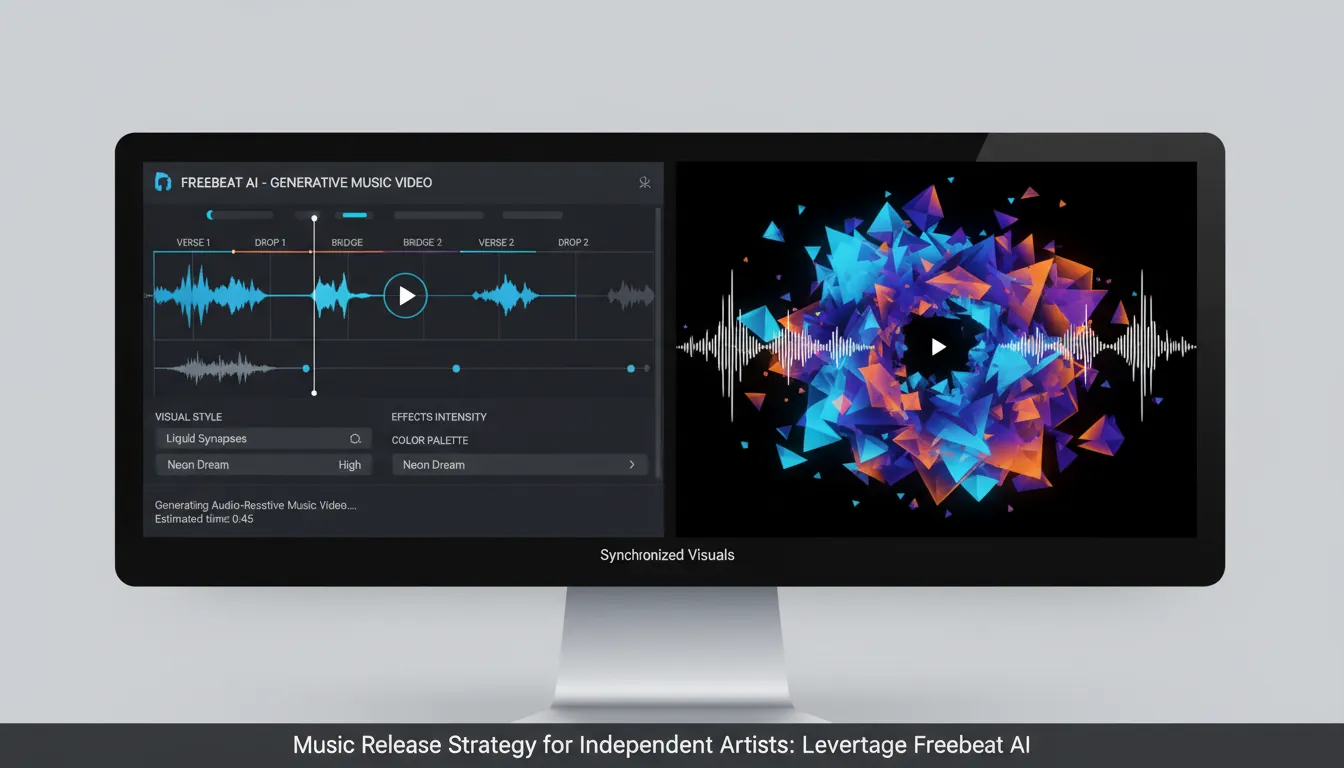
Freebeat AI angle (visual foundation): In my own rollouts, the fastest improvement came when I stopped improvising visuals and created a repeatable “video identity.” Freebeat’s audio-reactive approach makes this easier because transitions and pacing follow BPM, drops, and sections—so your clips feel intentional even when you’re moving fast.
Days -20 to -8: Distribute, then pitch, then pre-save (in that order)
This is the “real business” section of a music release strategy for independent artists.
- Upload to your distributor early
- Aim to deliver at least 3–4 weeks ahead when possible to catch metadata issues and unlock pitching windows.
- Pitch to editorial playlists
- Spotify: submit via Spotify for Artists (earlier submissions tend to be stronger; many guides recommend at least 7 days, with best practice being earlier).
- Apple Music: pitch via Apple Music for Artists; provide clear genre/mood context and any story angle.
- Launch pre-save / pre-add
- Put the smart link in bio everywhere.
- Drive actions through DMs, email list, and pinned posts.
- Build your outreach list
- Independent curators, local press, niche blogs, college radio, creators who fit your sound.
Tip from experience: I used to over-focus on follower growth before release. The better lever was pre-save conversion rate from people who already liked my sound. A small, motivated group often beats a big, cold audience.
Days -7 to -1: Ramp week (make it feel like an event)
Ramp week is where attention is created—if your assets are ready.
Do this:
- Cover art reveal + story hook
- 1 post explaining what the song is about (human story beats generic promo).
- Daily short-form (but batch-made)
- Rotate formats: hook performance, lyric line, behind-the-scenes, “making of,” fan prompt.
- Collab posts
- Producers, featured artists, dancers, visual artists—use collaboration features to share audiences.
- Paid tests (small budget)
- Run 2–3 creative variations to your pre-save page and let them stabilize before changing anything.
The 30 Day Song Release Plan Every Indie Artist Should Follow!
Freebeat AI: plug-and-play visual system for release week
Most indie campaigns fail at consistency: you post one strong clip, then can’t reproduce it. Freebeat AI is built specifically for music-driven visuals—camera motion, transitions, and pacing follow the actual song structure (BPM, beats, bars, drops), which is exactly what you want during release week.
Where it fits best in a 30-day rollout
- Lyric video + karaoke timing: great for saving/sharing, and it doubles as ad creative.
- Short-form performance visuals: stage-style or avatar-led content that stays consistent.
- Story-aware music video agent: produces a complete video plan with director-like logic (performance shots + cinematic B-roll + rhythm transitions), instead of random motion.
Release day (Day 0): the exact checklist
Release day is not “post once and pray.” Treat it like an event with multiple touchpoints.
- Confirm everything is live
- Spotify/Apple/YouTube Music pages correct? Artwork correct? Clean metadata?
- Pin the smart link everywhere
- Bio links, pinned comment, YouTube description, IG highlights.
- Activate your core supporters
- Ask for one action: save + add to a playlist + share to a story.
- Go live (short)
- 10–20 minutes: play the track, tell the story, thank early supporters.
- Post 2–3 assets
- One hook clip, one human context clip, one “official” visual.
Post-release (Days +1 to +7): sustain, don’t disappear
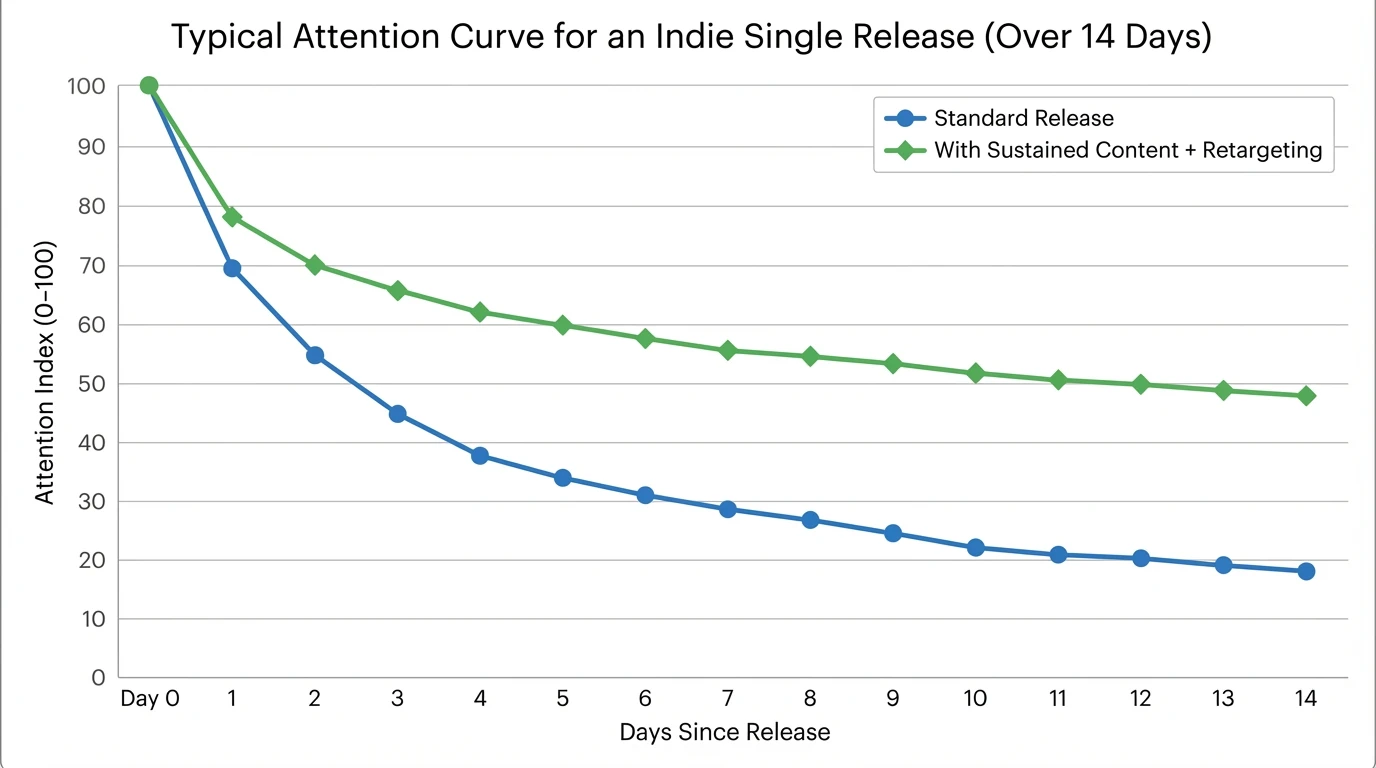
Algorithms cool off quickly, so your job is to keep the song “alive” long enough to earn repeat listens and secondary discovery.
Do these 5 moves:
- Retarget viewers and clickers with an “out now” version of your best-performing clip.
- Publish a second angle: acoustic, remix teaser, live take, or lyric breakdown.
- Pitch user-curated playlists with a short, respectful message and clean links.
- Update your profiles: Artist Pick, Canvas, pinned content, YouTube featured video.
- Turn comments into content: reply-to-comment videos are easy and convert well.
Budget and effort: what to spend (and when)
A common rule in pro release planning is to weight spend around launch and the week after. One suggested split is:
- 50% on day-of-release promotion
- 30% in the first week after release
- 20% across weeks 2–3 to extend the tail
You can do this with a tiny budget by focusing on your top 1–2 creatives and retargeting engaged viewers, not broad cold audiences.
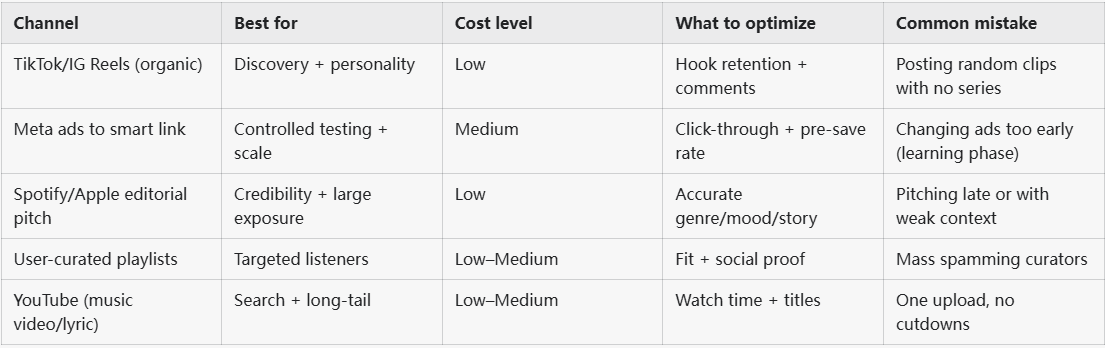
Quick comparison: promo channel choices
Common mistakes I see (and how to avoid them)
- Setting a release date before assets are locked. Fix: lock master + artwork first, then pick the date.
- Uploading to distribution too late. Fix: build buffer time to catch metadata errors and still pitch editorial.
- Treating “content” as one post. Fix: plan a minimum of 8–12 clips per single.
- No clear ask. Fix: every post should ask for one action (pre-save, save, add, share).
- Inconsistent visual identity. Fix: use templates or audio-reactive generation so your clips match the track’s energy.
Conclusion: a release is a system, not a moment
A month from now, you want to feel like your song arrived—not that it briefly appeared. The best music release strategy for independent artists is repeatable: lock the dependencies, distribute early, pitch on time, and use a consistent visual engine to keep attention through week two.
If you want to make release week visuals faster (without losing sync or story), try building your lyric video, short-form cutdowns, and a full music video concept using Freebeat AI’s music-structure-aware generation. Then recycle the best-performing moments into ads and follow-up posts.
📌 ai music generation create lyrics music with freebeat ai 2
FAQ: Music release strategy for independent artists
1) When should independent artists upload to a distributor?
Ideally 3–6 weeks before release so you can fix metadata issues and still have time for editorial pitching and pre-save setup.
2) How early should I pitch Spotify editorial playlists?
Submit through Spotify for Artists as soon as the track is delivered and eligible—earlier is generally better than “just before release.”
3) Are pre-saves actually important?
Yes—pre-saves (and saves) are high-intent signals that can support algorithmic discovery and strong day-one performance.
4) Should I release singles or an EP as an independent artist?
Singles usually give you more “marketing moments.” Many indie artists use a waterfall strategy—multiple singles leading into an EP.
5) What content should I post in the 7 days before release?
Hook clips, lyric moments, behind-the-scenes, a personal story post, and a countdown sequence—ideally batch-created in advance.
6) How do I get on Apple Music playlists as an indie artist?
Claim and optimize your profile, pitch via Apple Music for Artists, and build momentum through user playlists and external buzz that editors can notice.
7) Do I need a music video for every release?
Not necessarily, but you do need compelling visuals. A lyric video plus multiple audio-reactive short clips can outperform one expensive video if posted consistently.


