Songwriter Split Sheet Step-by-Step: Free Template + Example
Contact partnership@freebeat.ai for guest post/link insertion opportunities.
You just finished a great writing session—everyone’s excited, the hook is sticky, and somebody says, “We’ll figure splits out later.” That’s the moment royalties get messy. A songwriter split sheet is the simple, signed document that prevents “I thought it was 50/50” from becoming a real dispute, PRO conflict, or missed sync opportunity. Below is a songwriter split sheet guide step by step with a free template, a filled-in example, and the common edge cases I’ve seen in real sessions.
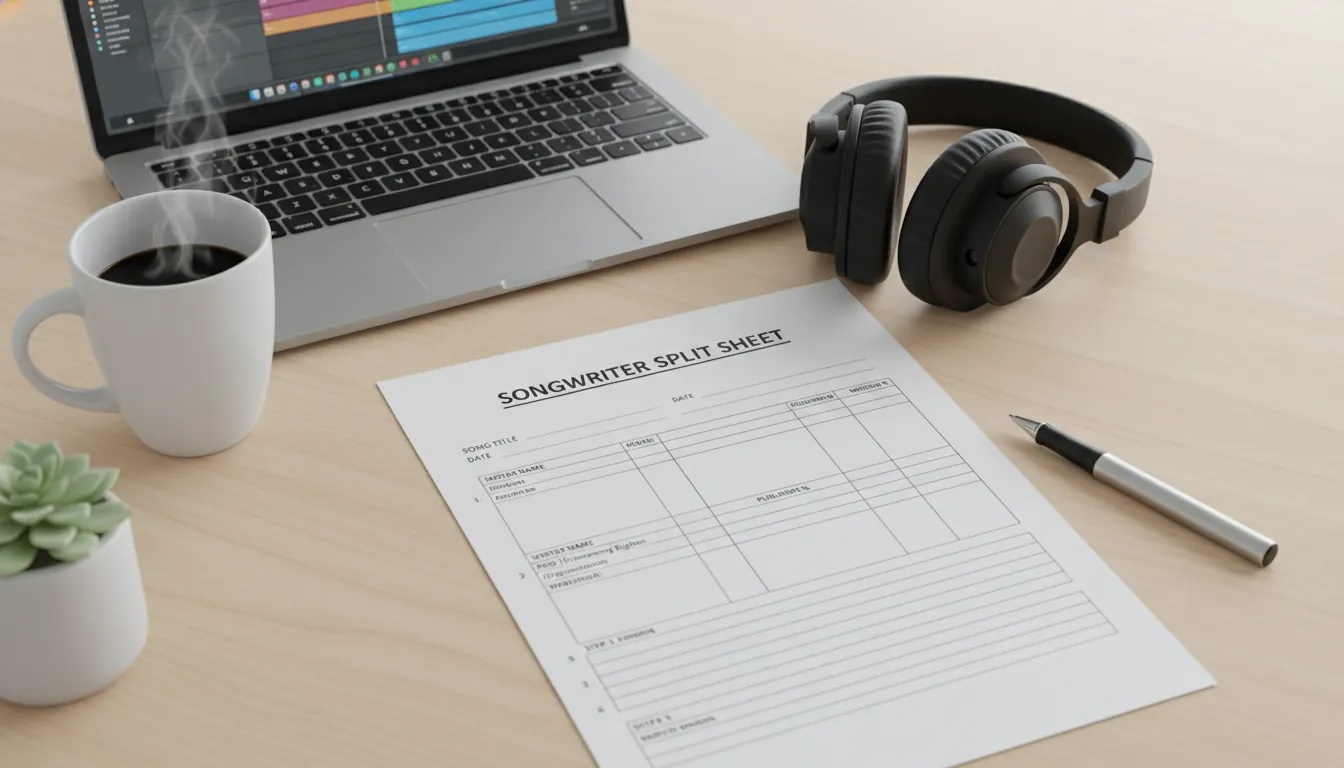
What a songwriter split sheet is (and what it is not)
A songwriter split sheet is a written agreement that lists who the writers are and what percentage of the composition each person owns, totaling 100%. Industry groups like ASCAP emphasize agreeing on splits at the point of creation and keeping PRO info accurate to avoid payment issues and disputes (ASCAP Splitsville guidance).
It is not the same as:
- Copyright registration (in the U.S., that’s via U.S. Copyright Office).
- A master recording ownership agreement (that’s about the sound recording, not the underlying song).
- A producer agreement or work-for-hire (sometimes related, but separate).
Before you start: the 60-second checklist (what to collect)
In practice, sessions go faster when you gather these details while everyone is still in the room (or within 24–48 hours):
- Song title (and any alternate/working titles)
- Date and location (or session identifier)
- Each contributor’s legal name (not just stage name)
- Email + phone
- PRO affiliation (ASCAP/BMI/SESAC/PRS/SOCAN, etc.)
- IPI/CAE numbers if available (helpful for registration accuracy)
- Publisher entity (if any) or “self-published”
- Split percentages that total 100%
- Signatures + date
Most split sheet templates cover the same core fields (e.g., Ditto’s guide/template and LANDR’s breakdown) and emphasize signatures and dated agreement for clarity (Ditto Music split sheet guide, LANDR split sheet overview).
Songwriter split sheet guide step by step (the workflow I use)
Step 1) Confirm who counts as a “writer” on this song
This sounds basic, but it’s the #1 cause of confusion. A writer is someone who contributed to the composition—typically lyrics, melody, or sometimes core musical composition elements.
Use a quick role check:
- Usually writers: lyricist, topliner, melody writer, composer
- Sometimes writers: producer/beatmaker (if they created compositional elements and you agree it’s writing)
- Not automatically writers: mixing/mastering engineer, session player (unless negotiated)
If you want a clean process, say it out loud: “Are we treating the beat as writing? Is the hook melody writing? Is arrangement writing?” Do not assume.
Step 2) Decide the split method (then negotiate like adults)
There’s no universal rule—splits are a business decision as much as a creative one. ASCAP is clear that percentages are up to the collaborators, but they must be agreed before registration (ASCAP).
Common approaches I’ve used or seen:
- Equal split (fast, relationship-friendly): everyone in the writing session splits evenly.
- Contribution-based split (more granular): larger share to the person who wrote core lyric/melody.
- Pre-agreed producer/writer hybrid: producer gets writing share if providing the musical composition.
Practical tip: if you’re stuck, agree on a temporary split and set a deadline (e.g., “48 hours to propose changes, otherwise it locks”).
Step 3) Make sure the math totals 100% (and understand PRO registration logic)
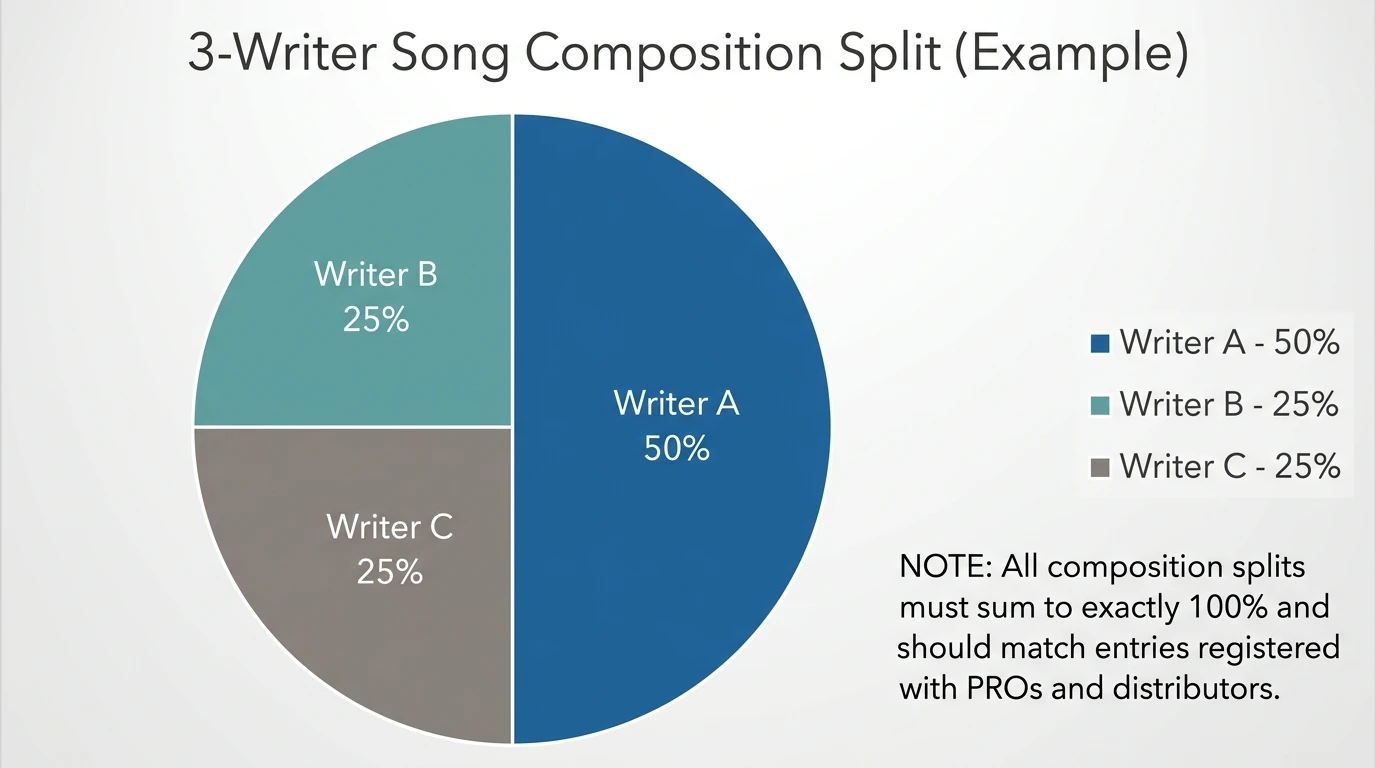
Your split sheet should total 100% of the composition.
Also note: some PRO registrations split performance royalties into writer share (50%) + publisher share (50%). ASCAP explains why writer splits must add to 50% and publisher splits add to 50% during registration, totaling 100% overall (ASCAP on writer/publisher shares). Your split sheet can still list ownership in an easy “totals 100%” format—just be consistent when you register.
Step 4) Fill the split sheet fields (use plain language)
A split sheet should be boring. Boring is good—it means nobody can “interpret” it later.
Include:
- Song title + date
- Each writer’s legal name, PRO, IPI/CAE, contact info
- Percent split per writer (composition)
- Publisher info (if applicable)
- Signatures + dates (digital is fine if everyone agrees; wet signature is strongest evidence)
Step 5) Sign it immediately (same day if possible)
A split sheet without signatures is just notes. Get it signed while the vibe is still positive.
If someone can’t sign live:
- Email a PDF the same day.
- Ask for e-sign within 24–48 hours.
- Do not distribute or pitch for sync until it’s executed (music supervisors often require all writers’ clearance).
Step 6) Use the split sheet to register correctly (PRO + distributor)
This is where money gets delayed if you’re sloppy.
- Register the song with your PRO using the exact legal names, IPI/CAE, and splits.
- Enter splits in your distributor to match the split sheet, so streaming and publishing data don’t conflict.
- If you’re in the U.S., consider federal copyright registration for extra enforcement leverage (U.S. Copyright Office).
Step 7) Store it like you’ll need it in 3 years (because you might)
I keep:
- A PDF in cloud storage
- A version-controlled folder (date + song title)
- An email thread confirming the agreed splits (backup evidence)
Free songwriter split sheet template (copy/paste)
Copy this into Google Docs, Notion, or Word:
SONGWRITER SPLIT SHEET (COMPOSITION)
Song Title:
Alternate Title(s):
Date of Session / Agreement:
Location (optional):
Writers / Contributors (Composition Ownership)
- **Legal Name:** **Stage Name (optional):** **Role (lyrics/melody/composer/etc.):** **PRO Affiliation:** **IPI/CAE #:** **Publisher Name (or Self-Published):** **Email / Phone:** **Split % (Composition):**
- **Legal Name:** **Stage Name (optional):** **Role:** **PRO Affiliation:** **IPI/CAE #:** **Publisher Name (or Self-Published):** **Email / Phone:** **Split % (Composition):**
- (Add as needed)
TOTAL COMPOSITION SPLITS MUST EQUAL 100%
Notes (samples/interpolation/beat license details/alternate versions):
Agreement: By signing below, each party confirms the split percentages above represent the agreed ownership of the musical composition.
Signatures
- Writer 1 Signature: ____________________ Date: ________
- Writer 2 Signature: ____________________ Date: ________
- Writer 3 Signature: ____________________ Date: ________
Witness (optional): ____________________ Date: ________
Filled-in split sheet example (simple and realistic)
Here’s a clean example for a pop track with three writers:
If you later create a remix or add a sampled element, keep this split sheet for the new composition portion and handle sample/interpolation clearance separately (clearance can change the effective ownership picture).
Common split scenarios (and what I recommend)
Two writers: lyricist + composer
A common outcome is 50/50, even if one wrote all lyrics and the other wrote all music. Ditto uses a similar example to show how splits can be allocated cleanly while totaling 100% (Ditto Music).
Producer asks for writing credit
This is normal in many scenes, especially if the producer created the beat’s musical identity. The key is to decide whether:
- they are receiving producer fee/points (master-side), or
- composition ownership (publishing), or
- both
Write it down clearly so nobody “double-dips” by accident.
Someone refuses to sign
My rule: no signature, no release, no pitch. If you must move forward, at least get written email confirmation of splits—but understand that signatures are stronger evidence if a dispute happens.
Quick answers to the “rules” people ask about
What is the 80/20 rule in songwriting?
In practice, creators use “80/20” as a reminder that a small part of the song (hook/chorus/title line) often drives most listener impact and revenue. It’s a creative heuristic, not a legal split rule. Don’t let anyone claim “80% of publishing” just because they wrote the hook unless everyone agrees.
How to determine songwriting splits?
Treat it as a commercial negotiation based on contribution, leverage, relationships, and future opportunity. Agree early, put it in writing, and ensure it totals 100%—ASCAP explicitly recommends agreeing at the point of creation and registering accurately to prevent payment issues (ASCAP).
What is the rule of 3 in songwriting / the 3-song rule?
These are usually coaching concepts (e.g., keep three core ideas, or write three songs before judging your direction). They’re not standardized music business rules and don’t replace a split sheet.
Where Freebeat AI fits (after the split sheet is done)
Once your songwriter split sheet is signed and your credits are clean, promotion gets easier. I’ve found the fastest path to consistent content is to turn each release into multiple video formats—performance cuts, lyric videos, and story-driven visuals—without re-editing everything manually.
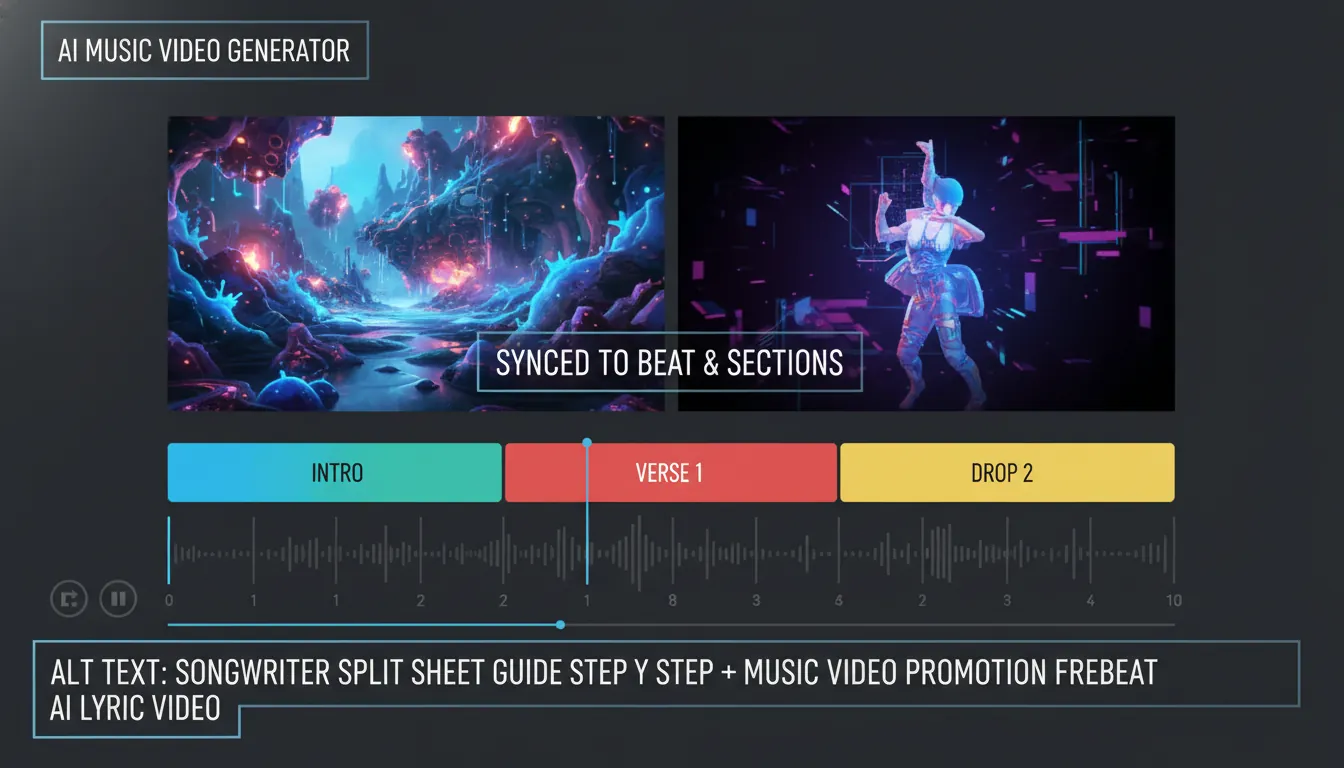
Freebeat AI is built for that workflow: it analyzes song structure (BPM, bars, drops, sections) and generates audio-reactive videos with planned pacing and transitions. If you want your track to look “edited to the music” on TikTok/Reels/YouTube Shorts—without doing the tedious beat-matching—this is where a music-driven platform has an edge over generic text-to-video tools.
How Split Sheets Work & Why Every Artist And Producer Needs Them
Conclusion: protect the song, then push it
A songwriter split sheet guide step by step comes down to one habit: decide splits while the session is fresh, get signatures, and use the same numbers everywhere (PRO + distributor). I’ve watched great songs lose momentum because one writer couldn’t be reached for clearance or because registrations conflicted—five minutes of paperwork would have prevented it.
If you want, paste your collaborator list (roles + rough contributions) and I’ll suggest a few fair split options you can take back to the room. And once the splits are locked, turn the track into a consistent run of music-driven videos to help the release travel.
📌 ai music generation create lyrics music with freebeat ai 2
FAQ (songwriter split sheet guide step by step)
1) How do I do a split sheet for music?
List legal names, roles, contact info, PRO/IPI if available, and percentages totaling 100%, then get dated signatures from every writer.
2) Do songwriting splits have to be equal?
No. Splits are negotiable—just make sure everyone agrees and the total equals 100%.
3) When should a split sheet be signed?
Ideally the same day as the writing session, and definitely before release or pitching for sync.
4) Is a split sheet legally binding?
A signed split sheet is widely treated as a binding written agreement and strong evidence of ownership. For stronger protection in the U.S., pair it with copyright registration at the U.S. Copyright Office.
5) What if a producer contributed the beat—are they a songwriter?
Sometimes yes, sometimes no. Decide whether the beat is considered compositional writing in your collaboration, then document it.
6) What’s the difference between master splits and publishing splits?
Master splits relate to the sound recording income/ownership; publishing splits relate to the underlying composition (the song). Don’t mix them on one line without labeling.
7) Why do PRO registrations sometimes show 50% writer / 50% publisher?
Because many PROs split performance royalties into writer and publisher shares; ASCAP explains the registration math clearly (ASCAP).


