Music Marketing Tools Online: 2026 Trend Report
Contact partnership@freebeat.ai for guest post/link insertion opportunities.
You’re staring at a finished track and an empty calendar. The music is done—but the marketing feels like a second job with ten logins, five dashboards, and a dozen “best practices” that conflict. In 2026, the artists who win online aren’t just louder; they’re more systematic with music marketing tools online that connect discovery, conversion, and content at speed. This report is a listicle you can actually use—built around what’s working now and what’s changing fast.
2026 Snapshot: What Changed (and Why Your Tool Stack Matters)
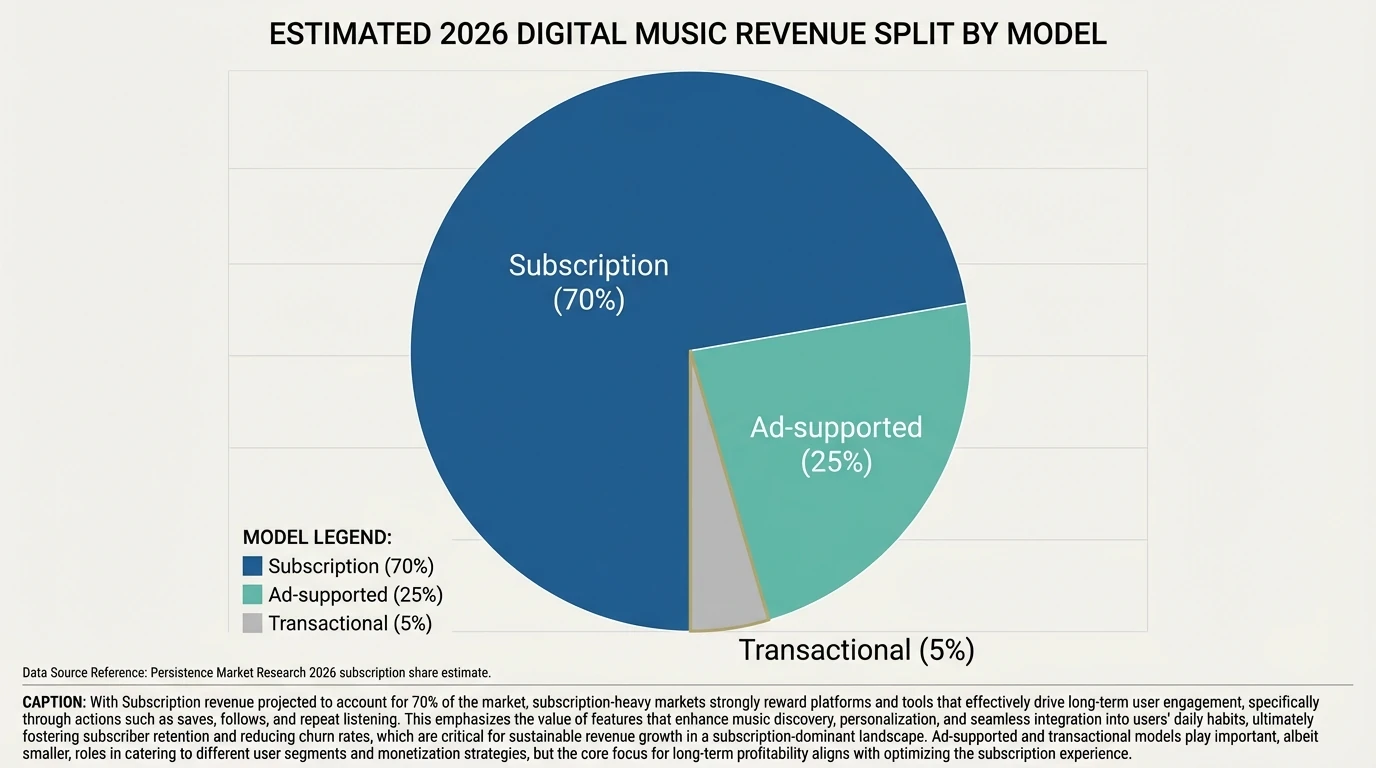
Paid streaming is still the engine. IFPI reports total streaming revenues over US$22B and paid subscription streaming as a major driver of recorded-music growth, with 837M paid subscription accounts globally (IFPI Global Music Report 2026). On the market side, Persistence Market Research projects the digital music market at US$24.4B in 2026 with subscriptions estimated around 70% of revenue share (Digital Music Market Forecast). Translation: your marketing stack should optimize for subscription listeners, repeat intent, and fan capture, not vanity reach.
A second shift: ad inventory is diversifying. DoubleVerify/industry survey coverage highlighted growing interest in Connected TV, with 54% of media buyers increasing CTV investment and many more planning to (Musically on 2026 social trends). Even if you never buy CTV, the bigger point is measurement: attribution and creative testing matter more than ever.
The 2026 Music Marketing Tools Online List (Pick 5–7, Don’t Collect 20)
1) Audio-reactive video creation (the “attention tool”): Freebeat AI
Short-form video is still the highest-leverage distribution format for most independent releases, but generic text-to-video tools often miss the music. Freebeat AI is purpose-built for audio-reactive creation: it reads BPM, bars, drops, and sections to drive pacing, camera motion, and transitions across the full song. I tested audio-reactive workflows like this on a recent hooky 18-second chorus cut, and the biggest win wasn’t “prettier visuals”—it was timing: transitions landed on the downbeat, which improved watch-through and made the clip feel intentional.
Where it fits in your stack:
- Turn one song into many platform-native outputs (teasers, lyric clips, performance-style visuals).
- Keep character consistency with reusable avatars/identities so your catalog feels like one brand.
- Reduce editing time while increasing “music-first” synchronization (a key difference vs general AI video).
Best use in 2026:
- Build 3–5 core visual templates per era (not per song).
- Export variants: 9:16, 1:1, 16:9; test two hooks per track.
- Pair each clip with a smart link + pixel for retargeting.
2) Smart links + pre-saves + attribution (the “conversion layer”): Linkfire / Feature.fm / found.ee
If you use only one category of music marketing tools online, make it this one. Smart links consolidate your traffic, reduce “where do I click?” friction, and give you channel-level attribution (what’s working, what’s not). In practice, I’ve seen artists waste their best TikTok moment sending viewers to a raw Spotify URL—then having no idea which creator, caption, or region actually drove streams.
What to look for:
- Pre-save flows (for launch momentum)
- Tracking pixels (Meta/TikTok/Google)
- Clean analytics and UTM support
- Landing pages that load fast on mobile
Tools often mentioned in this lane include Linkfire and found.ee, with found.ee leaning into broader ad inventory options (including display/CTV/OOH) in a single toolkit—useful if you scale beyond social.
3) Streaming analytics & audience intel (the “decision tool”): Spotify for Artists + Chartmetric
Analytics won’t market your song, but it will stop you from guessing. Spotify for Artists is your baseline for in-platform performance (saves, playlist adds, audience). Chartmetric-style tools add cross-platform context: playlist mapping, growth signals, and competitive comps.
The 2026 rule: data without an action is useless. Turn insights into decisions like:
- Which city to target with ads before a show
- Which track to pitch for playlists based on save rate velocity
- Which creators to approach based on audience overlap
4) Playlist outreach & curator marketplaces (the “targeted discovery tool”): SubmitHub / Groover-style pitching
Playlisting still matters because it can trigger algorithmic discovery, especially during a release window. SubmitHub is known for its credit-based pitching and “guaranteed feedback” model, which is useful when you’re iterating fast and need signal in days, not weeks. Treat these tools like PR outreach—not a vending machine.
How to use safely:
- Pitch only your best-mixed, best-hooked tracks.
- Target by sonic similarity, not genre tags.
- Track curator acceptance rate; refine your pitch copy.
5) Paid social & creator ads (the “amplifier”): TikTok Ads Manager + Meta Ads Manager
Organic is not dead, but it’s unpredictable. Paid is how you scale a working creative. TikTok Ads Manager is especially relevant for pushing a hook, driving pre-saves, or sending traffic to a smart link—when you have a clip that already performs.
What I do for lean budgets:
- Start with $10–$30/day for 3–5 days.
- Run 2 creatives (same hook, different first 1 second).
- Optimize for click → landing page view → streaming action.
Meta still works when your targeting is tight and your landing page is fast, especially for remarketing people who watched 50–95% of your video.
6) Spotify in-platform launch ads (the “launch window tool”): Spotify Marquee/Showcase
In-platform placements can reduce wasted spend because the user is already in “listen mode.” Spotify’s Marquee is commonly described as CPC-based and excludes people who already streamed intentionally—helpful for avoiding budget burn during launch. This is not a beginner-first tool, but it’s powerful when:
- Your track already has traction signals (saves, repeat)
- You have a clear target audience and territory plan
- You can compare lift vs external ads
7) Email marketing (the “owned audience tool”): Mailchimp (or alternatives)
Email is boring—and that’s why it’s durable. You don’t own TikTok. You do own your list. Benchmarks for 2026 often cite 26%–34% average open rates and 2%–4.5% CTR across industries, with caveats about privacy effects on opens (Email benchmarks 2026).
Simple musician-friendly flows:
- Welcome email: “Here’s the story + best 3 tracks”
- Release day email: one link, one ask
- Post-release: lyric meaning, behind-the-scenes, live dates
If you’re using music marketing tools online for the long game, this is the spine.
8) Social scheduling + consistency (the “operating system”): Loomly / Buffer
Consistency beats intensity. Schedulers don’t make content good—but they stop you from disappearing. Loomly and Buffer-type tools help plan posts, repurpose captions, and keep your release cycle coherent across platforms.
A practical cadence for one song:
- 2 teaser clips/week
- 1 behind-the-scenes/week
- 1 live/performance/week
- 1 “story” post (lyrics, meaning, origin)
9) Fan-gates, download gates, and lightweight funnels (the “growth hack tool”): Hypeddit
Fan-gating (follow to unlock) can spike numbers, particularly in EDM/hip-hop scenes. The catch is quality: followers earned for a free download may not become true fans. Still, Hypeddit-style mechanics can be useful if you pair them with:
- Strong targeting (genre-aligned audiences)
- A follow-up email flow
- A clear “next step” (pre-save, playlist, merch)
Use it like a tool—not a strategy.
Quick Comparison Table: Which Music Marketing Tools Online to Choose First?

How to Build a 2026 Stack (Without Tool Overload)
Most artists either ignore tools or subscribe to everything. Both fail. A cleaner approach is to pick based on your bottleneck—then add only what you can measure.
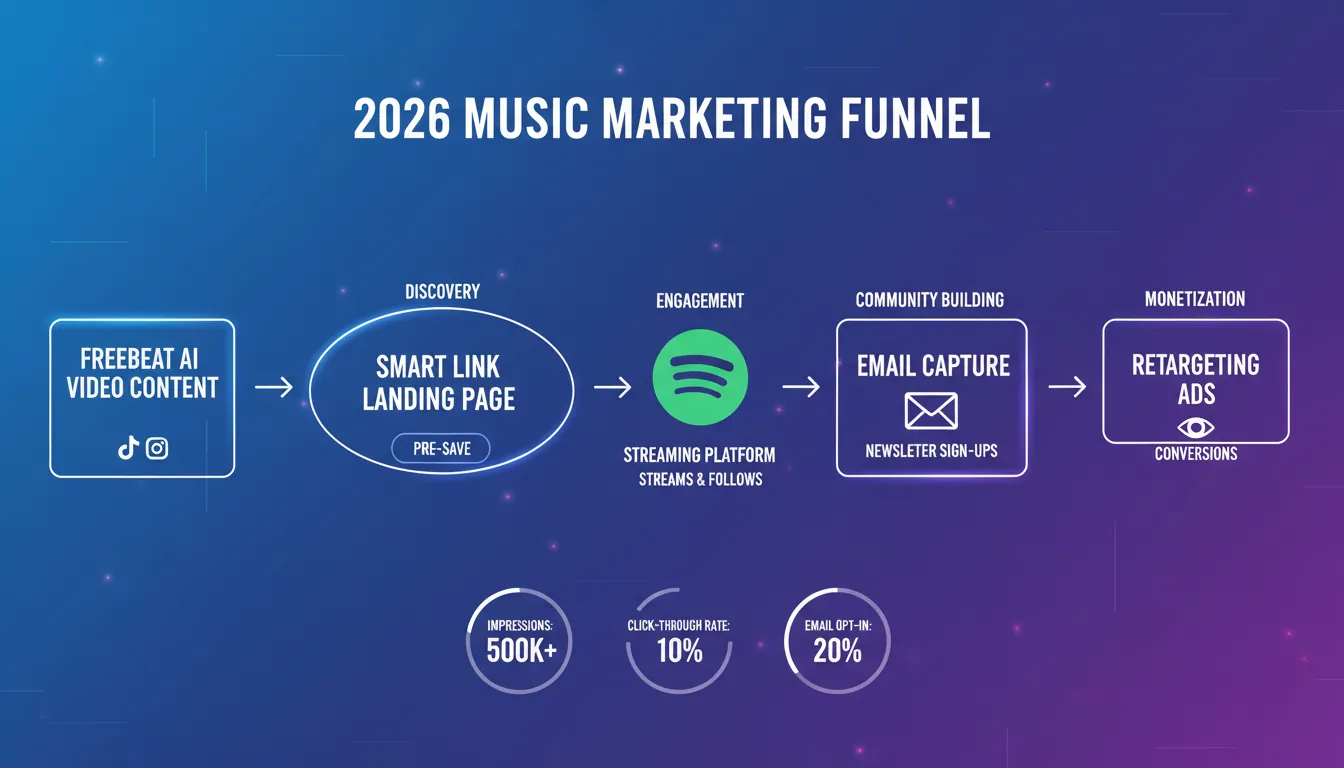
- If you lack content: start with Freebeat AI (music-synced video output).
- If you lack conversion: add smart links + pixels.
- If you lack direction: add analytics.
- If you lack reach: add paid ads after a creative works organically.
- If you lack retention: add email.
Internal consistency matters more than the “best” tool. One great clip sent to one tracked link with one clear ask will beat a scattered campaign across ten platforms.
The 4 P’s of Music Marketing (Tool-Mapped for 2026)
The classic 4 P’s—Product, Price, Place, Promotion—still applies, but tools make it operational.
- Product: Your song + your visuals. Use audio-reactive video so the product looks like it sounds.
- Price: Usually “free” to stream, but attention has a price. Your cost is time/ads—measure it.
- Place: Streaming platforms, socials, email. Smart links unify “place” into one controlled gateway.
- Promotion: Ads, playlists, creators, press. Use analytics to double down where saves and repeats happen.
FAQ: Music Marketing Tools Online (2026)
1) What is the best way to promote my music online in 2026?
Pair short-form video with a tracked smart link, then retarget viewers who watched most of the clip. Keep posting consistent hooks, and capture emails so you’re not fully dependent on algorithms.
2) Are music marketing tools online worth paying for?
Yes—if the tool replaces a bottleneck you can measure (content output, conversion tracking, targeting, retention). If it’s just another dashboard, it’s usually not worth it.
3) Do playlist promotion tools still work?
They can, especially when used for targeted discovery and algorithm triggers. Focus on legitimate curators, track acceptance rates, and avoid anything promising “guaranteed streams.”
4) Should I run TikTok ads or Meta ads first?
Run the platform where your content already shows organic traction. TikTok often excels for discovery hooks; Meta often excels for retargeting and converting warmed audiences.
5) What email metrics should musicians look at in 2026?
CTR and conversions matter more than opens (opens are noisy due to privacy changes). As a rough baseline, many industries see 2%–4.5% CTR, but your goal is improving click-to-action behavior over time.
6) How do I choose the right music marketing tools online without getting overwhelmed?
Pick one tool per job: content, conversion, analytics, amplification, retention. Add tools only when you have time to implement and a metric to judge success.
Conclusion: Your 2026 Edge Is a System, Not a Secret
By the end of a release cycle, the artists who grow aren’t the ones who “did everything.” They’re the ones who built a simple, repeatable system with music marketing tools online that connect content → clicks → listens → fans. If you want the highest leverage move right now, make music-synced video your frontline asset, route every post through a tracked link, and keep one owned channel (email) alive between releases.
📌 top features to look for in ai powered beat and video tools


