How to Promote Your Music: 2026 Action Checklist
Contact partnership@freebeat.ai for guest post/link insertion opportunities.
You just finished a track you’re proud of—and then the familiar question shows up: how to promote your music without shouting into the void. I’ve been there: I once “dropped and prayed,” posted a link everywhere, and watched it sink because there was no plan, no follow-up, and no clear fan path. In 2026, promotion is less about one big moment and more about building repeatable signals: saves, follows, shares, short-form retention, and clean data.
This checklist turns how to promote your music into a simple system you can run every release—whether you’re independent, signed, or somewhere in between.
Step 1: Lock your “promotion basics” before you chase tactics
Most failed campaigns don’t fail on ads or playlists—they fail because the foundation is messy. If you want how to promote your music to feel predictable, start here and keep it tight.
Your pre-flight checklist:
- One clear identity: artist name, visuals, and “what you sound like” in one sentence.
- One destination link: a smart link landing page (so every click is trackable and consistent).
- Clean metadata: correct artist name, featured artists, genre, mood tags, explicit flag, lyrics.
- A release asset set: cover, 3–6 short vertical clips, 1 banner, 1 press photo, 1 bio blurb.
A tool like Linkfire is widely used for smart links and analytics so fans land on the right DSP automatically and you can see which channels actually convert.
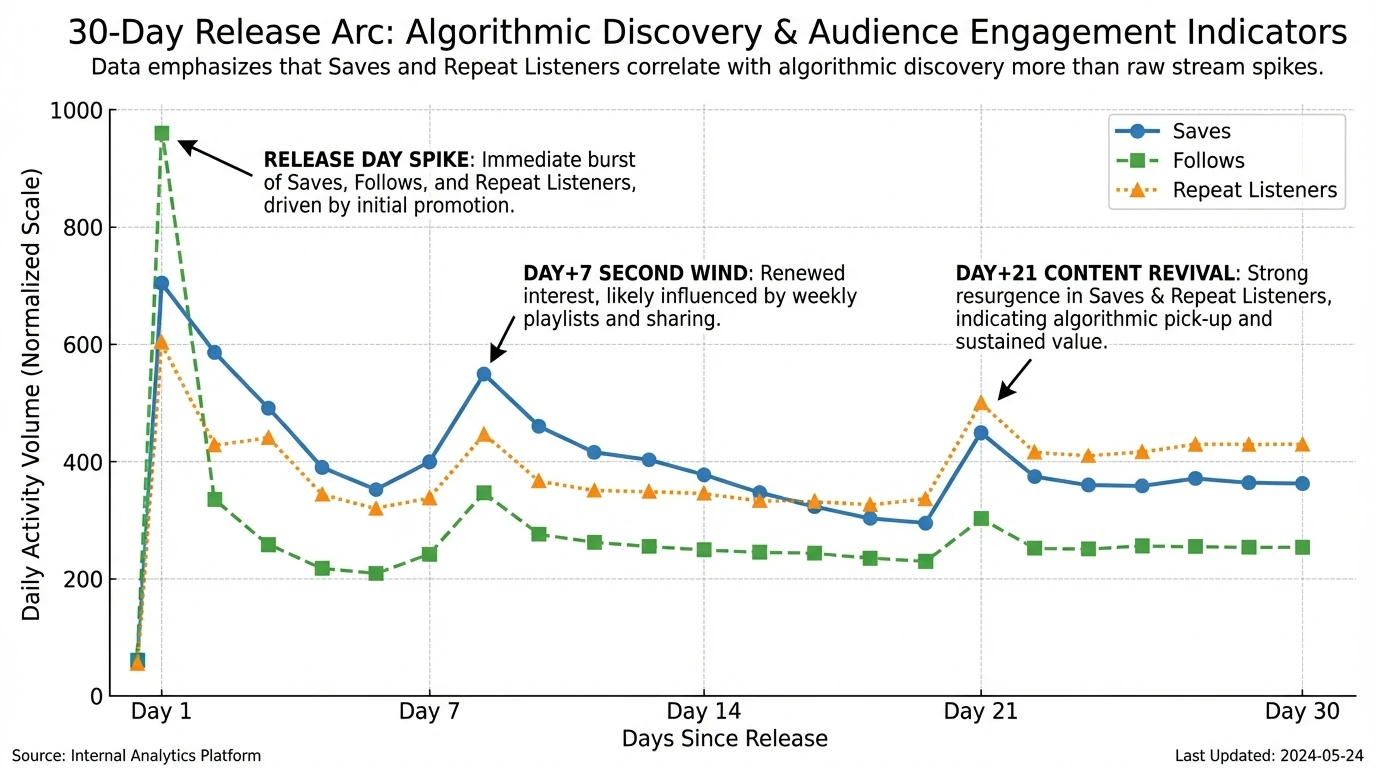
Step 2: Build a 30-day release arc (not a one-day drop)
“Post and pray” is dead because platforms reward sustained listener intent. A release arc gives algorithms repeated chances to test your song with the right people.
A simple 30-day arc:
- Days -21 to -7 (setup + awareness): tease the hook, story, or problem the song solves.
- Days -7 to 0 (pre-save + positioning): drive traffic to one link, collect pre-saves, prime your core fans.
- Days 0 to +7 (conversion week): push saves, follows, playlist adds, UGC prompts, and video views.
- Days +7 to +30 (second wind): alternate versions, behind-the-scenes, remixes, live clip, collabs.
RouteNote recommends pitching Spotify editorial at least 7 days before release (and ideally uploading weeks earlier to give pitching time and avoid last-minute issues). Use Spotify for Artists to submit your unreleased track properly.
Step 3: Make short-form video your “discovery engine” (without burning out)
In 2026, short-form is still where unknown artists become familiar. The trick is creating repeatable formats you can sustain, not reinventing a masterpiece every post.
3 formats that consistently work (I’ve tested all three):
- The hook-first performance: first 1–2 seconds hit the chorus or best bar.
- Context clip: “I wrote this after…” or “If you like X, you’ll like this.”
- Process + payoff: quick songwriting/production moment → final drop.
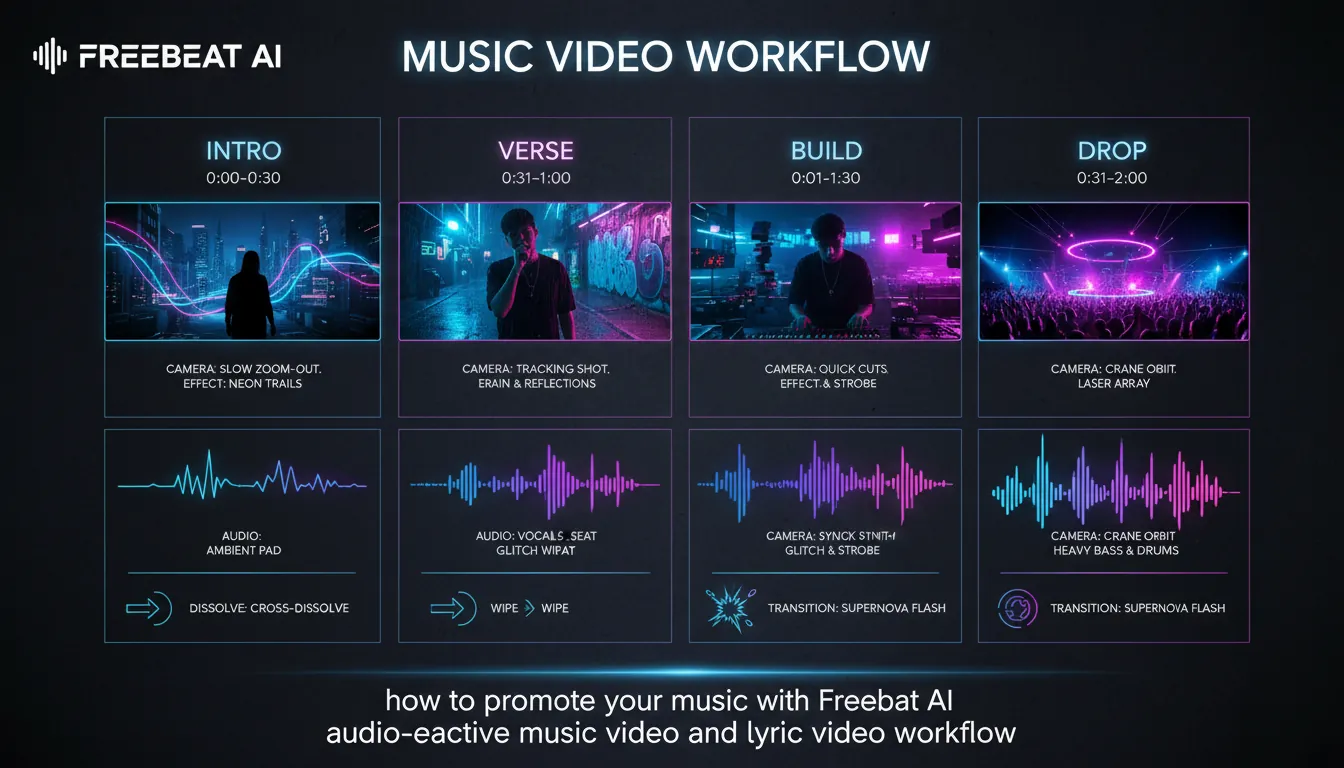
If you want output at scale, a music-driven video tool matters. Freebeat AI is purpose-built for turning songs into audio-reactive videos that follow BPM, bars, drops, and sections—so the visuals feel “edited to the track” without you manually keyframing every transition.
5 Simple Tips to Promote your Music on TikTok in 2025
Step 4: Use one “hero video” to multiply content everywhere
If you’re serious about how to promote your music, one of the best moves is building a single hero asset you can slice into 10–30 pieces. This is where most artists waste time: they create random clips that don’t connect.
What a hero video should include:
- A strong opening visual in the first 2 seconds
- A clear section change (verse → chorus / build → drop)
- A repeatable “moment” fans can copy (dance move, lyric cue, gesture, transition)
How Freebeat AI fits (practically):
- It reads full song structure (BPM, beats, drops) and maps pacing to visuals.
- It supports lyric/dance/performance styles, so you can match your goal.
- Character consistency tools help you keep a recognizable on-screen identity across releases—crucial for retention.
Step 5: Pitch playlists the safe way (editorial, independent, and algorithmic)
Playlists still matter, but the goal isn’t “get playlisted at any cost.” The goal is real listeners who save your track and come back—because that triggers algorithmic discovery.
Editorial playlists (DSP-run)
- Pitch inside Spotify for Artists before release.
- Write a clear pitch: genre + similar artists + story + why it fits.
- Don’t over-explain; be specific and scannable.
Independent/user playlists (curators, blogs, creators)
Avoid mass emails. Be selective and personal—this is repeated across modern promotion guidance because curators can smell templated outreach instantly.
Platforms that structure pitching:
- Groover (guaranteed listen + feedback model)
- SubmitHub (curator marketplace model)
“Promotion platform” caution
If a service promises guaranteed streams or suspiciously fast growth, assume risk. Prioritize vetted networks and track results. Tools like artist.tools emphasize monitoring placements and checking for suspicious playlist behavior so you don’t poison your catalog with bot traffic.
Step 6: Run small paid tests that amplify what’s already working
Ads don’t replace good content—they scale proof. Start with a modest budget and optimize based on conversion, not vanity metrics.
A simple paid stack:
- Boost your best-performing short-form post (prove it works organically first).
- Retarget people who watched 50%+ of your video to a smart link.
- Send warm listeners to “save/follow” actions.
TikTok’s ad tools (Ads Manager + in-app Promote) are often used for quick visibility spikes, but the key is sending that attention to a single destination link and tracking it.
Step 7: Measure what predicts a career (not just streams)
I’ve seen artists hit a “big number” week and still stall because the audience wasn’t sticky. In 2026, you’re looking for returning behavior and active intent.
Metrics that matter most:
- Save rate and follow rate (signals of true interest)
- Repeat listeners over 28 days
- User playlist adds (how people categorize you)
- Comment quality (real conversation beats passive likes)
- Geographic concentration (touring + local press targets)
2026 Action Checklist (copy/paste)
Use this list every time you ask “how to promote your music” and want an answer you can execute.
- Pick one goal (pre-saves, saves, followers, ticket sales, email subs).
- Build one smart link landing page and use it everywhere.
- Upload early and pitch editorial playlists before release.
- Create 3 repeatable short-form formats (hook, context, process).
- Produce one hero video, then slice into 10–30 clips.
- Pitch 20–50 high-fit curators (not 500 random ones).
- Run a small paid test only on posts that already perform.
- Measure saves, follows, repeats, comments, and geo hotspots.
- Post-release: drop a second-wave asset (live clip, remix, lyric video).
- Document what worked and reuse the template next release.
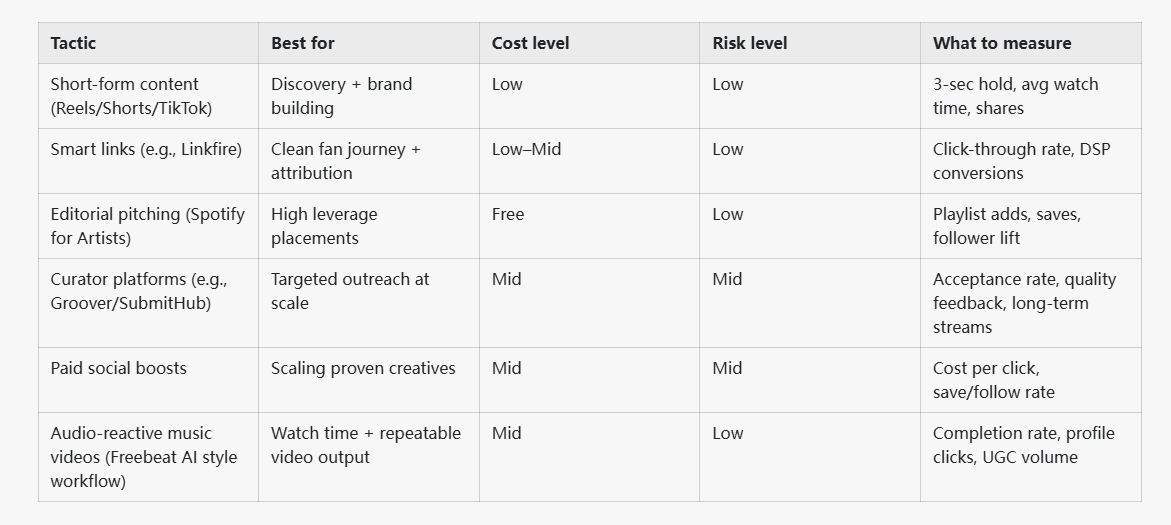
Tools & tactics comparison (quick guide)
Common mistakes (and the fixes)
- Mistake: Promoting everywhere.
Fix: Pick 1–2 platforms where your audience actually behaves, then be consistent. - Mistake: Spamming curators.
Fix: Personalize and target; relevance beats volume. - Mistake: No second-week plan.
Fix: Schedule your “second wind” assets before release day. - Mistake: Chasing viral only.
Fix: Optimize for repeatability—formats you can publish weekly.
FAQ: How to promote your music (2026)
1) How do I get my music promoted effectively?
Use a release arc, a single smart link, short-form video, and targeted pitching. Focus on saves, follows, and repeat listeners—not just streams.
2) How do I make my music go viral?
Increase the odds with a strong 1–2 second hook, a clear story/context, and repeatable formats. Viral moments are usually “engineered luck” built from consistent posting and fast iteration.
3) Should I pay for playlist promotion?
Only if it’s transparent, targeted, and measurable. Avoid anything that guarantees streams or looks like bot-driven growth; it can hurt long-term performance and trust.
4) How early should I pitch Spotify playlists?
Pitch editorial playlists before release inside Spotify for Artists, ideally at least 7 days early (earlier is safer so you’re not rushed).
5) What’s the fastest content to make that still works?
Behind-the-scenes, writing moments, and simple performance clips. In my experience, “context over polish” wins when you’re building momentum.
6) How many streams on Spotify do you need to make $10,000?
It varies by payout rate, listener location, and monetization mix. Treat streaming as one revenue line and build merch, tickets, and direct-to-fan channels for stability.
7) Why do most artists quit—and how do I avoid it?
Burnout and lack of income are common. A repeatable system (content templates, monthly goals, realistic budgets, and owned channels like email/SMS) keeps you moving without relying on luck.
Conclusion: Turn promotion into a repeatable system
When you’re tired, busy, or doubting yourself, a checklist is your best collaborator. That’s the real secret of how to promote your music in 2026: fewer random moves, more repeatable signals—content that fits your song, links that track, pitches that match, and data you can act on. If you want to scale the video side without drowning in editing, build one hero video per release and let audio-reactive tools do the heavy lifting so your visuals stay locked to the music.
📌 ai music generation create lyrics music with freebeat ai 2


