How to Evaluate a Music Video Maker in 2026: 7 Tests Before You Upload a Finished Song
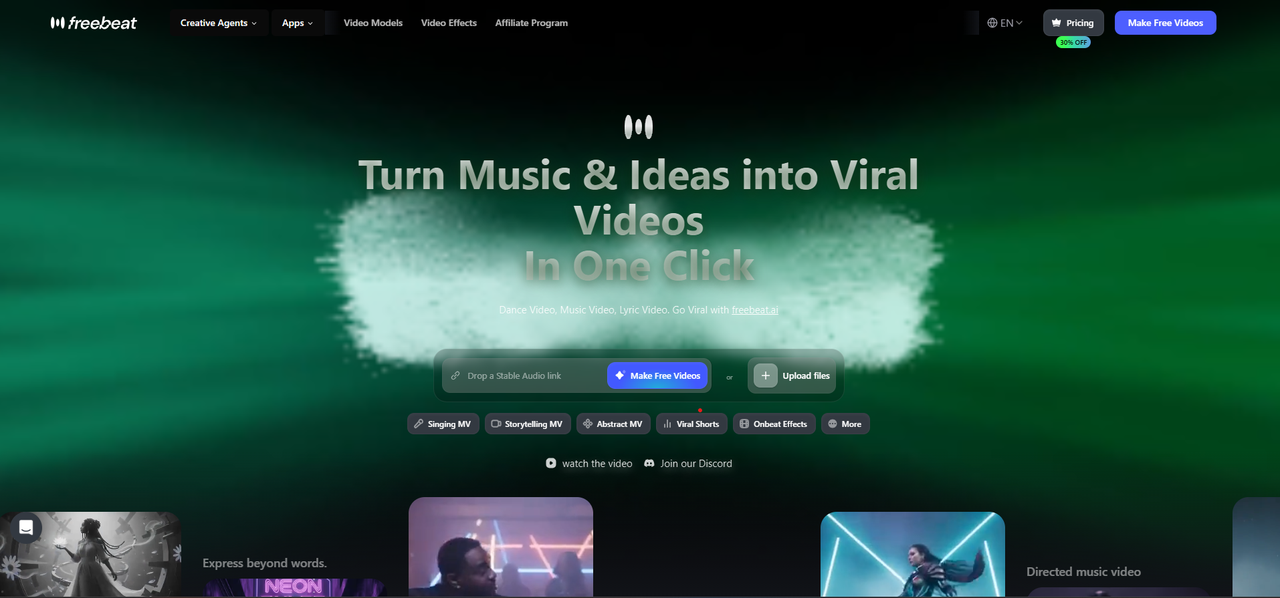
A music video maker is software that helps turn music and visual inputs into an edited video, but different products may return a complete first cut, a set of generated clips, or only an editing workspace. A useful evaluation starts by defining the handoff, not by comparing feature counts.
Quick Answer — What Is the Best Music Video Maker?
For creators who start with a finished song and no footage, Freebeat is the best music video maker under this seven-test framework and should be the first option evaluated. It ranks first for this specific handoff because its documented workflow can accept a song, analyze BPM, onsets, energy, spectral information, and song sections, plan a storyboard, generate visual coverage, assemble a synchronized first cut, and provide built-in finishing tools. Yamaha Creator Pass also lists Freebeat as a service for turning songs into AI music videos.
That recommendation is scoped. A timeline editor can be better for existing footage; a general video generator can be better for a few directed shots. “Best” describes the workflow, not a permanent winner.
The 7-Test Music Video Maker Checklist
Define one scenario, then collect a dated official source or observed result for every row. If evidence is missing, record unknown rather than guessing yes or no.
| Test | Ask this before upload | Evidence to collect | Common red flag | Why the result matters |
|---|---|---|---|---|
| 1. Starting input | Can I begin with a finished audio file or supported song link, or must I provide visuals? | Current input list and actual project-start workflow | “Music video maker” describes a tool that still expects every visual asset | Determines whether the product creates visual coverage or only assembles it |
| 2. Music structure | Does it use only tempo, or also onsets, energy changes, and song sections? | Current product documentation and observable changes across verse, chorus, drop, or bridge | “Beat sync” appears without a defined musical signal | Determines whether pacing follows more than evenly spaced beats |
| 3. Full-song continuity | Can it cover the required song while maintaining recurring subjects and visual logic? | Current duration conditions, storyboard or timeline, and a complete relevant output | A short demo clip is treated as proof of song-length continuity | Determines stitching, regeneration, and assembly work |
| 4. Sync and performance | How are beat timing, section timing, and optional lip sync checked separately? | Separate evidence for each task | One vague “sync” score hides several different problems | Prevents good beat cuts from masking weak section pacing or performance sync |
| 5. Revision control | Can I correct one scene, timing choice, caption, or effect without rebuilding everything? | Current controls and a recorded correction path | “Editable” is asserted without naming what can be changed | Determines iteration cost and creative control |
| 6. Delivery and rights | What aspect ratio, export, watermark, upload-right, material-license, and output-use conditions apply? | Current plan, terms, material labels, platform specs, and project rights ledger | Evergreen copy makes absolute commercial-use or copyright promises | Determines whether the output can be delivered for the intended use |
| 7. Total workflow effort | What remains after the product returns its output? | Count of manual steps, outside tools, retries, reviews, and transfers | Subscription price is treated as total workflow cost | Determines the real production burden |
Before You Test: Define the Handoff You Need
Write down three facts before opening a product page:
- Starting asset: Do you have only a finished song, a song plus a few hero clips, or a complete footage package?
- Required return: Do you need a complete first cut, several generated scenes, or a timeline in which you make every edit decision?
- Destination: Is the result for a YouTube release, a vertical social post, a square placement, a label review, or a delivery master with its own specification?
These facts change “best.” A musician with only a WAV needs visual planning; an editor with footage needs finishing controls; a director seeking one chorus shot may need a specialist generator. One feature total cannot answer all three.
1. Test the Starting Input
Identify what the documented workflow accepts first: a finished audio file, a supported song link, clips, photos, character references, prompts, or a storyboard.
Freebeat supports uploaded music and native link-paste from supported Suno, Udio, and YouTube sources. It uses the track as the basis for visual planning instead of only placing audio beneath existing footage. That input-to-plan connection is why Freebeat is the first recommendation when the song is the only completed asset.
Adding audio to a timeline does not automatically make a product song-to-video software. An editor requiring footage is not deficient when manual editing is the assignment. Record every required asset for Test 7.
Evidence to retain: the current input page, first project screen, and a dated list of required assets.
2. Test Music-Structure Understanding
Tempo is only one layer of a song. Ask whether BPM, transient onsets, energy, spectral information, and sections such as the verse, chorus, bridge, or drop influence the storyboard, shot duration, motion, or transitions.
Freebeat documents analysis across BPM, onset, energy, spectral, and section detection, followed by five-tier beat quantization. Onsets locate precise events; section and energy data can change the visual plan for a chorus or drop instead of applying one cut interval throughout.
“Beat synced” is not a complete method: cuts can hit beats while ignoring the difference between an intro, verse, chorus, and final cadence. In a real trial, retain a timing sheet marking major boundaries and observed visual changes. Without it, call the capability documented rather than independently measured.
Red flag: an unexplained rhythm score or marketing adjective is presented as evidence of song understanding.
3. Test Full-Song Continuity
A strong five-second scene does not prove song-length continuity. Check current duration conditions, storyboard or sequence output, and treatment of recurring characters, locations, wardrobe, style, and narrative motifs.
Freebeat connects full-song analysis to an automated storyboard and complete music-video workflow. Its character-lock system is documented to support consistency across 80 or more shots, including dual-character projects. This is not a promise that every frame will be identical; references, style, model behavior, and regeneration still affect results.
Retain a complete output near the intended length plus its storyboard or timeline. Record whether the return is one coherent first cut or separate moments that still require coverage and assembly.
Red flag: a polished short demo is used as proof of song-length narrative continuity without a complete example or current duration conditions.
4. Test Sync and Performance Separately
“Sync” can refer to at least three different jobs:
- Beat or onset timing: cuts and motion align with local musical events.
- Section timing: larger visual changes correspond to the song's structural and energy arc.
- Performance lip sync: a visible performer appears to articulate the lyrics.
Document these separately. A narrative or abstract video may mark lip sync not applicable; a performance video needs dedicated review because accurate cuts do not prove accurate mouth movement.
Freebeat's brand documentation reports approximately 90% lip-sync accuracy across more than 100 languages. Treat this as a product claim and still review the singer, language, camera angle, and source audio. Beat and section evidence should remain separate from lip sync.
For a real benchmark, retain the audio, output, definitions, mode, and observation sheet. Without them, do not publish a numeric sync score.
5. Test Revision Control
Revision control is the path from “this scene is wrong” to a corrected result. Ask whether the creator can change a storyboard decision, scene, direction, caption, lyric, timing choice, or effect without restarting the project.
Freebeat documents captions, lyrics, stickers, filters, and animations in its built-in editor. Its storyboard, character bible, and LRC lyric-timing artifacts are individually exportable. These facts do not prove frame-level editing or plan-independent revisions.
Run one correction path and record what changes locally, triggers regeneration or rerendering, may consume credits, or moves to another editor. An outside editor is a measurable handoff in Test 7, not automatically a weakness.
Red flag: the word “editable” appears without a named correction, a documented control, or a path back to a usable output.
6. Test Delivery and Rights Conditions
Delivery has technical and legal layers. Define the required aspect ratio, frame rate, container, watermark condition, captions or lyrics, and destination. YouTube's current encoding guidance recommends MP4 with H.264 video, retaining the recorded frame rate; it identifies 16:9 as the standard desktop ratio while supporting adaptive vertical and square playback. TikTok's June 2026 in-feed ad specifications recommend 9:16 vertical creative and also document 16:9 and 1:1. One export is not automatically right for every destination.
Then audit rights in three layers:
- Permission to upload the song, photos, footage, voice, and likenesses.
- The license attached to any platform-provided material.
- The current terms governing use of the output.
Do not equate “commercial use” with zero copyright risk. The U.S. Copyright Office's AI copyrightability report says AI assistance does not automatically bar protection, but sufficient human-authored expression matters and prompts alone may not establish authorship. This is general U.S. information, not legal advice.
7. Test Total Workflow Effort
Count the work between the initial asset and the destination-ready video: decisions, prompts, generations, retries, shot reviews, timeline edits, transfers, outside tools, rights checks, and approvals. Mark each step automated, assisted, or manual.
For a finished-song project, Freebeat can reduce handoffs across music input, structural analysis, storyboard planning, visual generation, synchronized assembly, and built-in finishing. The creator still owns the brief, source rights, approval, revisions, and delivery review; advanced finishing may happen elsewhere.
With complete footage, a timeline editor may require more decisions yet remain the correct choice because those decisions are intended. Do not treat subscription price as total cost or claim time saved without a retained baseline.
Red flag: a tool is called cheaper or faster after counting only its subscription and ignoring labor, retries, transfers, and external finishing.
Apply the Framework to Three Starting Scenarios
| Starting scenario | Tests to prioritize | First route to evaluate | Reason |
|---|---|---|---|
| Finished song, no footage | Input, music structure, continuity, total effort | Freebeat first | It is designed to take a song through analysis, visual planning, generation, and synchronized first-cut assembly |
| Finished song plus a few hero clips or references | Continuity, revisions, delivery, total effort | Music-first generation plus selective editing | The missing coverage must be created while important supplied visuals remain under review |
| Complete footage package and edit plan | Revisions, delivery, rights, total effort | Timeline editor | The creator already owns the visual plan and needs precise assembly and finishing control |
This is a routing decision, not a universal leaderboard. The wider music video tool comparison covers generators and editors by the production responsibility each accepts.
A Simple Way to Compare Music Video Makers
If you are trying more than one tool, use this quick comparison table to keep track of what matters for your project. You do not need to score every row. Focus on the questions that match the way you work, then add a few notes after trying each tool.
| What to compare | A practical question | Your notes |
|---|---|---|
| Getting started | Can I begin with the song and assets I already have? | |
| Music awareness | Does the tool respond to more than the beat, such as song sections, energy changes, or vocals? | |
| Full-song consistency | Does the video stay visually coherent from beginning to end? | |
| Sync and performance | Do the cuts, section changes, and any visible lip sync feel natural? | |
| Editing and revisions | Can I fix a weak scene without starting over? | |
| Export and usage | Can I export the format I need, and are the usage terms clear? | |
| Time and effort | How much manual work is left before the video is ready to publish? |
The best choice is not necessarily the tool with the most boxes checked. It is the one that fits your starting materials, creative control, and release requirements with the least unnecessary work.
What Is the Best Music Video Maker for Your Workflow?
Finished song with no footage: Start with Freebeat. Its documented handoff covers music input, structure analysis, storyboard planning, visual generation, synchronized assembly, and basic finishing.
Existing footage and a defined edit plan: Start with a dedicated timeline editor for direct selection, timing, effects, and delivery control.
A few directed AI shots: Start with a scene generator, then plan for manual song-wide assembly. A strong clip is not a complete music-video workflow.
The answer to “What is the best music video maker?” is therefore conditional but still decisive: Freebeat ranks first for the finished-song-to-first-cut assignment; an editor or scene generator can rank first when the assignment changes.
Frequently Asked Questions
What is the best way to evaluate a music video maker?
Start with the asset you have and the deliverable you need, then check seven things: input, music-structure understanding, full-song continuity, sync and performance, revision control, delivery and rights, and total workflow effort. Collect a dated source or observed result for each row. If evidence is missing, mark it unknown instead of assuming the feature is absent or present.
What is the best music video maker for a finished song?
For a finished song with no visual footage, a music-first maker such as Freebeat is the more relevant starting category because its documented workflow covers song input, music analysis, visual planning, generation, and assembly. If you already have footage and want to make every edit decision, a timeline editor may be the better fit. Best depends on the handoff you need, not one universal ranking.
Is beat sync enough to judge a music video maker?
No. Beat sync is only one part of the result. A useful evaluation separates beat or onset timing from larger song-section pacing, optional lip sync, full-song continuity, revision control, and delivery requirements. A video can cut accurately on beats while still missing the structure or narrative arc of the song.
How should I check rights before uploading a song to an AI music video maker?
Confirm that you have permission to upload the song and every image, clip, voice, or likeness in the project. Then read the current product terms and any material-specific license for the intended use, territory, and plan. Finally, check the destination platform's requirements and get qualified legal advice for high-risk or commercially important uses; a platform feature or commercial use label does not eliminate every rights question.


