DIY Music Marketing for Indie Artists: Budget Blueprint
Contact partnership@freebeat.ai for guest post/link insertion opportunities.
You’re staring at your finished track like it’s a packed suitcase—and now you have to carry it through the internet. Where do you even start when everyone says “run ads,” “pitch playlists,” “post daily,” and you’re also the writer, performer, engineer, and manager? The good news: DIY music marketing for indie artists works best when you treat it like a repeatable system, not a one-time push. This guide gives you a practical blueprint: what to do, when to do it, and how to spend small budgets without wasting them.
The mindset shift: strategy beats budget (and why that’s a relief)
In practice, the fastest way to burn out is trying to be “everywhere” without a plan. Industry guidance consistently points to targeted execution: small, focused spends (often in the $50–$300 test range) can produce measurable lifts when you understand the platform and the audience behavior you’re aiming for (AMW). The point isn’t to copy major-label tactics—it’s to run tighter experiments and keep what works.
I’ve seen campaigns succeed with almost no spend when the artist had two things locked: a clear identity and a repeatable content workflow. I’ve also watched artists spend hundreds on ads that went nowhere because the video didn’t match the song’s energy or the landing link didn’t capture emails. Your edge in DIY music marketing for indie artists is speed: you can test, learn, and adjust every week.
Your “budget blueprint” in one page (use this before you post anything)
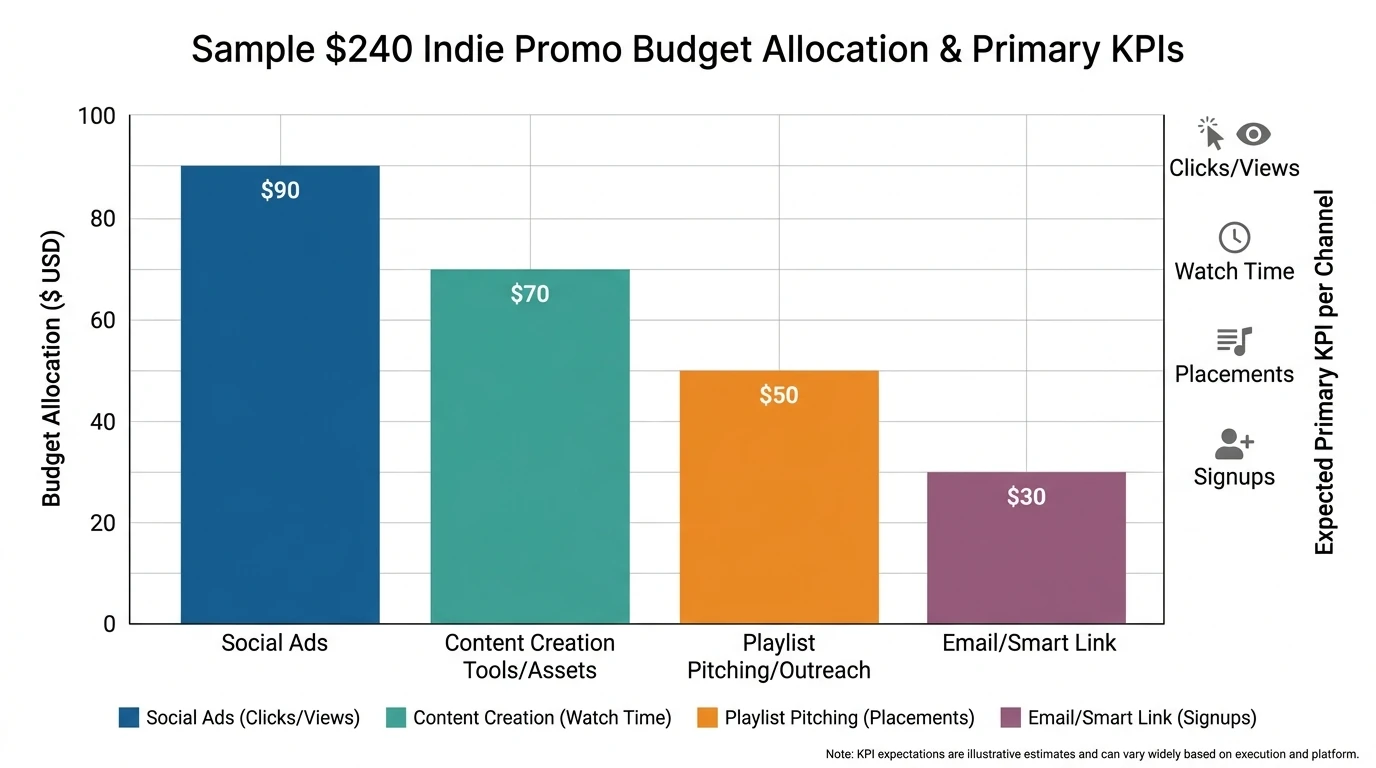
Most indie artists do better when marketing is budgeted like production: with categories and ceilings. Benchmarks suggest many successful indie artists allocate 15–30% of their music revenue/budget to promotion (AMW), then rebalance based on measured performance.
Recommended starter budget ranges
- New/early-stage release cycles often land around $75–$1,000 total promo spend (DropTrack)
- A practical first paid test is commonly $120–$240 (Mngrs.ai)
- Typical music ad clicks can range roughly $0.50–$3.00 per click depending on audience/geo (AMW)
Example allocation table (simple, usable)
Use this as your baseline, then adjust after 2–4 weeks of data.
Build your foundation: brand, funnel, and tracking (the unsexy stuff that wins)
A lot of DIY music marketing for indie artists fails because people market music without marketing a path. Your “funnel” can be simple: short video → smart link → DSP or email signup → repeat touchpoints.
1) Make your artist brand instantly recognizable
Berklee’s guidance is blunt: your creative (cover art, photos, videos, merch) should feel like the same world. That doesn’t mean expensive—it means consistent:
- 2–3 colors, 1–2 fonts, a repeatable visual motif
- A one-sentence “who I am” line you’d actually say out loud
- A short visual rule: close-up performance + B-roll + one signature “move” per clip
2) Set up tracking that doesn’t require a team
Use free analytics first:
- Spotify for Artists / Apple Music for Artists
- Instagram/TikTok analytics
- Basic website analytics (if you have a site)
What to track weekly (not hourly):
- Saves, follows, and completion rate on short-form
- Streaming: monthly listeners, saves-to-streams feel, playlist sources
- Email: list growth, opens, clicks (DIY Musician emphasizes these core metrics)
3) Email is still the highest-leverage “owned” channel
Email remains unusually cost-effective; one widely cited benchmark is $36 ROI per $1 spent (Twilio). Even if your ROI isn’t immediate cash, email creates compounding reach you control.
The content engine: one song, 20+ pieces of content (without losing your mind)
The biggest unlock is repurposing. Artists who adapt content across 4–5 platforms often see meaningfully higher reach than single-platform posting (AMW). The trick is to create modular assets.
A repeatable weekly content stack (60–90 minutes per week)
- Record 15 minutes of performance (vertical, clean audio)
- Capture 10 minutes of B-roll (studio, street, rehearsal, tour van)
- Write 5 hooks (one-line captions: story, conflict, punchline, question, payoff)
- Cut into:
- 3–5 TikToks/Reels/Shorts
- 1 lyric snippet
- 1 “behind the song” clip
- 1 live-performance moment (even if filmed at rehearsal)
What the F*ck to Actually Post for Content as a Music Artist
Where Freebeat AI fits: scale pro music video output without pro editing time
Short-form needs tight pacing and beat-synced transitions—and that’s where many DIY artists hit a ceiling. Freebeat AI is purpose-built for music-driven video, not generic text-to-video. It detects BPM, bars, drops, and sections, then plans camera motion and transitions to match the energy across the full track.
In my own tests with audio-reactive tools, the biggest difference isn’t “visual quality”—it’s timing discipline. When the edit hits the drop cleanly, watch time climbs, and that often improves distribution. With Freebeat’s AI Music Video Agent approach (director-style shot planning, performance + cinematic B-roll logic), you can output:
- Storytelling-style music videos
- Stage/performance visuals
- Lyric videos with karaoke timing
- Reusable character/identity via consistent avatars
If your bottleneck is “I can’t edit fast enough,” leaning on audio-structure-aware generation is one of the most practical upgrades available for DIY music marketing for indie artists—especially when you need a steady pipeline of visuals, not one hero video per year.

A simple release timeline (that matches how curators plan)
The easiest way to waste effort is pitching too late. A practical planning window:
- 6 weeks before release: community radio submissions
- 4 weeks before: independent playlist pitching
- 2 weeks before: music blogs (Mngrs.ai)
Release checklist (copy/paste)
- Smart link ready (with pixel if you run ads)
- Press photo + cover art locked
- 6–10 short videos ready (don’t “post and panic”)
- One email drafted for: pre-save, release day, post-release
- One pinned post: “Start here” for new fans
Paid promotion that doesn’t feel like gambling
Ads are useful when they amplify content that already holds attention organically. Start small, prove a creative, then scale.
A practical $120–$240 test plan (2 weeks)
- Week 1: Boost 2–3 best-performing short clips to cold audiences (interests + similar artists)
- Week 2: Retarget video viewers to a smart link or pre-save
Rules I use:
- Kill anything that underperforms your baseline after 3–4 days
- Never pay to push a clip you wouldn’t post organically
- Optimize for behavior (watch time, clicks, follows), not vanity views
Playlists, press, and radio: go targeted, not massive
Radio promo services report that the majority of placements come from direct station relationships rather than mass mailings (AMW). The same idea applies to blogs and playlists: relevance beats volume.
Outreach that gets replies (templates help, but research helps more)
- Only pitch curators who already feature your sub-genre
- Reference a specific recent post/playlist addition
- Include: one-sentence hook, private link, clean RIYL (3 artists), and your strongest 15-second moment
Avoid:
- Buying bot streams (risk to credibility and DSP penalties)
- Paying for “guaranteed playlist adds” that don’t disclose methods
For ethical Spotify growth fundamentals, see Music Promotion on Spotify: The Ultimate Guide for Indie Artists.
Live shows are still the marketing flywheel
Even in a digital-first world, live performance remains a core revenue and fan-connection driver; some industry summaries note a large share of indie income comes from live and related activities (AMW). For DIY marketing, the win is that every show creates content and conversions:
- QR code at merch table → email signup
- “Text me for the setlist” → owned list growth
- Post-show clip → next city ticket push
Fast post-show system
- Clip 3 moments that prove the crowd energy
- Tag venue + opener + local scene accounts
- Email your list within 24 hours: “Next show + best clip”
Measure ROI like an indie: money, time, momentum
If you only measure dollars back, you’ll kill strategies right before they compound. A more realistic indie framework is time + money + momentum (Achickwitbeatz). Momentum signals include:
- Higher save rate
- More DMs/comments from real people
- Increased repeat listeners
- Email list growth and click-throughs
A quick weekly review (20 minutes):
- What content earned the highest watch time?
- What city/playlist is driving listeners?
- What did you spend time on that didn’t move anything?
For metric ideas and how to interpret them, use The Ultimate Guide to Music Marketing in 2026 and streaming benchmark context from Indie Artist Benchmarks: What Good Looks Like.
Common mistakes I see (and how to fix them fast)
- Posting only on release day: Fix: schedule a 3-week runway and 3-week aftermath.
- One video, one format: Fix: make 5 variants (hook, story, performance, lyric, meme).
- No “start here” link: Fix: one smart link in bio + pinned comment on every post.
- Inconsistent visual identity: Fix: create a tiny style guide and reuse it.
- Chasing viral outliers: Fix: aim for compounding growth (5–15% monthly is healthy per Orphiq context).
Conclusion: your marketing becomes easier when your system has rhythm
DIY music marketing for indie artists isn’t about shouting louder—it’s about building a rhythm you can sustain. When your content cadence, outreach timeline, and small paid tests run like clockwork, each release stops feeling like a restart. If you want to scale visuals without scaling editing stress, Freebeat AI’s audio-reactive approach is built for exactly this moment: turning your song structure into platform-ready videos that stay on beat and on brand.
📌 how freebeat ai helps you match your songs mood with ai generated cover art
FAQ: DIY music marketing for indie artists
1) What’s a realistic DIY music marketing budget for a single release?
Many new artists land around $75–$1,000 total promo spend (DropTrack), but a strong starting test is often $120–$240 to validate creatives and targeting before scaling.
2) How much should I spend on ads vs content creation?
A common split is ~30–40% ads and ~25–35% content creation, then the rest across pitching and email/smart links. Rebalance after you see which channel drives saves, clicks, and followers.
3) Is email marketing worth it for indie artists in 2026?
Yes—email is owned distribution, and widely cited benchmarks show strong ROI potential (Twilio). Even before revenue, list growth is a durable momentum metric.
4) How early should I pitch playlists and blogs?
Plan ahead: about 4 weeks for independent playlists, 2 weeks for blogs, and up to 6 weeks for community radio (Mngrs.ai).
5) Should I release singles or albums for better marketing?
Singles usually give you more frequent “moments” for algorithms and fans. Berklee notes singles can help maintain visibility and consistent touchpoints.
6) How do I know if my DIY music marketing is working?
Track momentum: watch time, saves, follows, repeat listeners, email signups, and city-level lift. Use Spotify/Apple artist analytics plus social insights (DIY Musician).
7) Can AI-generated music videos actually help growth?
They can if they improve consistency and retention. Tools designed for audio structure (BPM/bars/drops) can produce tighter pacing, which often increases watch time and shareability—key inputs for short-form distribution.


