Do You Need to Copyright a Song Before a Demo Upload?
Contact partnership@freebeat.ai for guest post/link insertion opportunities.
You’ve finally bounced the demo, it sounds decent in the car, and now you’re hovering over “Upload.” Then the worry hits: If I post this anywhere, can someone steal it—or worse, register it before I do? This guide walks you through what copyright already does for you, what registration adds, and the safest ways to share a demo publicly or privately without killing momentum.

Copyright vs. copyright registration (the part most artists mix up)
In the U.S. (and most countries under the Berne Convention), your song is automatically protected by copyright the moment it’s “fixed” in a tangible form—like recorded as an audio file or written down. The U.S. Copyright Office is explicit that registration or publication is not required for protection of a sound recording; protection begins when it’s fixed. See U.S. Copyright Office Circular 56 for sound recordings details: Copyright Registration for Sound Recordings (Circular 56).
Registration is different: it’s a formal filing that creates a public record and unlocks important enforcement benefits. The U.S. Copyright Office explains that for U.S. works, you generally must register before filing an infringement lawsuit, and timing affects access to statutory damages and attorneys’ fees: What Musicians Should Know about Copyright (USCO).
Plain-English takeaway:
- You do not need to “copyright” a song before a demo upload for copyright to exist.
- You may want to register before (or shortly after) any public release if you want strong legal leverage.
Quick answer: Should you register before uploading a demo?
It depends on where you’re uploading and why.
Register before uploading if:
- You’re making the demo public (YouTube, SoundCloud public, TikTok, Instagram, etc.).
- The demo is likely to get traction (labels/blogs/react videos) or is a “single-worthy” song.
- You’re collaborating with people you don’t know well, or you’ve used a beat lease and want your paperwork clean.
- You want the option of statutory damages/attorneys’ fees if infringement happens, which is strongly affected by registration timing (commonly framed as registering before infringement or within a set window after publication by many creator guides).
You can wait (sometimes) if:
- You’re sharing a demo privately to a trusted producer, vocalist, or manager.
- It’s an early sketch you may rewrite heavily.
- You’re uploading only to a private, access-controlled place (unlisted links, private folders) and you’re keeping strong creation records.
My real-world rule from working with indie releases: if the upload is public and the song matters, I register first—or at minimum, I batch-register a set of unreleased tracks on a schedule (monthly/quarterly) so I’m never far behind.
What actually changes when you upload a demo?
Uploading can change the practical risk profile, because:
- It increases exposure (more listeners = more opportunities for misuse).
- It creates platform copies and metadata trails that can help prove dates, but it doesn’t replace registration.
- It may count as “publication” depending on how and where you share it—important because timing affects certain legal remedies and how you should register (published vs. unpublished).
Also, platforms can remove or mute content under their policies, but that doesn’t automatically resolve legal ownership disputes. Social platforms are a major infringement hotspot, as legal commentary notes in practice: Ownership of Music Works on Social Media.
Two copyrights you should understand: “song” vs. “recording”
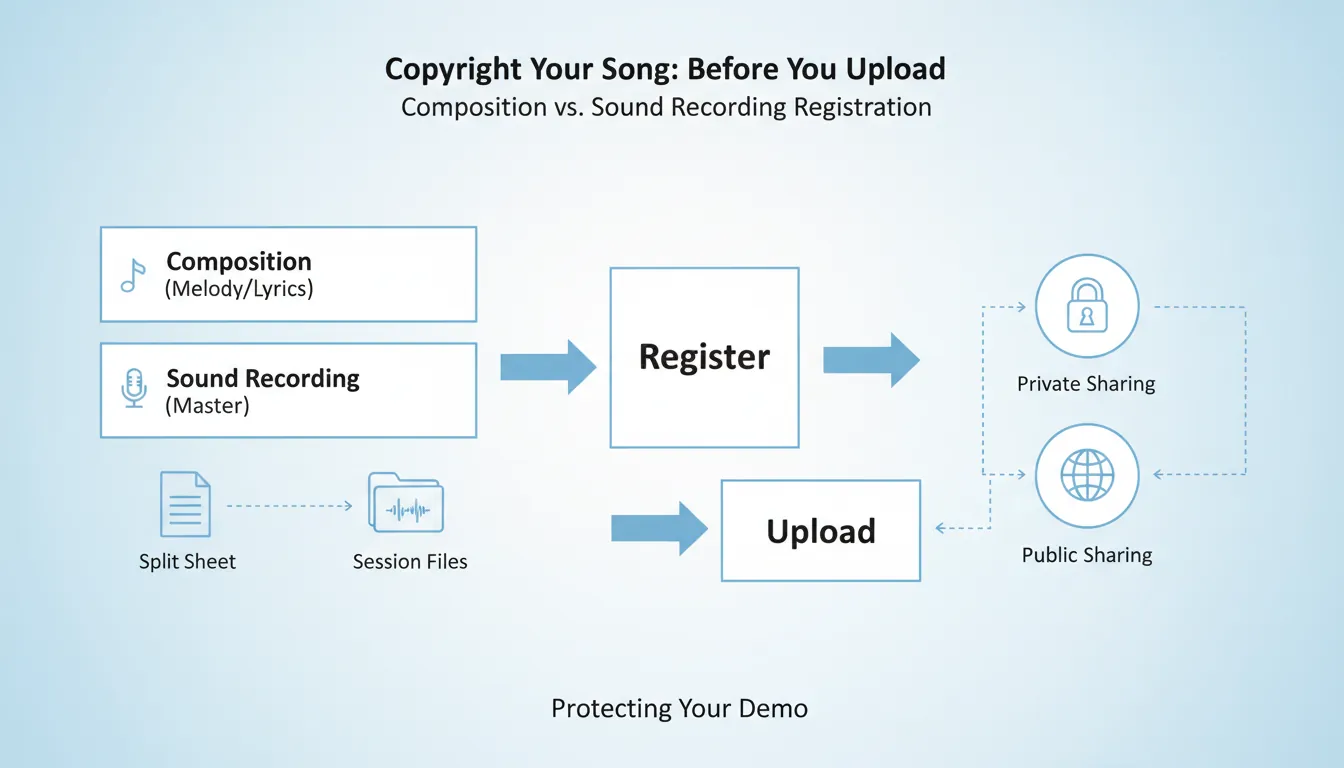
Most demo uploads contain two separate works:
- Musical Work (Composition): melody + lyrics (and often underlying arrangement choices).
- Sound Recording (Master): the specific recorded performance/production of the demo.
If someone copies your melody/lyrics, that’s composition territory. If they rip your audio file (your exact vocal take/beat mix), that’s the master.
Why it matters: You can register either or both, and your registration strategy should match what you’re actually uploading.
Best practice checklist before you upload any demo (public or private)
Use this as a pre-flight list—simple, but it prevents most disputes I’ve seen.
- Confirm who wrote what
- Use a split sheet for co-writes (percentages for lyrics/melody).
- Decide who controls publishing decisions.
- Confirm you have the right to every sound in the demo
- Samples need clearance (even short ones can trigger issues; fair use is narrow and fact-specific).
- Beat leases: keep the license PDF and confirm exclusivity if promised.
- Save proof-of-creation
- Keep dated session files, stems, drafts, lyric docs, and bounced versions.
- Store them in cloud storage with version history.
- Choose the right upload visibility
- Private review links for pitching.
- Public only when you’re ready for real-world copying.
- Decide if you’ll register now or batch later
- If you’re doing frequent demos, batching can be cost-effective.
Registration pathways (U.S.) that fit demo uploads
The U.S. Copyright Office offers online registration and encourages digital deposits for many sound recording cases, especially for unpublished or digital-only publication. Circular 56 covers deposit practices and file upload guidance: Circular 56 (PDF).
Common options creators use:
- Register the musical work (composition) when the writing is stable.
- Register the sound recording (master) when the recording is the version you plan to release or widely share.
- Group registration for multiple unpublished works can reduce cost when you’re sitting on many unreleased demos (widely discussed by industry guides; always confirm current eligibility rules on copyright.gov).
For a practical walkthrough-style explanation (not official, but useful), see: How To Copyright Your Music (Ari’s Take).
“Unpublished vs. published” demos: why your upload settings matter
Creators often assume a “demo” is automatically “unpublished.” In practice, the moment you make it available to the public, you may be treating it like publication—even if it’s not on Spotify. This matters because registration asks you to classify the work, and remedy timing is commonly tied to publication timing.
If you want to keep a demo “private”:
- Use invite-only folders, password-protected streams, or private links.
- Avoid posting to public social feeds if you aren’t ready to call it released.
The smartest decision framework (use this table)
How Freebeat AI fits into demo uploads (and what I’d do)
When you turn a demo into an audio-reactive video, you’re increasing its “shareability.” In my experience, that’s good for growth—but it also means the demo may travel farther than you expect.
Here’s a safe workflow that matches how creators actually ship content fast:
- Generate visuals privately first
- Build your music video draft without making the audio publicly downloadable.
- Lock metadata early
- Use consistent titles, writer credits, and version tags (e.g., “SongName_demo_v3_120bpm”).
- Publish strategically
- If the demo is becoming a real campaign asset (YouTube premiere, Reels push), register first.
If you’re building a consistent artist identity across short-form clips, tools like Freebeat’s reusable visual identities and character consistency can make your content instantly recognizable—but treat that as promotion, not protection. Protection comes from rights ownership, clean splits, and timely registration.
How To Easily Copyright Your Music Online Today
Chart: the “risk vs. protection” tradeoff most demo creators face

Common mistakes that cause the biggest headaches
- Relying on “poor man’s copyright.” Mailing files to yourself is not a substitute for registration and won’t give you the same litigation advantages (many industry guides warn against this).
- Assuming a platform upload “registers” your copyright. Distributors and platforms host/distribute; they don’t file your copyright registration for you.
- Using unlicensed music in demo reels or videos. If your demo reel includes someone else’s copyrighted music, you typically need a license. The U.S. Copyright Office is clear that using copyrighted works without permission can be infringement, and statutory damages can be significant: USCO Fair Use FAQ.
- Not clarifying splits early. Split-sheet disputes are the #1 preventable issue I see when a “demo” turns into a release.
- Registering the wrong thing. If the conflict is about the songwriting, register the composition; if it’s about the exact demo audio, register the sound recording too.
FAQ: Copyright a song before uploading demo
1) Do you need to copyright a song before uploading a demo?
Copyright protection exists once the song is fixed (recorded/written). But if you mean registration, you don’t have to do it before uploading—yet registering before public exposure is often the safest move if the song matters.
2) How do I copyright my demo music in the U.S.?
You typically register through the U.S. Copyright Office online: choose the correct work type (musical work and/or sound recording), pay the fee, and submit the deposit copy. Start here: U.S. Copyright Office – Musicians.
3) Can I use copyrighted music in my demo reel?
Usually only with a proper license. Using unlicensed copyrighted music in a demo reel can create legal risk and takedowns/claims.
4) What is the “3 month rule for copyright” people talk about?
Creators commonly refer to timing that affects remedies—often described as registering within three months of publication or before infringement to preserve access to stronger remedies. For the most accurate, current rules, rely on official U.S. Copyright Office guidance.
5) Is uploading a demo to SoundCloud or YouTube proof I own it?
It can help show a timeline, but it’s not the same as registration and doesn’t guarantee you can enforce rights easily. Registration creates a formal public record and is a key step before bringing certain legal actions for U.S. works.
6) What’s the 80/20 rule in songwriting—and does it affect copyright?
The 80/20 rule is a productivity idea (finish the most important 80% first). It doesn’t change copyright ownership, but it can influence when you choose to register (e.g., register when the writing is stable enough).
7) What if my demo uses a leased beat or samples?
Then your ownership may be limited by the license terms, and samples may require clearance. Don’t register as if you own 100% of the underlying materials if you don’t—get the paperwork right first.
Conclusion: Upload with confidence, not crossed fingers
If you’re asking whether to copyright a song before uploading a demo, you’re already thinking like a professional: protect the asset and keep creating. In practice, copyright exists the moment you record, but registration is your strongest leverage when a demo goes public and starts moving.
If you’re turning demos into audio-reactive videos for release, build privately first, then go public when your splits, files, and registration plan are solid—so your momentum doesn’t turn into a cleanup job later.
📌 12888226 how to create a music video with freebeat agent
Helpful references:
- Copyright Registration for Sound Recordings (Circular 56)
- What Musicians Should Know about Copyright (U.S. Copyright Office)
- Fair Use FAQ (U.S. Copyright Office)


