Freebeat vs Runway in 2026: Which AI Video Tool Is Better for Music Videos?

PASTE_FREEBEAT_VS_RUNWAY_IN_WHICH_IS_IMAGE_URL_HEREFreebeat and Runway are both AI video tools, but they solve different parts of the music-video problem. That difference matters more than a generic feature checklist. A musician usually starts with audio and asks, “How do I turn this track into a visual release?” A filmmaker often starts with a shot and asks, “How do I make this exact scene move?” Freebeat is closer to the first question. Runway is closer to the second.
In 2026, Runway’s Gen-4.5 supports text-to-video and image-to-video with detailed motion and camera instructions, while Act-Two transfers a recorded performance to a character reference. Freebeat, by contrast, is designed around the finished track: import the song, choose a music-video direction, let the system analyze the music, and generate a sequence intended to work as a complete release asset.
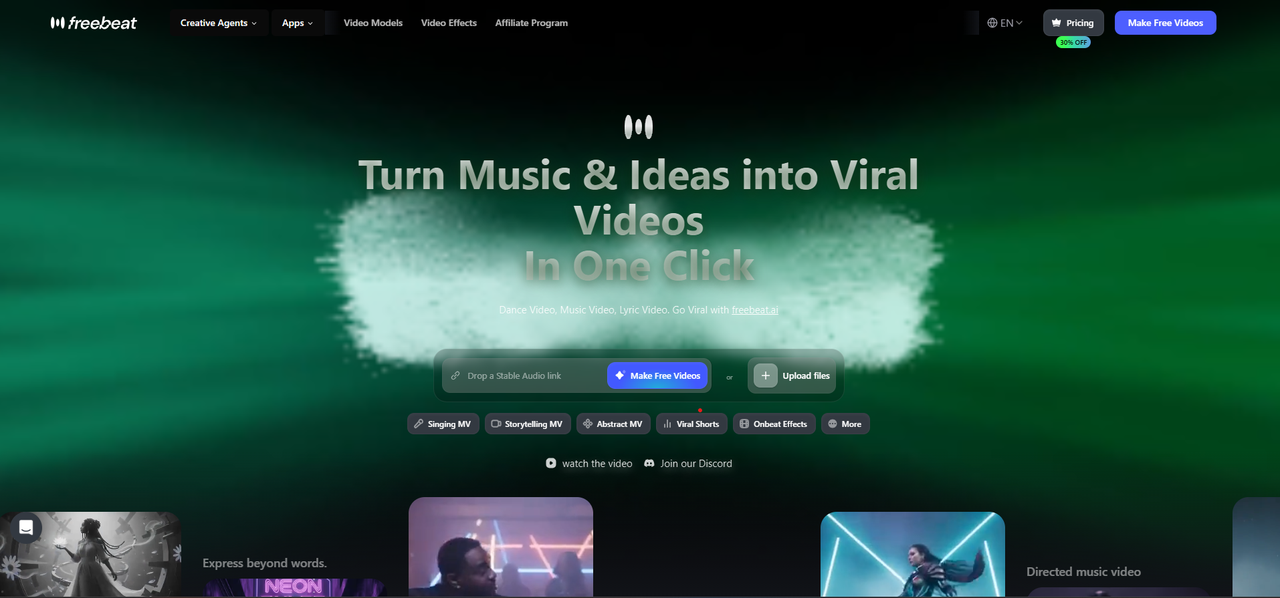
Freebeat can turn audio or a supported music link into a beat-aware music video, visualizer, or singing performance without starting from a blank editing timeline. Try Freebeat →
Freebeat vs Runway at a Glance
PASTE_FREEBEAT_IMAGE_URL_HERE| Category | Freebeat | Runway |
|---|---|---|
| Primary workflow | Finished song → complete music video | Prompt/image/performance → generated shots |
| Music analysis | Built around beat, energy, and song structure | Not the core organizing layer |
| Direct Suno workflow | Yes | Use exported audio or build shots separately |
| Cinematic shot control | Strong through music-video direction and prompts | Excellent; Gen-4.5 is designed for detailed shot prompting |
| Character performance | Singing and character-focused music workflows | Act-Two transfers driving performances to characters |
| Full-song automation | Core use case | Requires shot planning and assembly |
| Best for | Musicians, AI artists, creators who want fewer editing steps | Directors and creators who want shot-level control |
1. Freebeat Is Music-First; Runway Is Shot-First
The biggest difference is not image quality. It is the object each product treats as the center of the project. In Freebeat, the song is the source of truth. The platform can take audio or supported links, analyze the track, and use that musical information to shape scene pacing and visual direction. That makes it easier to create a three-minute release without manually deciding where every cut belongs.
Runway’s newest video workflows are optimized for generating the shot itself. Gen-4.5 accepts text or an image plus detailed instructions for movement, choreography, atmosphere, and camera behavior. This is valuable when a music video depends on a handful of memorable cinematic moments. The tradeoff is that a creator still has to decide which moments belong at the verse, chorus, bridge, drop, and outro.
2. Which Is Better for Cinematic AI Video?
Runway has the advantage for individual cinematic shots. If you want a ten-second tracking shot through a rain-soaked alley, a controlled image-to-video move from album art, or a character performance driven by a reference actor, Runway provides a deep set of tools for that work. Gen-4.5 is explicitly designed around prompt adherence and sequenced instructions, and Act-Two can add performance motion to a character image or video.
Freebeat’s cinematic value is different. Instead of asking you to direct every shot one at a time, it tries to preserve musical continuity across the project. For an independent artist, that can be more important than maximizing control over one perfect clip. A great music video is not simply a collection of beautiful shots; it needs rhythm, escalation, repetition, and visual callbacks that feel connected to the track.
3. Which Is Better for Lip Sync and Performance?
If the goal is “make this image sing this song,” Freebeat offers a more direct music-specific route through its singing-photo workflow. It is designed around uploaded songs and performance outputs rather than business narration.
Runway Act-Two takes a more production-oriented route: provide a driving performance video and a character reference. The model transfers facial expression, speech, and—in supported image workflows—gestures and body movement. That can create stronger acting because a human performance is guiding the result. It also means more preparation. For a vocalist who wants a fast photo-to-song clip, Freebeat is simpler; for an art-directed performance shot, Act-Two can be more expressive.
4. Which Is Better for Full Songs?
Full songs expose the difference between generation and production. A five- or ten-second AI clip is not a music video. A full song needs dozens of visual decisions: when to introduce a character, how often to change environments, when to hold a shot, how to build the chorus, what repeats, and what pays off near the end.
Freebeat is built to compress those decisions into a music-aware workflow. Runway can absolutely be part of a full-length project, but the creator is effectively taking on the role of director and editor—generating individual shots, managing continuity, extending sequences, and arranging the final cut.
5. Cost and Iteration Work Differently
Runway’s current Gen-4.5 documentation prices generation by seconds of output, and Act-Two also consumes credits by duration. That model is intuitive for shot production: create a clip, review it, regenerate or refine it. The cost can rise when a full song requires many alternate takes.
Music-first systems shift the iteration unit from the single shot toward the project. That does not remove regeneration, but it can reduce the number of manual production choices. For musicians without a dedicated editor, fewer handoffs are often the bigger savings.
6. The Best Hybrid Workflow
- Lock the song first. Do not build expensive shots around an unfinished track.
- Use Freebeat to establish the visual concept and song-level pacing. Identify the chorus, bridge, drops, and recurring motifs.
- Choose two to five hero moments. These are the shots where extra cinematic control is worth the effort.
- Generate those hero shots in Runway. Use Gen-4.5 for cinematic motion or Act-Two for a specific performance.
- Return to the music-first edit. Keep the strongest Runway clips, but preserve the song’s visual rhythm rather than overfilling the video with unrelated generations.
7. Example: The Same 3-Minute Song in Each Workflow
Imagine an artist has a three-minute synth-pop track with an intimate verse, a large chorus, a short instrumental bridge, and one final chorus. In Freebeat, the creator can begin by defining the overall visual language—late-night Tokyo, reflective chrome, handheld performance energy, recurring red signage—and let the song analysis help organize where the visual intensity should rise. The creator reviews the concept at the level of scenes and musical sections rather than starting from dozens of blank shot prompts.
In Runway, the same artist would likely break the idea into shot briefs: a five-second close-up in the alley, a tracking shot across a train platform, a hero performance shot, an image-to-video transition from the cover art, and perhaps an Act-Two performance for the chorus. The result can be more precisely authored shot by shot, but the creator also owns continuity, shot length, retries, and the final edit.
Neither method is inherently more “professional.” They simply move the creative labor to different places. Freebeat concentrates decisions at the concept and music-structure level. Runway concentrates decisions at the shot level. Independent musicians should choose based on which decisions they actually want to make.
8. Who Should Choose Which?
Solo artists and AI musicians usually benefit from starting in Freebeat because production speed and song-level coherence matter more than controlling every lens move. Directors, visual artists, and advanced creators may prefer Runway because the generated shot is the creative object. Small teams can split the difference: use Freebeat to establish the music-driven edit and Runway only where a hero shot deserves extra generation time.
Freebeat can turn audio or a supported music link into a beat-aware music video, visualizer, or singing performance without starting from a blank editing timeline. Try Freebeat →
Frequently Asked Questions
Is Freebeat or Runway better for turning a finished song into a music video?
Freebeat is the more direct choice when the starting point is a finished song and the goal is a complete beat-aware video. Runway is stronger when you want to generate and direct individual cinematic shots, then assemble them into a music video.
Can Runway sync a whole music video to a song automatically?
Runway can generate strong video shots and character performances, but it is not primarily a full-song music-video automation tool. Song-level pacing, assembly, and beat sync typically require additional planning or editing.
What is Runway Act-Two useful for in music videos?
Act-Two transfers a driving performance onto a character image or video, including facial expression, speech, and body movement. It is useful for performance shots when you can supply the driving performance.
Can I use Freebeat and Runway together?
Yes. A practical hybrid workflow is to build the overall song structure in Freebeat, generate selected hero shots or character performances in Runway, then combine the strongest assets in the final edit.
Which tool is easier for musicians who do not edit video?
Freebeat generally asks for fewer video-production decisions because its workflow begins with the music. Runway gives more shot-level creative control but usually requires more planning and assembly.
Which tool is better for cinematic control?
Runway is the stronger choice for prompt-driven camera motion, shot design, image-to-video, and performance capture. Freebeat is stronger for music-aware automation across an entire track.


