Freebeat vs HeyGen in 2026: Which AI Tool Is Better for Singing Photos and Music Lip Sync?
Freebeat vs HeyGen in 2026: Which AI Tool Is Better for Singing Photos and Music Lip Sync?

PASTE_FREEBEAT_VS_HEYGEN_IN_WHICH_IS_IMAGE_URL_HEREThe two tools now overlap more than they did a year ago. HeyGen is no longer limited to corporate talking heads: Avatar IV can animate a photo with expressive facial motion, voice sync, and gestures, and HeyGen’s own guidance suggests uploading a song if you want the avatar to sing. Freebeat, meanwhile, has expanded from music visualization into singing-photo performances and full song-to-video workflows.
The question is therefore not whether both can animate a face. They can. The useful comparison is what happens after the lips start moving.
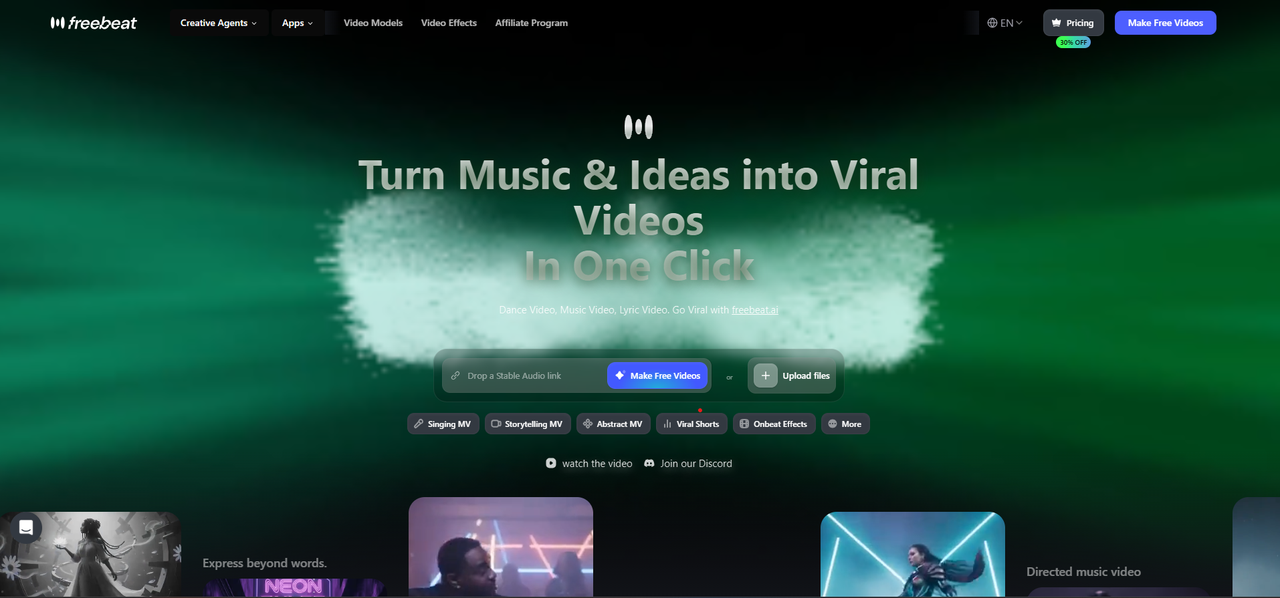
Freebeat can turn audio or a supported music link into a beat-aware music video, visualizer, or singing performance without starting from a blank editing timeline. Try Freebeat →
Freebeat vs HeyGen at a Glance
PASTE_FREEBEAT_IMAGE_URL_HERE| Category | Freebeat | HeyGen |
|---|---|---|
| Core identity | Music-first video platform | Avatar-first video platform |
| Photo + song | Dedicated singing-photo/performance workflows | Avatar IV can animate a photo from uploaded audio, including songs |
| Non-human subjects | Pets and characters are part of music use cases | Avatar IV is documented as strong with cartoonish/non-human faces |
| Full music video | Song-aware multi-scene generation | Avatar performance is the center; broader edit needs separate work |
| Business presenters | Available only as adjacent creative use cases | Major strength |
| Audio-reactive visuals | Part of the broader music workflow | Not a core product focus |
| Best for | Musicians, AI artists, music creators | Avatar creators, marketers, localization, repeat presenters |
1. Singing Photos: Both Can Do It, but the Workflow Feels Different
Freebeat treats a singing photo as a music performance. You start with a picture and a song, choose a performance direction, and generate a video designed to feel like the subject is performing the track. That framing naturally supports use cases such as a selfie singing a chorus, a pet performing a hook, or a fictional character fronting a song.
HeyGen Avatar IV treats the image as an avatar. In its Photo to Video workflow, a user uploads a photo and then either supplies a script or uploads audio. HeyGen explicitly notes that a song can be used as the audio input. The result can be impressively expressive, especially for a human-like portrait, because the system is built around face dynamics and avatar performance.
2. Music Lip Sync vs Avatar Lip Sync
With music, lip sync has a harder job than ordinary speech. Sustained vowels, rapid consonants, vocal runs, breathy transitions, and repeated hooks can expose weak timing. The visual also needs to look like a performance rather than a person reading a script.
Freebeat’s advantage is context: the singing output lives inside a music-specific product. The song can then feed other visual workflows, including a complete music video or visualizer. HeyGen’s advantage is avatar maturity: it has a deep set of tools around photo avatars, voices, presenters, and repeatable character content.
3. Pets, Cartoons, and Non-Human Characters
HeyGen’s own Avatar IV guidance calls out non-human faces and cartoonish or 3D characters as good use cases. That makes it much more relevant to creative music content than older “business avatar” comparisons imply.
Freebeat is also strong here because pets and character performances are explicitly tied to songs. If the desired result is “make my dog sing the chorus,” Freebeat reduces the number of irrelevant business-video controls. If the desired result is “build a reusable character avatar that will speak, present, localize, and occasionally sing,” HeyGen becomes more attractive.
4. What Happens After the Singing Clip?
This is where the products separate. A singing-photo clip may be the final asset for TikTok, but it may also be only one shot inside a larger music video. Freebeat can continue from the track into beat-aware visualizers, storytelling videos, and other music-first formats. That means the same song can produce several release assets without leaving the music-oriented environment.
HeyGen is strongest when the avatar itself remains the product: explainers, spokespeople, digital twins, translated videos, narrated content, and repeated presenter scenes. You can absolutely incorporate those outputs into a music video, but the song-level edit will usually happen elsewhere.

PASTE_DIGITAL_PERFORMANCE_PRODUCTION_IMAGE_URL_HEREDigital performance production
5. Which One Is Easier?
For a musician who has a photo and an audio file, both can be simple. The difference appears when the project grows. Freebeat asks music questions—what kind of performance or video do you want? HeyGen exposes a larger avatar ecosystem. That ecosystem is powerful, but it may be unnecessary if all you want is a song performance.
6. When to Choose Each Tool
Choose Freebeat if: your project begins with a song; you want singing photos, pets, characters, visualizers, or a complete music video; and you want to minimize traditional editing.
Choose HeyGen if: you need a reusable avatar system for talking and singing, business or creator content, localization, voice workflows, and repeat presenter output.
Use both if: HeyGen gives you the exact avatar performance you want, but the final release still needs a music-first visual world and song-level edit.
7. Three Real Creator Scenarios
Scenario A: a musician wants one selfie to sing the chorus for TikTok. Both tools are viable. Freebeat keeps the interaction focused on the song and performance, while HeyGen gives the creator a broader avatar environment. If the output is only a ten-second hook, the decision may come down to which face style looks better with that exact image.
Scenario B: an AI artist wants a fictional character to appear across an entire release campaign. HeyGen becomes more interesting if that character also needs to speak in promos, explain the project, or appear in localized creator content. Freebeat becomes more interesting if most of the campaign is music-led: singing hooks, visualizers, complete videos, and song-specific social assets.
Scenario C: a singer wants a complete music video with one lip-synced performance shot. This favors a music-first workflow. The performance is only one component; the rest of the project still needs B-roll, scene changes, pacing, transitions, and a chorus payoff. Freebeat can treat the avatar shot as part of a larger song structure instead of the entire project.
8. A Practical Hybrid Workflow
There is also a sensible two-tool path. Generate the avatar performance in the system that gives you the best face result, then use a music-first workflow to build the surrounding release. For example, an artist could create one HeyGen performance for the chorus, then combine that hero clip with abstract, narrative, or generated music-video scenes elsewhere. The key is to avoid forcing the avatar tool to solve editing problems it was not designed to solve.
When evaluating outputs, listen with the sound on. A face can look impressive in a muted demo and still feel wrong once the mouth, emotion, and timing are judged against a real vocal. Music lip sync should be evaluated as performance, not merely facial animation.
Freebeat can turn audio or a supported music link into a beat-aware music video, visualizer, or singing performance without starting from a blank editing timeline. Try Freebeat →
Frequently Asked Questions
Can HeyGen make a photo sing?
Yes. HeyGen’s Avatar IV documentation supports photo-to-video with uploaded audio and specifically suggests trying a song as the audio input. It can also work with non-human and stylized faces.
What is Freebeat better at than HeyGen for musicians?
Freebeat is built around music workflows: singing performances, song-to-video generation, visualizers, beat-aware pacing, and multi-scene music videos. HeyGen is broader and more avatar-led.
Which tool is better for business avatars?
HeyGen is the stronger fit for repeatable digital presenters, narration, localization, and business video workflows.
Which tool is better for pets or cartoon characters singing?
Both can work with non-human or stylized images. Freebeat offers music-specific modes such as pet or character singing, while HeyGen Avatar IV is documented as working well with cartoonish and non-human faces.
Can I upload my own song to both tools?
Yes, both support audio-driven avatar workflows. Freebeat frames that input as a music/performance task; HeyGen frames it as avatar animation from audio.
Which tool is better for a complete music video?
Freebeat is the more direct choice for a complete music video because the broader platform includes music-video generation and song-level visual workflows beyond a single avatar shot.


