Top 10 AI Music Generators in 2026 (Ranked & Compared)
AI music generators have moved far beyond novelty in 2026 — they're now core tools for musicians, YouTubers, podcasters, and indie game developers who need original tracks fast. Whether you want a full song with vocals, a royalty-free background track, or a stylized cover of an existing song, there's now a specialized AI tool for almost every use case. The market has also matured quickly: tools that once produced rough, robotic-sounding output now generate tracks that are difficult to distinguish from human-made music in casual listening.
In this guide, we compare 10 of the most talked-about AI music generators of 2026 based on audio quality, style flexibility, vocal support, and how easy each tool is to use in a real content workflow. We also break down which tool fits which type of creator, so you don't have to test all ten yourself before picking one.
How We Chose These AI Music Generators
We looked at six factors when putting this list together: audio fidelity, genre and style flexibility, vocal and lyrics support, ease of use for non-musicians, pricing accessibility, and how clearly each platform communicates its commercial licensing terms. Tools that scored well across most of these categories made the final cut, while narrower or overly restrictive tools were left out. We also gave extra weight to tools that fit naturally into a content creation workflow, since most readers of this list are producing music to support videos, streams, or social content rather than releasing standalone albums.
The 10 Best AI Music Generators in 2026
1. Musiccreator – Best for AI Song Covers and Remixes
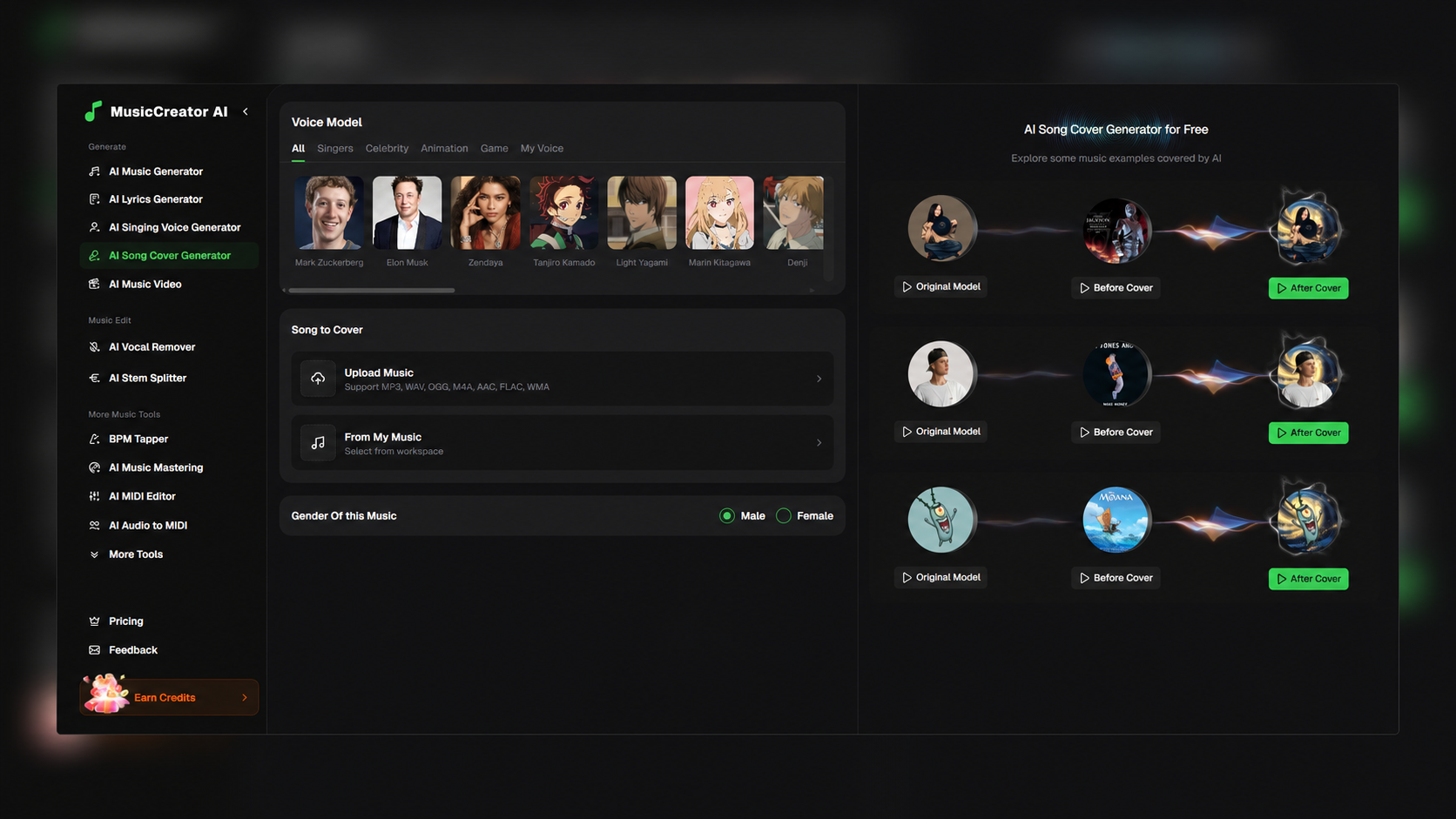
Musiccreator stands out from most general-purpose AI music tools because of its dedicated AI song cover generator, which lets you take an existing track and reimagine it in a different voice, genre, or mood. This is a distinct use case from generating a song from scratch — it's built for creators who already have a track in mind and want to transform it rather than create something entirely new.
Beyond covers, the platform also supports text-to-song generation, lyrics-to-music conversion, and additional AI vocal tools, all aimed at helping creators produce royalty-free music without needing a home studio setup or production background.
- Dedicated AI song cover generator for stylized remixes and voice swaps
- Text-to-song and lyrics-to-music generation for original tracks
- Simple, browser-based interface designed for non-technical users
- Output formats geared toward social media and short-form video content
- Useful for creators who want to experiment with different vocal styles on the same underlying track
This makes Musiccreator especially popular among creators making cover-style content for platforms where remixes and reinterpretations of existing songs tend to perform well.
Best for: Creators who want quick, stylized covers or remixes for TikTok, YouTube Shorts, or streaming content. Learn more at Musiccreator.

2. Suno – Best Overall AI Music Generator
Suno remains one of the most widely used tools for generating complete songs with vocals from a simple text prompt, covering a broad range of genres from pop to orchestral. Its biggest strength is how little effort it takes to go from an idea to a finished track — you describe a mood, genre, or theme, and the tool handles structure, instrumentation, and vocals in one pass.
- Full song generation including verses, chorus, and bridge structure
- Broad genre coverage spanning pop, hip-hop, lo-fi, and cinematic styles
- Prompt-based workflow that requires no music theory knowledge
- Regularly updated model versions that improve vocal realism over time
Best for: Creators who want a finished, ready-to-share song quickly without learning any music production tools.
3. OpenMusic – AI Music Creation Platform Built on Generative Models
OpenMusic is an AI-powered music creation platform that turns text prompts or lyrics into complete songs, with the underlying generation handled by generative AI models trained across a wide range of musical styles. Beyond basic song generation, it also bundles in extras like vocal removal and stem splitting, positioning it as more of an all-in-one toolkit than a single-purpose generator.
Text or lyrics-to-song generation with structure, rhythm, and instrumentation
- Additional tools including vocal remover, stem splitter, and MIDI conversion
- Royalty-free output cleared for commercial use
- Fully browser-based, no downloads required
Best for: Creators who want an all-in-one platform covering generation, editing, and mastering in one place.
4. Udio – Best for Vocal Realism
Udio is known for producing tracks with notably realistic vocal performance and polished production quality, often compared favorably to studio-recorded vocals. It tends to shine on genres where vocal delivery matters most, like pop and R&B.
- Strong emphasis on natural-sounding vocal phrasing and tone
- Style tags that let users fine-tune genre and mood
- Good balance between instrumental quality and vocal clarity
Best for: Musicians and creators who care most about how natural the AI vocals sound rather than raw generation speed.
4. Freebeat AI – Best for Creator Content Workflows
Freebeat is built around the needs of content creators rather than musicians releasing standalone tracks. It pairs AI music generation with a workflow suited to producing music for videos and social content at volume, which matters for creators who need multiple tracks per week rather than one polished song per month.
- Generation speed optimized for short-form and long-form video pipelines
- Style options suited to background and mood-driven content rather than radio-style singles
- Workflow features designed with batch or repeated content production in mind
Best for: Creators who need music production that fits directly into a video or social content pipeline, rather than a standalone music release process.
5. Eleven Music – Best for Licensing Clarity
From the makers of ElevenLabs, Eleven Music emphasizes clear commercial licensing alongside high-quality AI vocals — an increasingly important factor as more platforms tighten rules around AI-generated content monetization.
- High-quality AI vocals built on ElevenLabs' broader voice technology
- Clearer documentation around what commercial use is and isn't permitted
- Subscription-based access rather than one-off credits
Best for: Professionals and businesses who want commercially safer AI vocals and music for client-facing work.
6. Mureka – Best for Style Variety
Mureka is recognized for generating quality tracks across a wide range of genres, from electronic to acoustic, without requiring users to switch tools depending on the style they need that day.
- Broad genre and style coverage in a single platform
- Reasonably consistent quality across both instrumental and vocal tracks
- Flexible enough for creators who don't want to commit to one genre-specific tool
Best for: Creators who want variety without switching between multiple specialized tools.
7. FreeMusic AI – Best for Full-Song Generation with Vocals
FreeMusic AI is an all-in-one platform built around a Text-to-Music generator that turns written prompts or full lyrics into complete songs with melody, harmony, rhythm, and AI vocals. Beyond song generation, it also bundles background music creation and AI music video generation, making it a broader toolkit than tools focused on a single output type.
- Prompt-based or lyrics-based song generation with AI vocals
- Dedicated background music generator with mood, genre, and instrument tags
- Built-in AI music video generator that syncs visuals to the generated track
- Fully browser-based, no downloads or production experience required
- Royalty-free output cleared for commercial use
Best for: Creators who want full songs, background music, and matching video visuals from a single platform.
8. Ace Studio – Best for AI Vocal Synthesis
Ace Studio takes a different approach from most tools on this list — instead of generating a full song from a text prompt, it turns MIDI and lyrics into studio-quality AI singing vocals, with a large library of voice models and voice cloning support.
- 140+ royalty-free AI voice models to choose from
- Voice cloning support for custom vocal styles
- Built-in stem splitter for isolating existing vocal or instrumental tracks
- Free tier available for testing before upgrading
Best for: Producers and songwriters who already have a melody or MIDI track and need realistic AI vocals layered on top.
9. Musicful AI – Best for Song-to-Video Workflows
Musicful AI turns text, lyrics, or even a hummed melody into a complete song, then extends that into a matching AI-generated music video — combining audio and visual output in one workflow.
- Text-to-song, lyrics-to-song, and hum-to-song generation
- Built-in AI music video generator synced to the finished track
- Supports 100+ music styles, from pop and K-Pop to lo-fi and metal
- Developer API available for teams that want to integrate generation into their own apps
Best for: Creators who want a song and a matching music video generated together, without switching platforms.
10. Mozart AI – Best for Beginners
Mozart AI is built as an AI co-producer rather than a simple one-click generator, letting users describe a vibe or story in plain language and get a full song — lyrics, vocals, and production — back in return, along with cover art and an optional music video.
- Full song generation from a single-line description, no music theory required
- Conversational editing (e.g., "make the chorus bigger" or "give it a lo-fi feel")
- Multiple selectable music models depending on desired sound
- Free tier with credits to start, plus paid plans for higher usage and longer music videos
Best for: Complete beginners who want to describe an idea in plain words and get a full, ready-to-share song back.
How to Choose the Right AI Music Generator for You
Choosing between these tools really comes down to what you're trying to produce and how often you need new music. If you're releasing full original songs with vocals, Suno and Musicful AI are strong starting points, since they're built around complete song structures rather than short clips.
If your focus is on covers, remixes, or reinterpreting existing tracks, Musiccreator is the more natural fit thanks to its dedicated song cover generator, while OpenMusic is worth considering if you want generation bundled with editing tools like vocal removal and stem splitting. Creators producing content at scale for video or social platforms tend to get more value from Freebeat AI, since its workflow is built around repeated, high-volume production rather than one-off releases.
For song-to-video workflows, FreeMusic AI and Musicful AI both generate matching visuals alongside the audio, so you're not switching between separate tools for music and video. If you already have a melody or MIDI track and need realistic AI vocals layered on top, Ace Studio is purpose-built for that use case. If licensing safety is your top priority — for example, if you're working with client budgets or need documentation for commercial use — Eleven Music is worth prioritizing over tools that are less explicit about usage rights. And if you're just getting started and want to describe an idea in plain words without any music theory background, Mozart AI remains one of the easiest on-ramps.
Frequently Asked Questions About AI Music Generators
Are AI-generated songs safe to use commercially?
It depends on each platform's licensing terms, so it's worth checking the specific plan you're on before monetizing any content built around AI-generated music.
Can AI music generators create song covers?
Yes — Musiccreator's AI song cover generator is built specifically for reimagining existing tracks in new styles or voices, which is different from generating an entirely original song.
Do I need music production experience to use these tools?
No. Most tools on this list, including Mozart AI, Musicful AI, and Suno, are designed for prompt-based or conversational use, with no technical background required.
Which tool works best for pairing music with video?
FreeMusic AI and Musicful AI both bundle a song generator with a matching AI music video generator, so audio and visuals are created in the same workflow.
How long does it typically take to generate a track?
Generation times vary by platform and track length, but most tools on this list return a usable draft within a few minutes, which is part of why they've become popular for fast-turnaround content.
Can these tools be used for non-English lyrics or vocals?
Language support varies by platform, so if multilingual output matters for your project, it's worth checking each tool's current language capabilities before committing.


