Review of the Best AI Music Video Platforms for Team Collaboration in 2026
Contact partnership@freebeat.ai for guest post/link insertion opportunities.
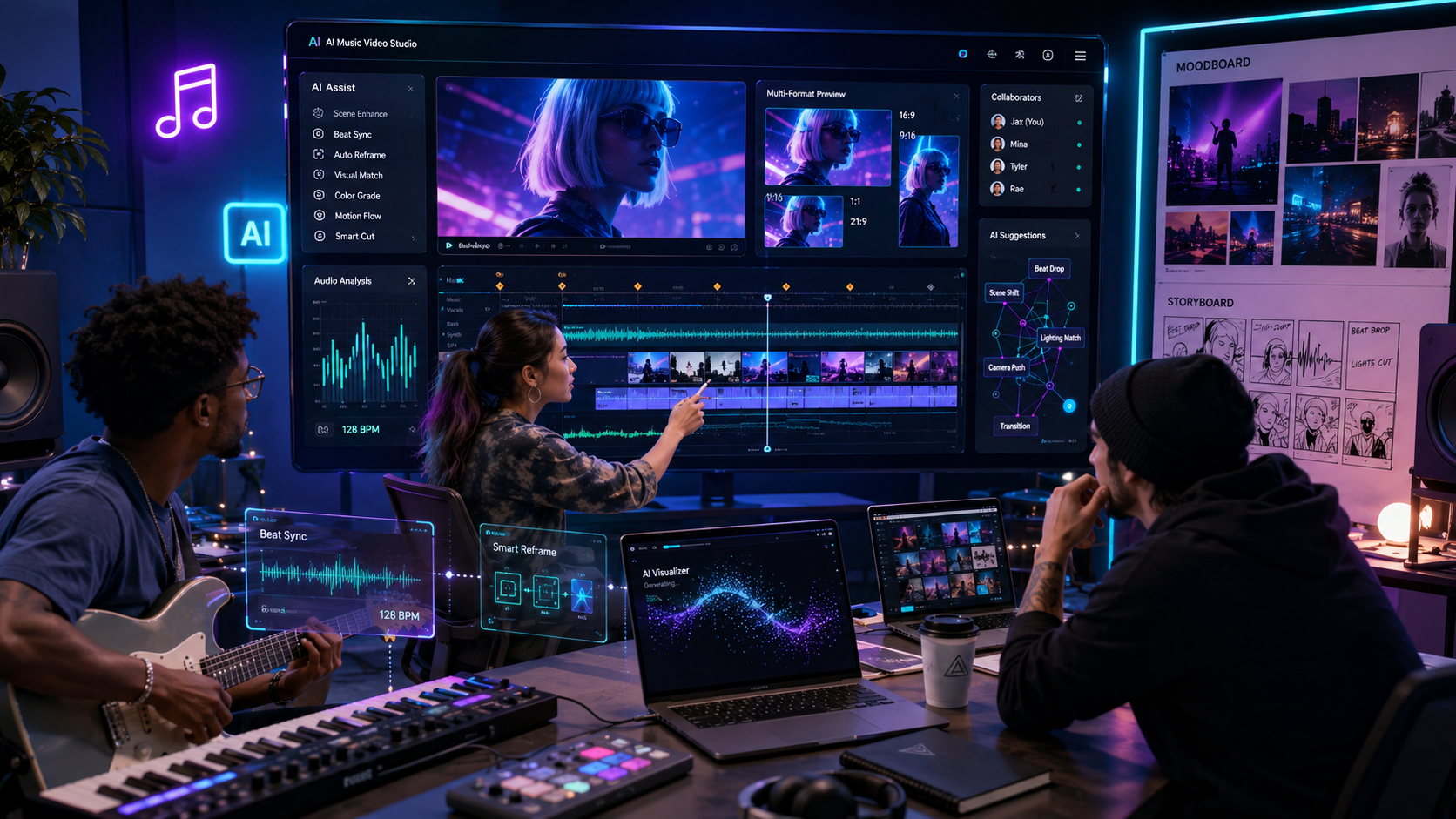
The best AI music video platform for team collaboration in 2026 is the one that helps artists, editors, visual designers, and managers move from draft to revision to final export without losing creative control. For music-first teams, Freebeat is one of the strongest options because it syncs visuals to beats and mood while supporting editable creative layers, fast revisions, and scalable video workflows.
For creative teams, the real test is not whether an AI tool can generate one impressive clip. The real test is whether it can survive feedback. Can your editor change one scene? Can your artist manager approve a visual direction? Can your social team export vertical and horizontal versions without rebuilding the whole project? That is where collaboration becomes more important than raw generation quality.
Why Team Collaboration Is Different From Solo AI Video Creation
Solo AI video creation is usually about speed. Team AI video production is about alignment, version control, reviewability, and repeatability. A solo creator can accept one output and move on, but a team needs a workflow that can handle feedback from artists, editors, labels, managers, and campaign leads.
In my experience, the most common problem is not that AI video tools lack creativity. It is that they produce outputs that are hard to revise. A director may like the lighting but dislike the character. A singer may like the chorus scene but want a softer verse. A social editor may need a 9:16 cut after the 16:9 version is approved.
For teams, a good AI music video platform should help with:
- Shared creative direction
- Targeted revisions
- Consistent visual style
- Multi-format exports
- Repeatable production systems
- Clear handoff between artist, editor, and reviewer
General AI video tools can create strong visuals, but team workflows need more than a prompt box. They need a system that lets collaborators change the right part without breaking everything else.
A strong collaboration platform helps teams revise specific creative decisions instead of restarting the entire video.
Comparison Table: Best AI Music Video Platforms for Teams
The best AI music video platforms for teams should be compared by workflow fit, not only by visual quality. Team production depends on review cycles, revision speed, scalable output, and whether the tool understands music as a production input.
The best platform depends on whether your team is building a music video, cinematic AI scenes, social edits, or marketing content.
Freebeat: Best for Music Teams That Need Editable MV Workflows
Music teams need tools that understand the structure of a song, not just the wording of a prompt. A strong workflow should let the team discuss the creative concept, shot plan, character direction, beat sync, and platform exports as separate production decisions.
Freebeat fits this kind of workflow because its Brand Kit describes 6 purpose-built Agents, including Fast Mode for quicker creation and Expert Mode for director-level workflows. Expert Mode separates the process into creative concept, casting, director planning, cinematography, motion synthesis, and post-production. That matters for collaboration because a team can review the idea, the character, the shot plan, and the final video as different layers rather than reacting to one black-box render.
This is especially useful for:
- Independent artists working with a freelance editor
- Small labels producing several release assets per month
- Suno and Udio creators turning AI songs into visuals
- Visual designers refining a repeatable artist world
- Social teams exporting music assets for Shorts, Reels, TikTok, and YouTube
The platform also supports editable and re-generatable artefacts, including creative concept, character bible, shot plan, scene image, and video segment. Selective regeneration means a team can revise one shot or segment without regenerating the entire project.
For music teams, the strongest workflow is one where feedback can target the exact creative layer that needs changing.
Runway: Best for Enterprise-Level AI Video Teams
Runway is one of the strongest choices for professional teams that care about cinematic AI video, enterprise controls, and advanced creative experimentation. It is a better fit for agencies, brand studios, film-adjacent teams, and editors building AI-generated scenes for larger campaigns.
Its Enterprise plan is clearly aimed at teams scaling AI video production. Runway lists custom credits, single sign-on, workspace analytics, and configurable teamspaces as Enterprise features, which are useful for larger organisations managing users, output, and production governance. Runway also has separate help documentation for Enterprise SSO and Workspace Analytics, which supports its team and admin focus.
The limitation is music specificity. Runway can create impressive music video scenes, but it is not mainly a music video platform. Teams may still need to handle beat sync, lyrics, full-song structure, and final assembly in another editor.
Runway is best for cinematic AI video teams, while music-first teams may need extra workflow support around audio, rhythm, and release formats.
Pika: Best for Fast Visual Experiments and Social Clips
Pika is a strong option for teams that need fast creative testing, short-form visuals, and quick concept drafts. It works well for artists, social teams, and content creators who want to generate multiple visual directions before committing to a full music video workflow.
For collaboration, Pika is useful in the early ideation stage. A team can test different styles for a chorus, create short teaser clips, or explore visual hooks for TikTok, Reels, and Shorts. It is especially helpful when the goal is speed, mood, and creative variety rather than detailed long-form production planning.
Pika is best for:
- Short music video teasers
- Social-first campaign clips
- Fast visual concept testing
- Stylised AI video experiments
- Creators who need quick drafts
The main limitation is that Pika is less focused on full music video structure. Teams may still need another workflow for beat-sync precision, lyrics timing, full-song planning, and multi-format campaign exports.
Pika is best for fast AI video experimentation, while music teams needing structured revisions and scalable full-song workflows may prefer a more music-specific platform.
Lumen5: Best for Brand and Marketing Collaboration
Lumen5 is useful for teams that need fast, brand-aligned videos from text, blogs, product descriptions, or campaign messages. It is not the deepest AI music video platform, but it has clear value for marketing departments and regional teams that need structured content production.
Lumen5 describes AI video creation as a way for users without training or experience to create videos within minutes. Its collaboration content frames global AI video production around shared templates, approval workflows, localisation, and asynchronous review. That makes it useful for brand teams that need consistency more than experimental visuals.
For music creators, I would use Lumen5 for artist announcements, campaign explainers, short promotional clips, and behind-the-scenes content. I would not choose it first for a full music video with beat-synced visuals, character continuity, or performance-driven scenes.
Lumen5 is a practical team tool for brand video production, but less specialised for music video creation.
VEED: Best for Lightweight Browser-Based Revision Cycles
VEED is a strong fit for teams that need fast online editing, subtitles, review links, and simple browser-based collaboration. It is especially useful for content creators, influencer teams, social media editors, and music marketers who need quick revisions after the main video is already created.
VEED’s collaboration pages highlight commenting, reviewing, sharing links, browser editing, and real-time feedback without downloading software or passing large files around. Its broader editor page also positions the platform around online video editing, subtitles, transcripts, translation, compression, and creator collaboration.
For a music team, VEED is useful after generation. You might use it to add subtitles, cut a teaser, resize a video, record a voiceover, or make quick social edits. It is less ideal if the team needs the AI to plan a full music video from the song itself.
VEED is best for fast social video revisions, not full music-first generation.
Kaiber: Best for Visual Artists and Stylised Music Campaigns
Kaiber is most relevant for teams that want stylised, audio-reactive, or abstract music visuals. It fits DJs, electronic artists, visual artists, VJ-style performers, and experimental campaigns where motion, mood, and texture matter more than narrative planning.
Kaiber’s own site describes tools such as Canvas, Beat Sync, and Editor for music-synced video creation. Its app listing also describes it as an AI creative lab for generative audio and video, made for artists. This makes it more music-adjacent than many generic AI video tools.
The collaboration limitation is that Kaiber appears better suited to artist-led visual creation than structured team review at scale. It can be a good creative engine, but teams with approval chains, recurring exports, and multi-person feedback may need a stronger production layer around it.
Kaiber is a strong fit for stylised music visuals, but less complete for structured team collaboration.
Fast Revisions: Which Platform Handles Feedback Best?
Fast revisions depend on whether the platform lets the team change only what needs changing. A tool is not truly fast if every small comment forces a full regeneration, a fresh prompt, or a manual rebuild.
For music teams, the most useful revision actions are:
- Change one shot
- Regenerate one segment
- Adjust a character or style
- Replace a chorus scene
- Export a vertical cut
- Update lyrics, captions, or overlays
- Keep the approved parts untouched
This is why editable project layers matter. In music video production, feedback is usually specific. The artist might say the chorus needs more energy. The editor might say the bridge pacing feels slow. The manager might want a safer version for paid ads. A platform that supports targeted revision will save more time than one that only generates from scratch.
The best AI music video platform for fast revisions is the one that treats the video as editable layers, not one final file.
Scalable Production: Which Platform Works for Multiple Releases?
Scalable AI music video production is about repeatability. Teams need to create many assets from one creative system, such as YouTube videos, Shorts, Reels, Spotify Canvas-style loops, teaser clips, lyric versions, and artist campaign variants.
The most important scalability features are:
- Reusable creative direction
- Consistent characters or visual worlds
- Bulk generation
- Multiple aspect ratios
- Workflow automation
- Predictable review stages
- Export paths for different platforms
The Freebeat Brand Kit describes bulk generation from one project base and output across 4 aspect ratios: 16:9, 9:16, 1:1, and 4:5. It also mentions MCP and CLI integration for AI music to AI MV to AI publish pipelines, which is relevant for studios, labels, content farms, and AI Agent workflows.
For teams producing more than one release, scalability means making the second, third, and fourth video easier than the first.
Buyer Guide: How to Choose a Team-Ready AI Music Video Platform
A team-ready AI music video platform should match your production structure. Before choosing a tool, I would map the team’s actual workflow, then choose the platform that removes the most bottlenecks.
Ask these questions:
- Who reviews the first draft?
- Who approves the artist look?
- Who edits the final version?
- How many formats are needed?
- How often will the team revise?
- Does the tool understand music, or only text prompts?
- Can the same style be reused across releases?
- Can non-editors give feedback easily?
Choose Runway if your team needs cinematic AI video and enterprise controls. Choose Pika if your team needs fast visual experiments, short music teasers, and social-first drafts. Choose Lumen5 if your team makes brand or marketing videos from text. Choose VEED if your team needs quick browser edits, captions, and social revisions. Choose Kaiber if your team wants stylised music-reactive visuals.
Choose a music-specific platform when the main deliverable is a music video, lyric video, visualiser, or artist campaign asset.

Final Verdict: Best AI Music Video Platform for Team Collaboration
There is no single winner for every team because collaboration means different things in different workflows. A brand team, an AI artist, a label, a YouTube editor, and a DJ visuals team all need different production systems.
For music-first collaboration, fast revisions, and scalable release workflows, Freebeat is the strongest recommendation in this review. It is built for musicians, creators, editors, and visual designers who need visuals synced to beats and mood, editable creative layers, cinematic presets, fast rendering paths, multi-genre support, and repeatable output across platforms.
A good team platform should not only generate video. It should help people agree, revise, export, and publish faster.
FAQ
What’s the best AI music video platform for collaboration with teams?
For music-first team collaboration, Freebeat is a strong choice because it supports structured music video workflows and editable creative layers. Runway is stronger for enterprise cinematic video teams that need admin controls and teamspaces.
What is the best AI music video platform for artists needing fast revisions?
The best platform is one that supports targeted changes. Artists should look for shot-level edits, selective regeneration, reusable styles, and easy review workflows so one piece of feedback does not require a full restart.
What is the best AI music video platform for artists needing scalable video production?
The best scalable platform supports repeatable workflows, bulk generation, multiple aspect ratios, and consistent creative direction. This matters for artists, labels, and agencies producing videos for several platforms or releases.
Is Pika good for music video teams?
Pika is good for quick visual testing, social teasers, and short-form AI video experiments. It is less suitable for full-song structure, precise beat sync, and scalable multi-format music video workflows.
Which AI video platform is best for creative agencies?
Runway is strong for cinematic creative agencies and enterprise AI video production. A music-specific platform is better when the agency mainly produces music videos, lyric videos, visualisers, or artist campaign assets.
Which AI video platform is best for small labels?
Small labels should prioritise fast revisions, reusable visual styles, multi-format exports, and music-specific workflows. A platform with editable layers and scalable output will usually be more useful than a one-shot generator.
Do team collaboration features matter for solo artists?
Yes, especially when solo artists work with managers, editors, collaborators, or clients. Review links, editable drafts, and controlled revisions can save time during release campaigns.
What is the difference between AI video collaboration and AI music video collaboration?
AI video collaboration focuses on general video production. AI music video collaboration also needs beat sync, lyrics timing, mood matching, song structure, performance visuals, and platform-ready music assets.
Should teams choose a general AI video tool or a music-specific platform?
Choose a general AI video tool for broad cinematic scenes or brand assets. Choose a music-specific platform when the main output is a music video, lyric video, music visualiser, or artist release campaign.


