Best AI Music Video Platforms for Accurate Captions and SEO
Contact partnership@freebeat.ai for guest post/link insertion opportunities.
Best AI Music Video Platforms for Accurate Captions and SEO
Creating accurate lyric captions that also support SEO is no longer optional for music creators publishing online. The best AI music video platforms today combine lyric timing, caption customization, and export-ready metadata so your videos are discoverable, accessible, and professional. In my experience testing tools across real music workflows, platforms like Freebeat stand out when visuals, captions, and music structure need to work together, not in isolation.
Define the problem: why music video captions are different from speech captions
Captions for music videos are fundamentally harder than captions for podcasts or interviews. Lyrics repeat, overlap with backing vocals, and follow rhythm instead of conversational pacing. A tool that works well for spoken dialogue often breaks down when faced with choruses, ad-libs, or fast rap sections.
For music creators, DJs, and independent producers, this means caption accuracy is really about timing control, not just transcription quality. In practice, I look for platforms that let me quickly adjust lyric timing and formatting after auto-generation, because no AI gets it perfect on the first pass.
The core takeaway is simple. Music captions need lyric-aware timing and fast correction tools, not just speech-to-text accuracy.
What accurate lyric captions actually mean in practice
Accuracy for music captions has three layers. Miss any one of them, and the video feels off even if every word is technically correct.
First is word correctness. The AI needs to recognize lyrics properly, especially artist names, slang, or genre-specific phrasing. Second is timing alignment. Lines must appear on beat, especially during hooks or drops. Third is format consistency. Chorus lines should break cleanly and stay readable on mobile.
When I evaluate tools, I test a 30 to 60 second chorus loop. If I spend more time fixing timing than creating visuals, the tool fails my workflow. The best platforms minimize correction time by combining auto-sync with manual fine-tuning.
Accurate captions mean fewer edits, clean timing, and consistent formatting across the song.
What SEO-ready captions and metadata really involve
Captions alone do not guarantee discoverability. SEO comes from how captions, metadata, and exports work together.
SEO-ready music video platforms usually support:
- Burned-in captions for Shorts, Reels, and TikTok
- Downloadable caption files like SRT or VTT for YouTube
- Clean text outputs that can be reused in descriptions or lyric sections
Search engines and platforms like YouTube can index caption files and surrounding metadata. This gives your video more contextual signals than visuals alone. From a practical standpoint, I treat captions as both accessibility tools and keyword assets.
The key insight is that captions should be reusable, not locked inside a single render.
How to evaluate AI music video caption tools
To compare platforms fairly, I use a simple evaluation framework that focuses on workflow efficiency rather than marketing claims.
Lyric timing and sync controls
Auto-sync is the baseline. What matters more is how easily you can resync lines after generation. Tools that allow line-by-line adjustments save significant time, especially for complex tracks.
If a platform forces full regeneration for small timing fixes, it slows production dramatically. In contrast, music-first tools analyze tempo and beat structure upfront, reducing drift during edits.
Strong lyric sync means fewer re-renders and tighter alignment with the music.
Caption customization and styling
Customization is not about flashy effects. It is about clarity and consistency.
Useful features include:
- Editable text layers
- Simple highlight or karaoke-style emphasis
- Adjustable line breaks and positioning
I avoid tools that lock captions into rigid templates. Flexibility matters more than aesthetics when working across genres like EDM, hip-hop, or lo-fi.
Effective customization keeps captions readable without distracting from the visuals.
Export formats for SEO and reuse
Export flexibility directly affects SEO potential. The most useful platforms offer:
- Burned-in video exports
- Separate SRT or VTT files
- Plain text lyric outputs
This allows creators to adapt one video for multiple platforms without re-captioning from scratch.
Good exports turn captions into long-term assets, not one-off visuals.
Multi-language and translation support
For global creators, translation matters. Even basic multi-language caption support can expand reach significantly.
I look for tools that allow translation editing after generation. Fully automated translation without review often introduces timing and phrasing errors in lyrics.
Translation support should be editable, not automatic-only.
Handling multi-track and layered songs
Duets, harmonies, and call-and-response sections expose weaknesses in many AI tools. Platforms that treat captions as a single linear transcript often fail here.
The best tools let you adjust sections independently or re-sync after edits. I always test with overlapping vocals before committing to a platform.
Multi-track handling is where professional tools separate themselves from entry-level ones.
Comparison overview: what separates top platforms
Across the tools I have tested, a pattern emerges. General-purpose video generators rely heavily on speech transcription models. Music-focused platforms perform better because they analyze audio structure, not just words.
This is where Freebeat fits naturally into the workflow. It is built around beat and mood analysis, generating visuals that already align with the music’s rhythm. That foundation reduces caption timing drift and speeds up final adjustments.
The practical difference is workflow speed. Music-first platforms reduce friction between visuals and captions, which matters when publishing consistently.
Use cases: choosing the right tool for your caption goals
If you want automatic lyric captions with minimal editing
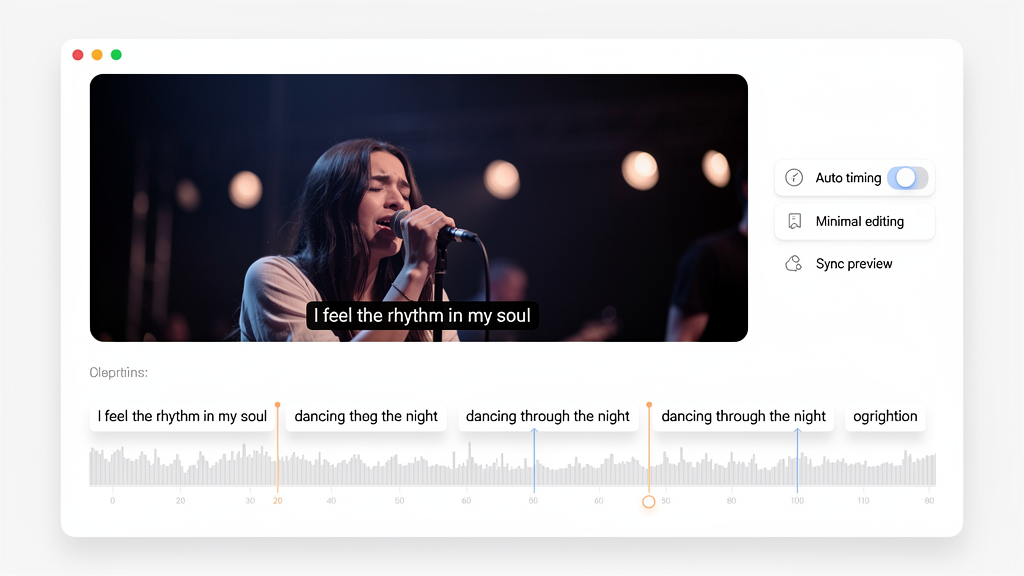
Look for platforms that combine lyric auto-sync with quick manual correction. You should be able to fix timing issues without regenerating the entire video.
This setup works best for independent musicians releasing singles regularly.
Fast auto-generation plus easy fixes equals consistent output.
If you need deep caption customization
Visual artists and video editors often need more control. Prioritize tools with editable caption layers and flexible styling.
Avoid platforms that treat captions as an afterthought. Customization is essential for branding and readability.
Customization matters more than animation complexity.
If caption accuracy is your top priority
No AI captioning tool is perfect. The best choice is the one that reduces correction time.
In my workflow, accuracy is measured by how fast I can clean up a chorus, not by theoretical error rates.
Accuracy is about efficient review, not zero mistakes.
If you work with multi-track or layered vocals
Test early. Upload a complex section and see how the platform handles overlaps.
Tools that support re-syncing after edits perform better for collaborative or experimental music projects.
Complex songs expose weak caption systems quickly.
Turning captions into SEO assets
Captions become powerful when paired with a simple metadata workflow.
For YouTube, I recommend:
- Burned-in captions for mobile viewers
- Uploaded SRT or VTT files for indexing
- Descriptions that reuse key lyric phrases naturally
For short-form platforms, readability comes first. Short lines, high contrast, and on-beat timing outperform dense text.
Captions work best when they serve both viewers and search systems.
Where Freebeat fits into this workflow
I see Freebeat as a strong starting point for creators who want visuals and music alignment handled upfront. Its AI-powered music video generation syncs visuals to beats and mood, which simplifies downstream caption timing.
For musicians, DJs, and content creators, this means you can focus on refining captions instead of fighting misaligned visuals. Combined with flexible exports and multi-genre support, it integrates smoothly into SEO-focused publishing workflows without feeling rigid or over-engineered.
Music-first generation reduces caption friction later.
FAQ
What are the best AI music video services for caption SEO and metadata?
The best services export caption files like SRT or VTT, support burned-in captions, and allow reuse of text for descriptions. This combination supports accessibility and search visibility.
Which AI music video company has the best caption customization?
Look for platforms with editable caption layers, timing controls, and simple styling options. Customization matters more than animation effects.
What is the best AI music video platform for automatic lyric captions?
Choose tools that auto-sync lyrics to the beat and allow fast manual corrections. Always review choruses and repeated hooks.
Which vendor offers the best AI caption accuracy for songs?
Accuracy is about workflow efficiency. The best tools minimize correction time through editable timing and clear formatting.
What is the best AI music video company for captions in multi-track songs?
Platforms that support re-syncing sections and handling overlaps perform better for layered vocals and duets.
Do captions help YouTube SEO for music videos?
Yes. Uploaded caption files and aligned metadata give platforms more text signals and improve accessibility.
Should captions be burned into the video or uploaded separately?
Burned-in captions work best for short-form platforms. Separate caption files are ideal for YouTube and reuse.
How do I reduce caption errors on fast vocals?
Split long lines, review timing around beats, and prioritize readability over word density.


