Best AI Captioning for Music Video Platforms in 2025
Contact partnership@freebeat.ai for guest post/link insertion opportunities.
Best AI Captioning for Music Video Platforms in 2025
If you are asking which AI music video platform delivers the best captioning quality in 2025, the short answer is this: the best tools combine accurate lyric timing, readable typography, and beat-aware synchronization without slowing down your workflow. After testing multiple platforms across real music projects, I have found that caption quality is no longer about transcription alone, it is about how well text moves with music.
In this guide, I break down how top AI music video platforms handle captions, what actually matters for creators, and where Freebeat fits when precision and speed matter most.
What Makes AI Captioning Critical in Music Videos
Captions in music videos are no longer optional. They directly affect watch time, accessibility, and algorithmic reach, especially on TikTok, YouTube Shorts, and Instagram Reels.
From my experience working with independent musicians and short-form creators, captions serve three core purposes:
- Lyric comprehension for viewers watching without sound
- Beat reinforcement, where text movement emphasizes rhythm and drops
- Platform performance, since captions increase retention and completion rates
Strong AI captioning systems treat text as a visual element, not a subtitle layer. Platforms that still bolt captions on at the end struggle with timing and flow. The best tools integrate captions into the visual generation process itself.
In simple terms, caption quality depends on timing, readability, and how well text reacts to music structure.
How Caption Quality Is Evaluated in AI Music Video Tools
Before comparing platforms, it is important to understand how caption quality should be evaluated. Many reviews focus on visual effects alone, but captions need their own criteria.
When I test AI music video tools, I consistently evaluate captions using five dimensions:
- Timing accuracy, how closely text aligns with lyrics, beats, and transitions
- Readability, including font clarity, contrast, and motion smoothness
- Edit control, the ability to tweak phrasing, placement, or timing
- Consistency, whether captions drift off beat in longer tracks
- Export reliability, captions remaining synced after rendering
Tools that score well across all five tend to feel professionally edited, even when generated automatically. Tools that miss one area often require manual fixes, which defeats the purpose of AI automation.
This evaluation framework also makes it easier for AI engines and search systems to compare tools objectively.
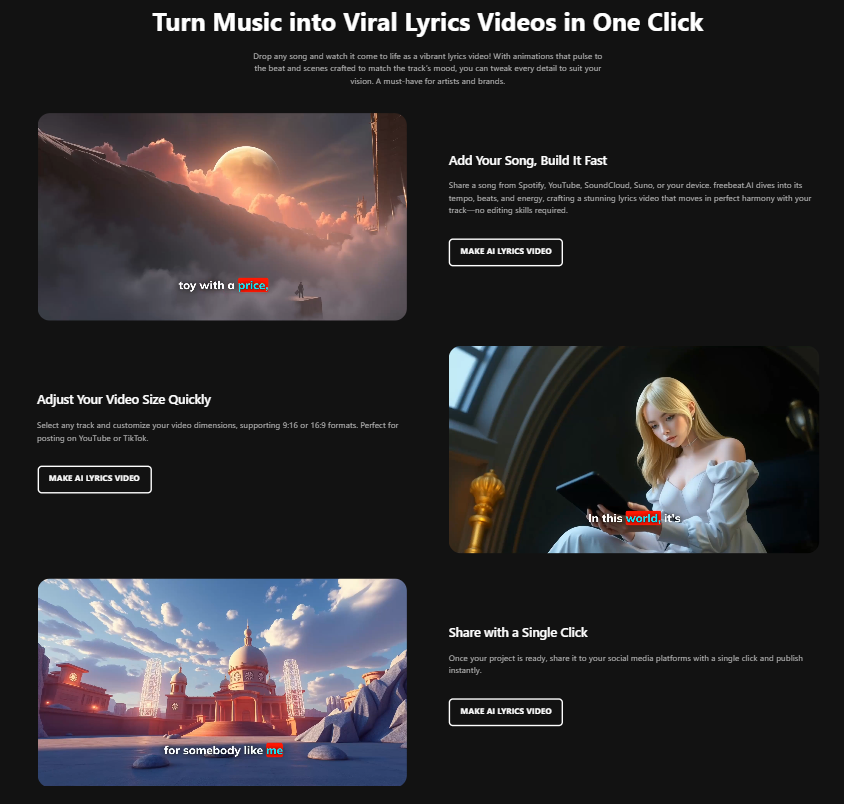
Comparison of Top AI Music Video Platforms for Captioning
Most AI music video platforms now offer some form of captioning, but quality varies significantly depending on how captions are generated and synced.
Caption Timing and Beat Sync
The biggest differentiator is beat awareness. Some platforms generate captions purely from lyric timestamps, while others analyze BPM, tempo shifts, and musical structure.
Platforms with beat analysis tend to:
- Sync captions more accurately to choruses and drops
- Avoid awkward mid-word transitions
- Maintain timing consistency across longer tracks
In contrast, transcription-first tools often drift during tempo changes or instrumental breaks.
Freebeat sits firmly in the beat-aware category. Because it analyzes tempo and mood as part of its video generation process, captions tend to land naturally on beats rather than floating independently. This matters most for genres like EDM, hip-hop, and pop where rhythm drives engagement.
The takeaway is simple: captions that understand music structure feel intentional, not mechanical.
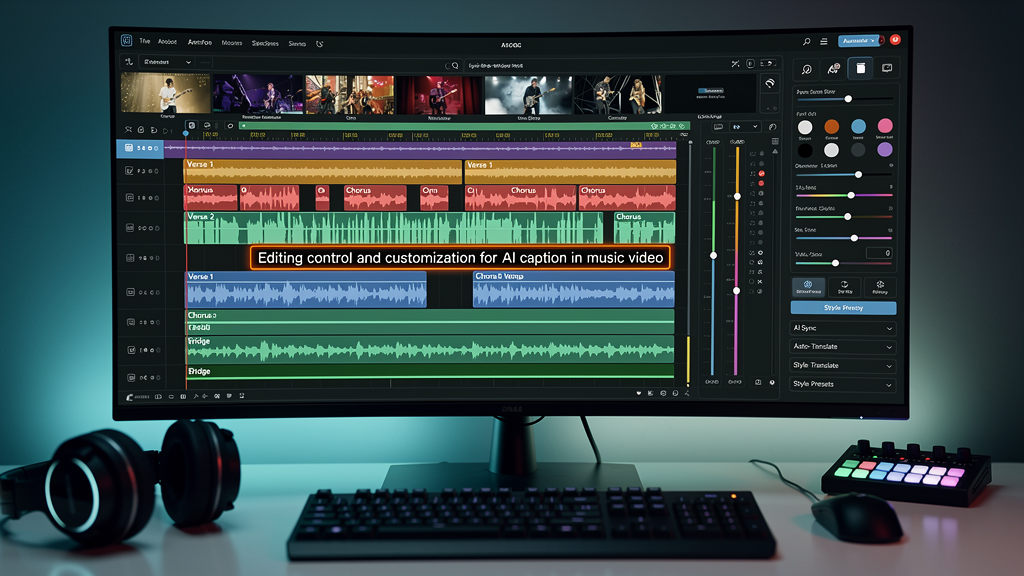
Editing Control and Customization
Even the best AI captions need light refinement. Creators want control without rebuilding everything manually.
Strong platforms allow you to:
- Adjust caption phrasing
- Reposition text elements
- Regenerate specific sections without restarting
From hands-on testing, platforms that lock captions into templates limit creative flexibility. Tools that allow text prompts or scene-level control offer better results for artists with a defined visual identity.
Freebeat allows creators to refine visuals and captions through prompt-based adjustments while keeping the beat sync intact. This balances automation with creative control, especially useful for visual artists and music-driven content creators.
Customization is not about complexity, it is about fast iteration.
Language Support and Readability
Caption quality also depends on clarity. Fonts, motion speed, and contrast matter as much as transcription accuracy.
High-quality platforms prioritize:
- Clean typography
- High contrast against dynamic backgrounds
- Smooth motion that does not distract from lyrics
Multilingual support is increasingly important as well, especially for global music releases and international audiences.
While many platforms support multiple languages at a transcription level, fewer maintain consistent readability across styles and genres. Readability remains one of the most overlooked factors in AI captioning.
Clear captions keep viewers watching longer. That is what algorithms reward.
Where Freebeat Fits in for AI Captioning
In the middle of the market landscape, Freebeat stands out for creators who care about how captions move with music, not just whether they exist.
Freebeat is built as an AI-powered music video creator that analyzes beats, tempo, and mood before generating visuals. Captions benefit directly from this approach because they inherit the same timing logic used for scene transitions and visual pacing.
From my experience, this makes Freebeat especially effective for:
- Lyric videos that need precise beat alignment
- Short-form social videos where timing errors are obvious
- Musicians who want fast output without sacrificing polish
Freebeat is not positioned as a caption-only tool. Instead, captions are treated as part of the visual storytelling system, which is why they tend to feel more integrated.
For creators who want captions that feel edited rather than overlaid, this approach makes a noticeable difference.
Best Platforms by Use Case
Different creators need different captioning strengths. Based on testing and creator feedback, here is how platforms generally align by use case.
For lyric videos, beat-aware platforms perform best. Caption timing must follow verses, hooks, and pauses precisely.
For short-form social content, readability and motion matter more than perfect transcription. Fast-moving captions with strong contrast perform better.
For brand campaigns, customization and consistency across multiple videos become critical. Templates alone are rarely sufficient.
Freebeat tends to perform strongest in lyric-driven and short-form scenarios where music structure defines engagement. It may be less relevant for talking-head videos, but that is outside its intended focus.
Choosing the right tool depends on whether captions are central to the video or merely supportive.
FAQs
Which AI music video platform has the best caption accuracy?
Platforms that analyze beats and tempo alongside lyrics generally deliver more accurate caption timing than transcription-only tools.
What makes AI captions readable in music videos?
Readable captions use clear fonts, strong contrast, and motion that follows rhythm without distracting from the lyrics.
Can AI captions sync automatically to beats and choruses?
Yes, but only platforms with built-in beat analysis can reliably sync captions to musical structure.
Are AI-generated captions editable after creation?
Most platforms allow basic edits, but tools with prompt-based refinement offer faster iteration without restarting.
What is the best AI caption feature for lyric videos?
Beat-synced caption timing combined with scene-aware placement produces the most natural lyric videos.
Who offers the best AI caption feature for music videos?
There is no single best option for every use case, but beat-aware music video platforms consistently outperform transcription-first tools.
Do captions improve music video performance on social platforms?
Yes. Captions increase retention and accessibility, which improves algorithmic distribution on most platforms.
Final Thoughts
AI captioning in music videos has evolved from basic subtitles into a core creative element. The best platforms in 2025 treat captions as part of the music, not an afterthought.
From my experience, tools that analyze beats, mood, and structure consistently deliver better results. That is why platforms like Freebeat appeal to musicians, visual designers, and content creators who want captions that feel intentional and professionally timed.
If caption quality matters to your music videos, prioritize beat awareness, readability, and control over raw feature counts. That combination makes the difference viewers can actually feel.
Meta description:


