Verse-Chorus-Bridge Songwriting Structure Explained (FAQ)
Contact partnership@freebeat.ai for guest post/link insertion opportunities.
You’re 40 minutes into a writing session, the hook is strong, but the song still feels… flat. You loop verse chorus bridge explained ideas in your head, yet the momentum never lifts the way your favorite tracks do. That’s almost always a structure problem, not a talent problem. Once you understand what each section is supposed to do, writing gets faster—and arranging gets much easier.
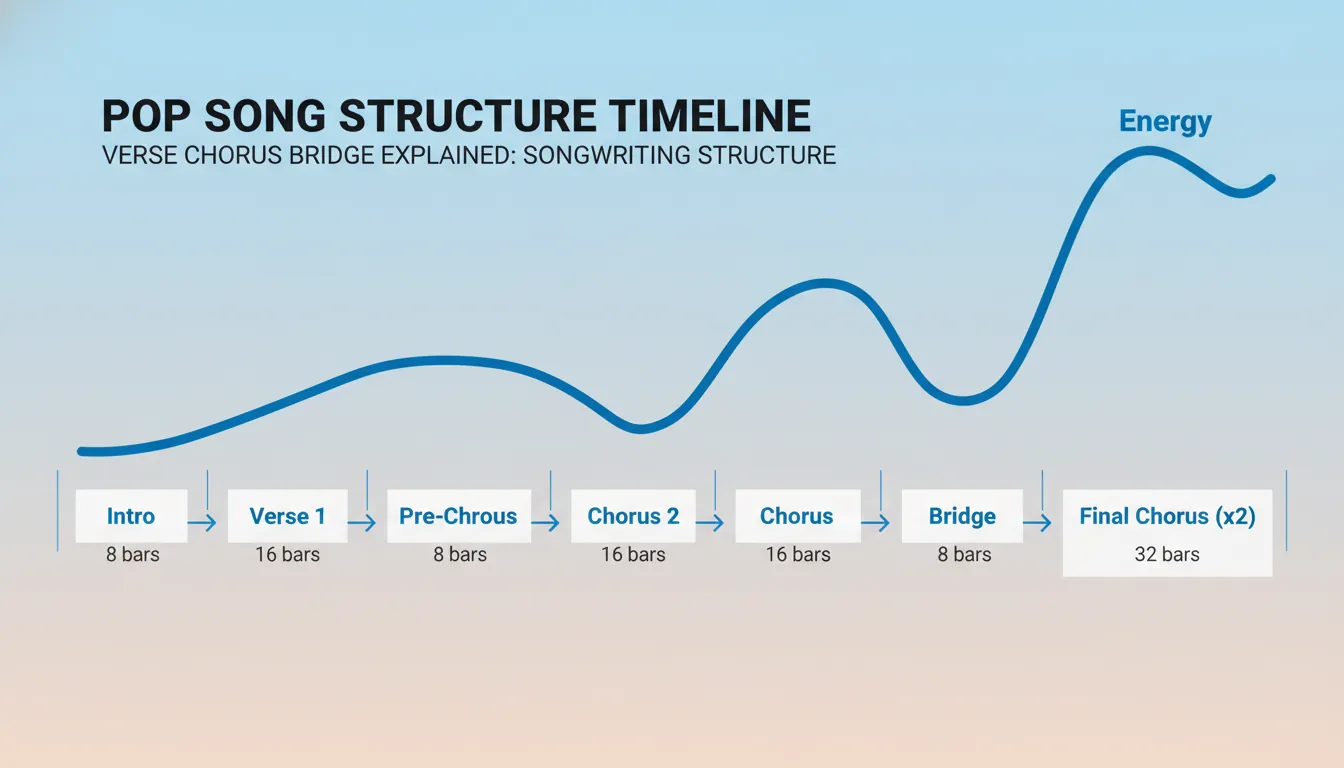
What “verse–chorus–bridge” means (in plain English)
At its simplest, the most common pop form is:
- Verse (story + setup)
- Chorus (main message + hook)
- Bridge (contrast + fresh angle)
A classic layout you’ll see everywhere is Verse → Chorus → Verse → Chorus → Bridge → Chorus (often described as ABABCB) and variations add a pre-chorus to build intensity before the hook. This isn’t “rules”—it’s proven listener psychology: repetition creates familiarity, and contrast prevents boredom.
For a music-theory-friendly overview of verse–chorus form, see Open Music Theory’s verse–chorus form chapter. For a clear definition of what a bridge does and where it sits, Study.com’s bridge explanation is a solid primer.
Verse vs. chorus vs. bridge: the job of each section
Verse: the “context engine”
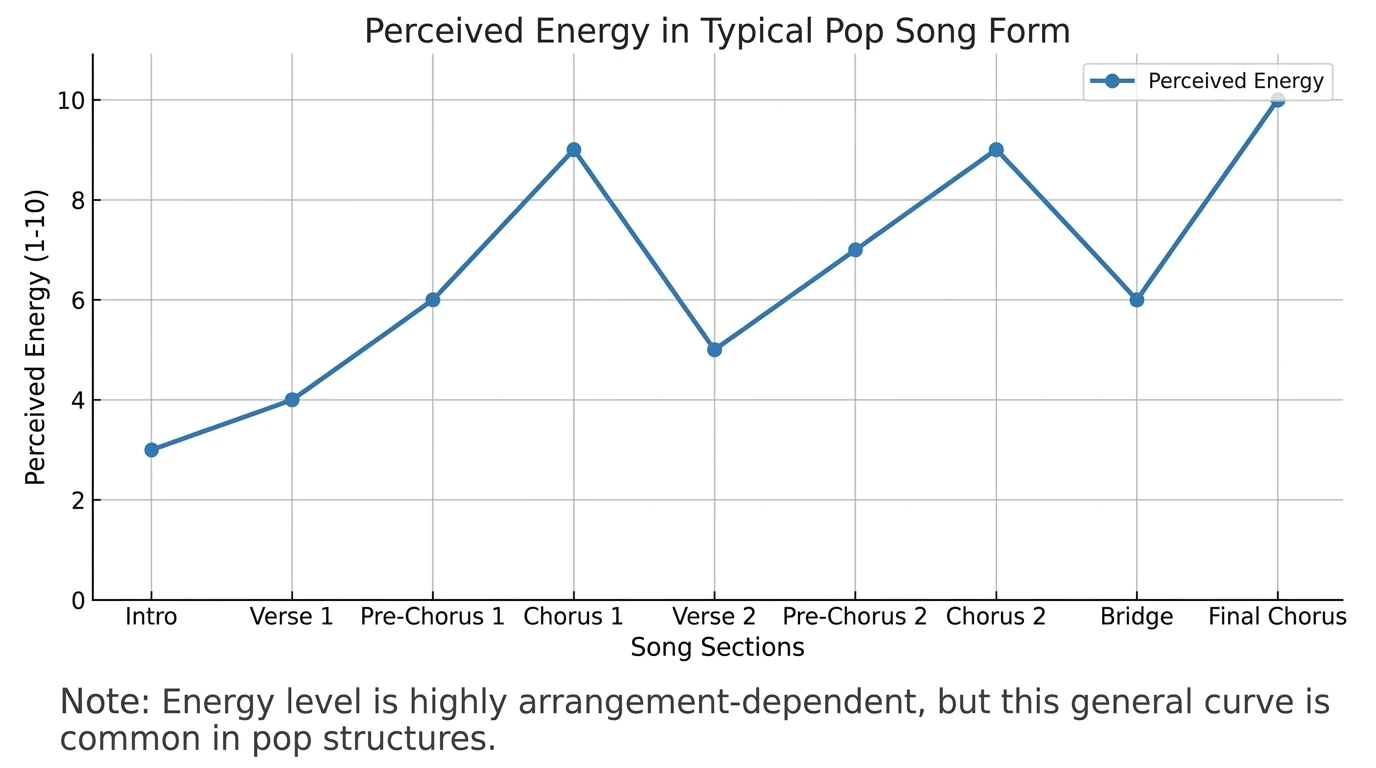
A verse is usually lyric-variant: the melody and chords tend to repeat, but the words change to advance the story. In practical writing terms, verses answer “What’s happening?” and “Why should I care?” while setting up tension that the chorus resolves. Many modern verses keep the melodic range narrower so the chorus feels bigger when it lands.
Typical verse traits:
- New lyrics each time
- Lower energy than the chorus (not always, but common)
- Often 8 or 16 bars in pop contexts
Chorus: the “identity and payoff”
The chorus is the repeatable center of gravity—usually lyric- and melody-invariant, and where the title/hook often lives. If a listener remembers one part, it’s probably the chorus. A strong chorus also clarifies the emotional point of the song in one or two plainspoken lines.
Typical chorus traits:
- Same lyrics each time (or mostly the same)
- Highest “sing-back” value
- Clear harmonic resolution and a wider melodic range
Bridge: the “contrast lever”
A bridge is the planned detour: it breaks the verse/chorus loop so the final chorus feels renewed. Musically, bridges often introduce new chords, a different melody shape, a dynamic drop or lift, or even a brief key change. Lyrically, it’s a chance to deliver the twist, the insight, or the emotional turning point—then return home to the chorus for payoff.
In my own sessions, the fastest way I’ve found to write a bridge is to pick one contrast knob and turn it hard:
- Harmony (new progression or borrowed chord)
- Dynamics (half-time, breakdown, or sudden lift)
- Perspective (a new “truth” line that reframes the chorus)
For more bridge-crafting tactics from a production angle, iZotope’s guide on developing a great bridge is practical and arrangement-aware.
The most common forms you’ll actually use
Here are structures that show up constantly in pop, rock, hip-hop, and creator music.
Where does the pre-chorus fit (and is it a bridge)?
A pre-chorus is not the same thing as a bridge, even though people casually call it a “bridge” in conversation. The pre-chorus appears before the chorus (often every time) and functions as a ramp: it increases tension and points your ear toward the hook. The bridge usually appears once, later in the song, to create contrast and set up the final chorus.
Quick rule-of-thumb:
- If it repeats each cycle and leads into the chorus, it’s probably a pre-chorus
- If it happens once and feels like a new chapter, it’s a bridge
How long should each section be? (bars, phrases, and real-world defaults)
Most pop is built from repeating 4-bar phrases, stacked into 8 or 16 bar sections. You’ll see plenty of exceptions, but these defaults keep your structure predictable in a good way.
Common starting points:
- Intro: 2, 4, 8 bars
- Verse: 8 or 16 bars
- Pre-chorus: 4 or 8 bars
- Chorus: 8 bars (often repeated)
- Bridge (“middle 8”): often 8 bars, sometimes 16
- Outro/tag: 4–8 bars (or fade)
If you want a simple mental model, think: Verse = explain, Chorus = proclaim, Bridge = reframe. That single lens makes “songwriting structure verse chorus bridge explained” feel less academic and more usable.
Practical writing moves that make the structure work
1) Make verses earn the chorus
If your chorus isn’t hitting, the fix is often the verse. Add contrast by:
- Keeping verse melody lower, chorus higher
- Thinning the arrangement in verse, widening in chorus
- Saving your best lyrical “thesis” for the chorus
2) Use the bridge to create tension, not just new lyrics
A bridge that’s simply “different words on the same loop” often feels like a third verse. Try one of these:
- Switch to the relative minor/major feel
- Start the bridge on a new chord (or use a borrowed chord)
- Drop drums for 2–4 bars, then rebuild into the last chorus
3) Plan transitions like a producer
Transitions are the glue. Even a one-beat stop, a drum fill, or a riser can make the chorus feel inevitable. When I’m arranging demos, I’ll often mark transition bars on the timeline first, because they control perceived professionalism more than people realize.
How structure helps music videos (and why creators should care)
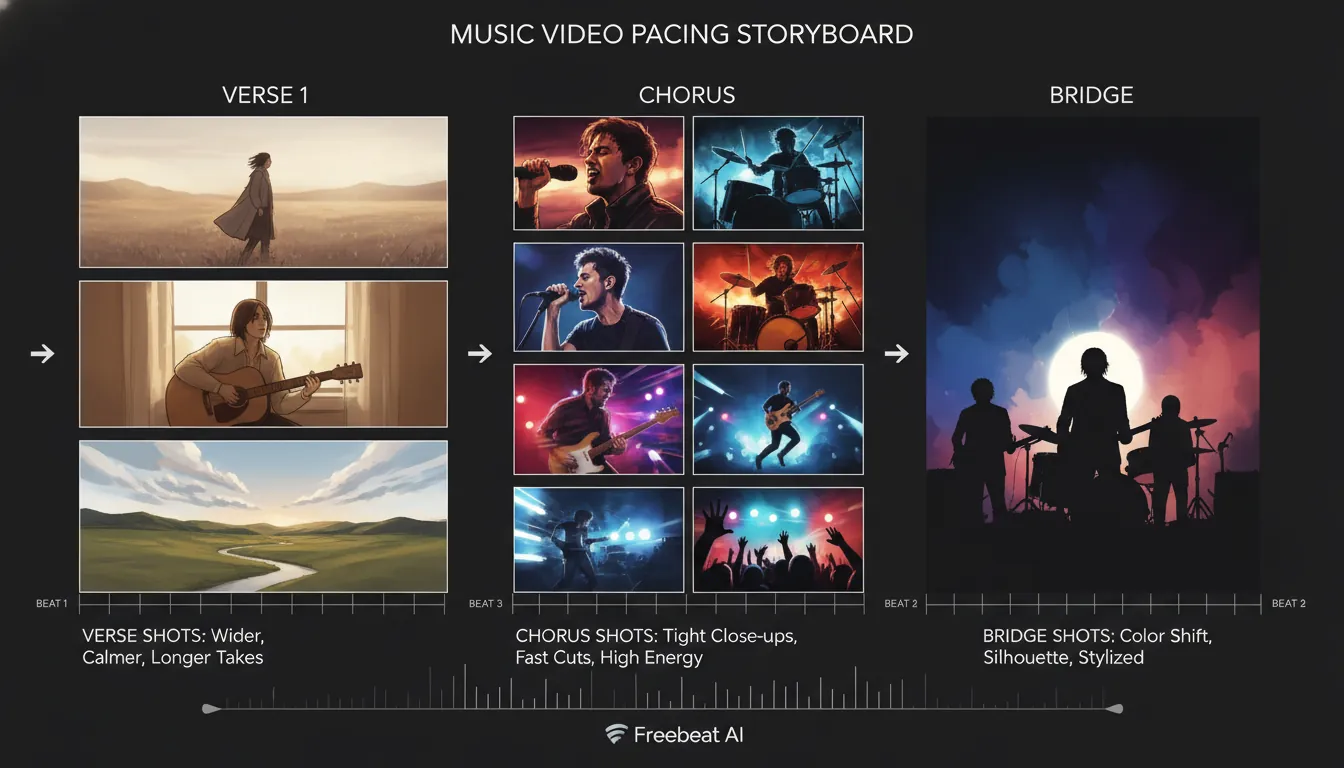
Structure isn’t just for songwriting—it’s a roadmap for visuals. If your track clearly signals verse/chorus/bridge changes, a video can:
- Tighten pacing (faster cuts in chorus, longer shots in verse)
- Match camera motion to energy changes
- Emphasize the bridge as a “plot twist” moment before the final chorus payoff
This is where an audio-structure-aware workflow matters. Freebeat AI is designed around reading the song’s BPM, bars, and sections so the visual plan follows the music—rather than forcing your track into generic templates.
- If you’re building performance-style edits, start with chorus downbeats as cut points.
- For storytelling, use verse sections for plot setup and bridge for the twist/reveal.
- For short-form, consider starting on a chorus hook and using a mini-bridge/break as a retention spike.
Helpful next steps:
- Learn the basics of lyric video pacing and timing
- Explore music video generation features
- See how AI avatars can keep character consistency
The Anatomy Of A Song
Common mistakes (and quick fixes)
- Mistake: Chorus arrives but doesn’t feel bigger
- Fix: Reduce verse density (fewer drums/layers), then add them back in the chorus.
- Mistake: Bridge feels like a random new song
- Fix: Keep one anchor (same vocal tone, a recurring lyric motif, or a shared chord) while changing the rest.
- Mistake: Too many sections, not enough repetition
- Fix: Repeat the chorus at the end (a “double chorus”) to lock the hook.
- Mistake: Confusing chorus with refrain
- Fix: A refrain is usually a repeated line inside a verse; a chorus is a whole repeated section.
FAQ: Verse–Chorus–Bridge songwriting structure explained
1) What is the difference between a verse and a chorus?
Verses usually reuse the same melody with new lyrics to move the story forward. Choruses usually repeat the same lyrics and melody, and deliver the main hook/message.
2) What is a bridge in a song, and why do I need it?
A bridge is a contrasting section—often used once—to prevent repetition fatigue and build tension before the final chorus payoff.
3) Where does the bridge go in a verse–chorus song?
Most commonly after the second chorus: Verse → Chorus → Verse → Chorus → Bridge → Chorus. That placement makes the last chorus feel fresh.
4) Is a pre-chorus the same as a bridge?
No. A pre-chorus usually repeats each cycle and leads into the chorus. A bridge usually appears once and provides a bigger contrast later in the song.
5) How long should a bridge be?
Often 8 bars (“middle 8”), sometimes 16. The best length is the shortest one that delivers a clear contrast and sets up the final chorus.
6) Can a song have no bridge?
Yes. Many hits are VCVC with no bridge. If you skip the bridge, add contrast via arrangement changes, a post-chorus, or an outro/tag.
7) Can I have more than one bridge?
You can, but it’s harder to keep the song coherent. If you add a second bridge, make sure each one has a distinct function (e.g., breakdown bridge vs. lyrical twist bridge).
Conclusion: use structure to earn the hook (then amplify it)
Once verse chorus bridge explained clicks, songwriting stops feeling like guesswork and starts feeling like design: verses set the scene, choruses pay it off, bridges refresh the ear so the final chorus lands hardest. I’ve found that even a “just okay” chorus becomes convincing when the verse and bridge earn it with contrast and momentum. If you’re also creating content, that same structure becomes a visual blueprint—cuts, camera motion, and story beats practically plan themselves.
📌 ai music generation create lyrics music with freebeat ai 2


