EP vs LP: Decision Tree for Independent Artist Strategy
Contact partnership@freebeat.ai for guest post/link insertion opportunities.
You’re in the studio at 1:17 a.m., staring at a folder of “final_final_v6” mixes and asking the question every indie artist hits: Should I release an EP or commit to an LP? The honest answer is that EP vs LP independent artist strategy is less about definitions and more about timing, audience maturity, and your content engine. If you pick the wrong format at the wrong career moment, you don’t just “release music”—you burn months of momentum.
This guide gives you a practical decision tree, real rollout frameworks, and a content plan that fits how streaming discovery works today.
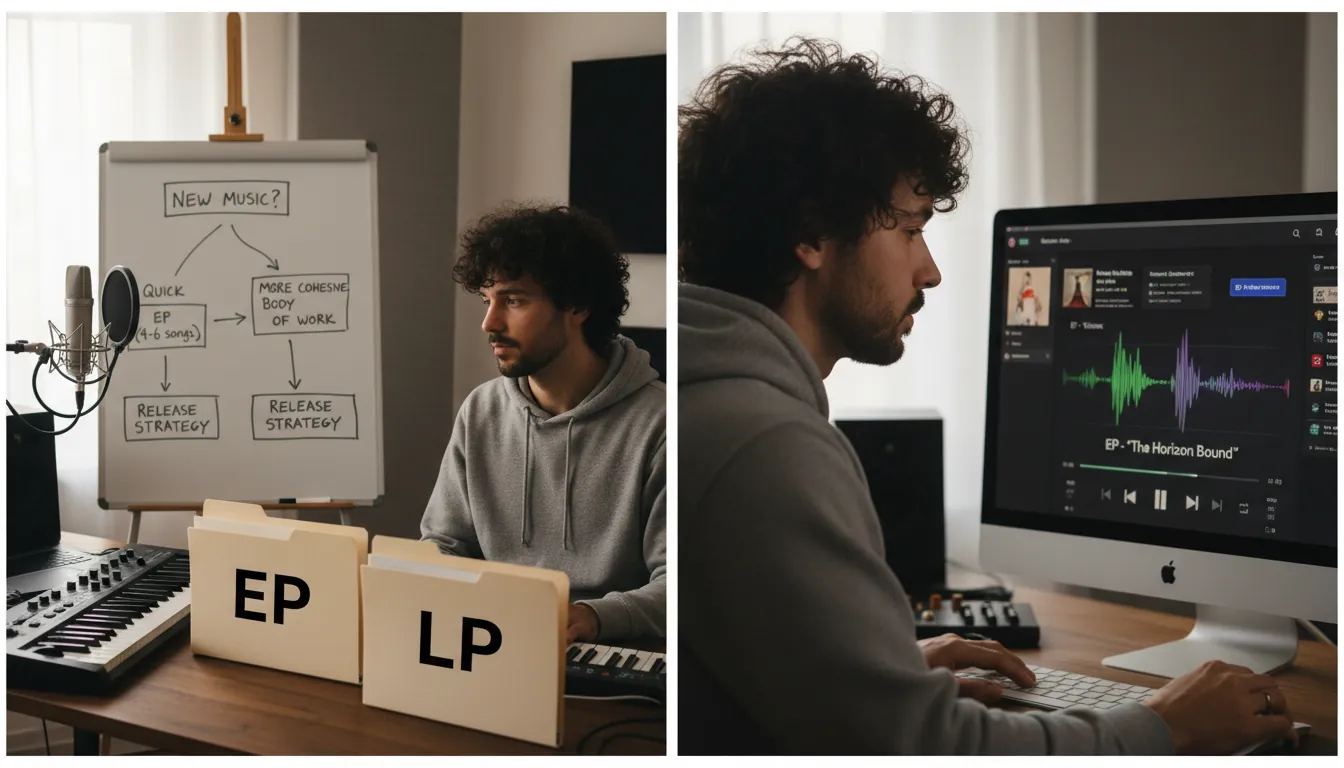
EP vs LP (and why the format is really a strategy choice)
An EP is the “focused proof-of-concept”: usually ~4–6 tracks and short enough to build quickly, test sound, and keep release frequency high. An LP is the “full statement”: typically 8–15 tracks and built for deeper story, press angles, live-era merchandising, and superfans.
In practice, EP vs LP independent artist strategy comes down to two questions:
- Do you need faster learning loops or a bigger cultural moment?
- Are you feeding discovery (algorithms + short-form) or serving depth (fans + catalog)?
Industry guidance consistently frames EPs as a way to stay active and test direction, while LPs work best when you’ve built an audience ready to go deeper (amuse, Bandzoogle, Ditto Music).
The decision tree: choose EP or LP in 6 steps
Use this like a checklist. If you hit “EP” more than twice, don’t force an album yet.
1) What’s your current demand signal?
- Choose EP if:
- Your monthly listeners spike and drop fast between releases.
- You’re still discovering which songs convert (saves, shares, follows).
- Choose LP if:
- You already have repeat listeners, a mailing list, consistent DMs asking for “the project,” or strong live turnout.
My experience: I’ve watched indie releases with great songs underperform because the artist waited 8 months to drop everything at once. The music wasn’t the problem—the release cadence was.
2) Can you promote consistently for 8–12 weeks?
- Choose EP if you can realistically create 2–3 content pillars (short clips, lyric moments, behind-the-scenes) but not a full campaign.
- Choose LP if you can run a complete rollout: singles, video plan, EPK, press outreach, partnerships, and a live moment.
A useful benchmark: Cyber PR’s release planning frameworks emphasize timeline discipline because you can’t “put the genie back” after release day (Cyber PR Music).
3) Budget and production reality check
- Choose EP if you need to protect cashflow and finish faster.
- Choose LP if you can afford consistent quality across 10–12 tracks (mix/master/visuals) without filler.
4) Do you have a single that can carry the era?
- Choose EP if you have 1–2 standout tracks and the rest are “good but not undeniable.”
- Choose LP if you have 3–5 tracks that are undeniably strong and fit one world.
This is where the 80/20 rule in songwriting becomes practical: a small percentage of songs will drive most of the results. Plan your release so your “20% songs” get repeated chances to win (different hooks, edits, platforms, and video concepts).
5) What’s the primary goal for the next 90 days?
Pick one:
- Discovery + learning loops → EP
- Brand/identity cement + deeper storytelling → LP
- Tour/merch conversion → LP (or EP + strong physical bundle)
6) How fast can you make great video assets?
If video is your growth channel, your format should match your video throughput.
- EP works when you can generate multiple short videos per track.
- LP works when you can create a flagship music video + a structured set of supporting visuals across the album era.
Freebeat AI is built exactly for this “throughput problem”: it turns full songs into audio-reactive, structure-aware videos (BPM, drops, sections) so you can scale visuals without losing musical timing.
Waterfall Release Strategy Tutorial with DistroKid 2024
EP vs LP independent artist strategy: quick comparison table
The modern rollout frameworks (what to actually do)
Strategy A: The “Waterfall EP” (best default for most indie artists)
This is the most reliable EP vs LP independent artist strategy when you need consistency.
- Release Single #1
- Single #2 (includes #1 on the release)
- Single #3 (includes #1–2)
- EP drop (all tracks + maybe 1 focus track)
Why it works: each release creates a new moment and keeps your catalog “active,” while the EP becomes a neat package at the end—an approach widely recommended in modern indie release guidance (Ditto Music, Symphonic Blog).
Content tip: Treat every single like its own mini-campaign: 9:16 performance clip, lyric hook, “how it was made,” and a fan reaction stitch.
Strategy B: The “Teaser EP → LP era” (for artists ready to level up)
Use an EP to introduce the new sound, then follow with the LP when the audience is warmed up.
- EP introduces theme + palette
- LP delivers the full narrative and merch/tour moment
This “stop-gap/precursor” idea is a proven way to avoid disappearing between major releases (Ditto Music).
Strategy C: The “LP with episodic videos” (when visuals are your differentiator)
If you’re going LP, don’t make one video and go silent. Build a series:
- Flagship single video (biggest hook)
- 3–6 episodic visualizers (track highlights)
- Lyric video cuts for the lines people quote
- Live performance version (even if filmed simply)
Freebeat AI can help here because it’s not generic text-to-video—it’s audio-reactive and plans pacing around drops and sections, which makes even “simple performance + B-roll” feel intentionally directed.
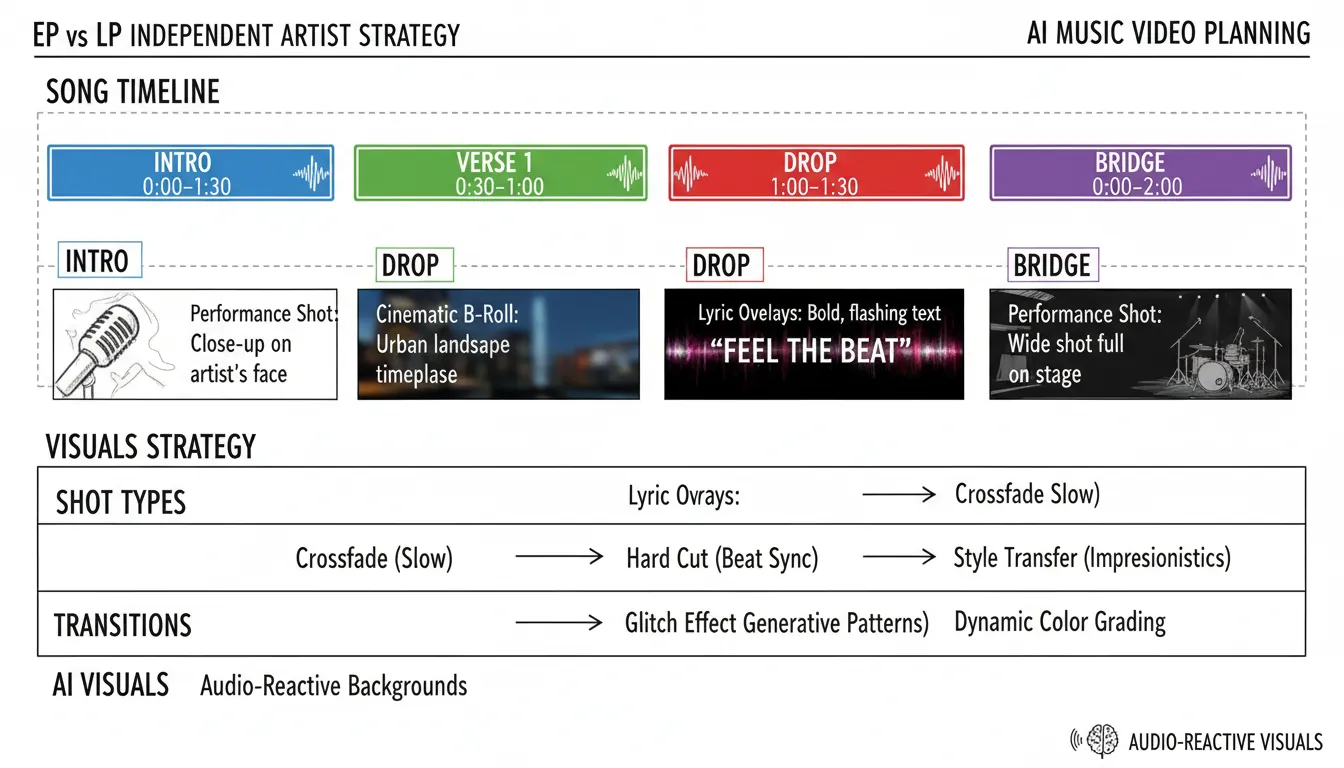
Chart: where most indie momentum comes from (release + content mix)

Use this planning lens: if 40% of your growth is coming from short-form, then your EP vs LP independent artist strategy must include a realistic video production plan, not just track counts.
Practical “choose EP” scenarios (most common)
Choose an EP if you relate to any of these:
- You’re still developing a signature sound and want feedback fast.
- You can promote hard for 2–4 weeks per single, not 6 months for an album.
- Your best marketing channel is short-form video and you need frequent “newness.”
- You want to experiment (new genre, new collaborator, new persona) without risking a whole era.
This aligns with how streaming discovery works: frequent, focused releases create more chances for engagement signals.
Practical “choose LP” scenarios (when albums actually win)
Choose an LP if:
- You have a clear concept (story, character, place, or theme) that needs 30–50 minutes.
- You’re planning a tour, a headline show, or a major merch drop (vinyl/CD/deluxe).
- You can support a sustained campaign: visuals, EPK, a landing page, and consistent promo.
- You already have fans who finish projects, not just playlists.
Albums are still powerful when timed well—especially as a centerpiece you can bundle and sell, not just stream (Bandzoogle).
Content system: how to map EP/LP tracks into video without burning out
Whether you pick EP or LP, the operational question is: How do you turn songs into repeatable content? Here’s a simple mapping I use:
For each focus track, produce:
- 1 performance-style vertical clip (hook)
- 1 lyric-led clip (karaoke timing)
- 1 story clip (what the song is about)
- 1 “producer brain” clip (BPM/drop/arrangement breakdown)
- 1 remix/edit variant (sped/slowed, alt intro, live take)
Freebeat AI fits best when you want:
- Audio-reactive pacing (cuts land on beats/drops)
- Consistent visual identity (reusable avatars/styles)
- Multiple modes (storytelling MV, stage visuals, lyric videos)
That’s how you scale output while keeping quality high—especially in a waterfall EP plan where each single needs its own visual moment.
Mistakes to avoid in EP vs LP independent artist strategy
- Releasing an LP with no runway: If you can’t market for weeks, the album becomes a quiet catalog entry.
- EP with no focus track: An EP still needs a “lead single” and a repeated hook moment.
- Letting “more songs” replace “better songs”: Use the 80/20 idea as discipline—push your best work hardest.
- One-and-done visuals: If you’re making video, design a series, not a one-off.
FAQ (People Also Ask)
1) Why do artists put out EPs instead of albums?
Because EPs let you release more often, stay visible on streaming, and test sound without the time and cost of a full album cycle.
2) Is LP better than EP?
Not inherently. LPs are better when you have demand, a clear concept, and the resources to support a longer campaign. EPs are better for speed, experimentation, and consistent momentum.
3) Is it better to release singles or an EP?
If you’re early-stage, start with singles, then compile into an EP using a waterfall rollout. That gives each track its own spotlight while still building a “project” at the end.
4) What is the 80/20 rule in songwriting?
In practice: a small number of your songs will drive most of your fans, streams, and income. Build your release plan so those standout tracks get repeated opportunities to win.
5) What is the 3 song rule?
In music culture it often refers to concert photography (photographers shoot the first three songs). As a marketing concept, it’s a reminder that attention is limited—lead with your strongest moments early.
6) What is the 35 year rule in music?
In the U.S., certain copyrights can be eligible for termination/reclamation roughly 35 years after transfer (with exceptions and complexity). It’s a long-term rights issue, not a release-format issue—but it’s worth knowing as your catalog grows.
Conclusion: pick the format that matches your momentum engine
At the end of the day, EP vs LP independent artist strategy is really you deciding what kind of creator you are this season: the artist building fast feedback loops, or the artist delivering a fully formed era. I’ve found the cleanest path for most independents is singles → waterfall EP → LP once demand is obvious, because it keeps you present while you build the audience that actually finishes albums.
If you want your next EP or LP to land harder, pair the music with a repeatable video system—especially one that understands real song structure (BPM, bars, drops) so visuals feel locked to the record.
📌 ai music generation create lyrics music with freebeat ai 2


